Why Do Japanese Towns Play Music at 5 PM? — The Sound of Going Home
Local Life · 2026-06-06 · ~1,500 words · ~5 min read
Contents (7)
- The Simple Answer
- What You're Actually Hearing
- The Part About Children
- A Deeper Reading — Held Loosely
- The Other Side
- Where to Feel This
- A Last Thought
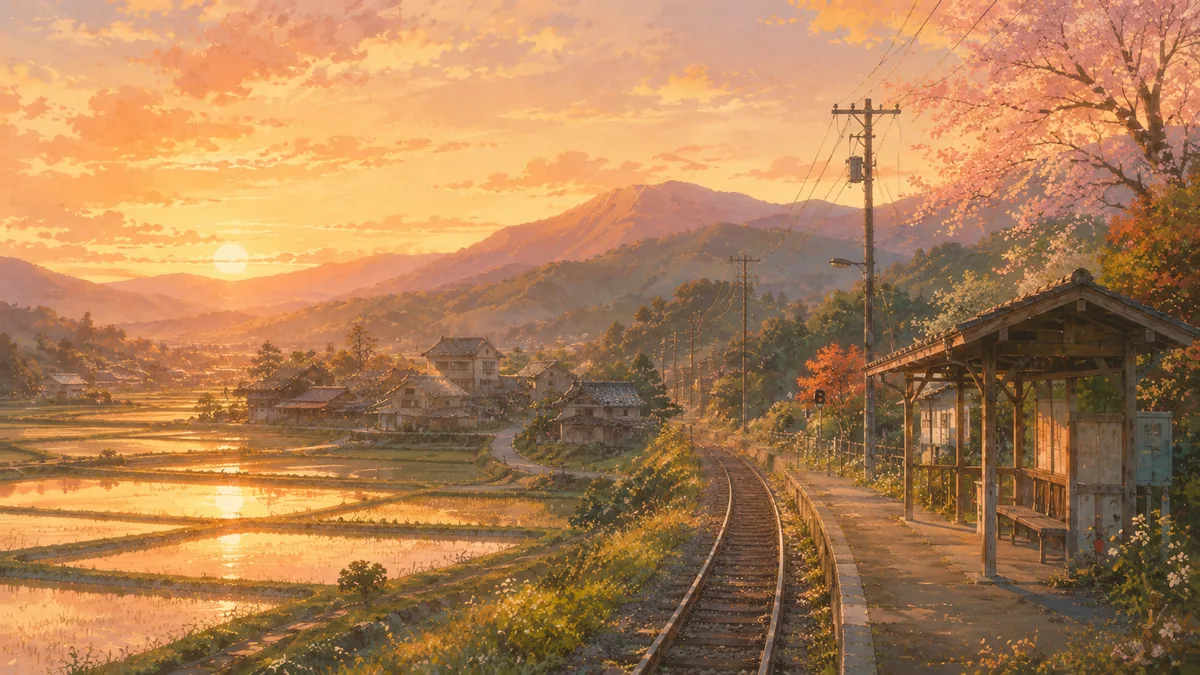
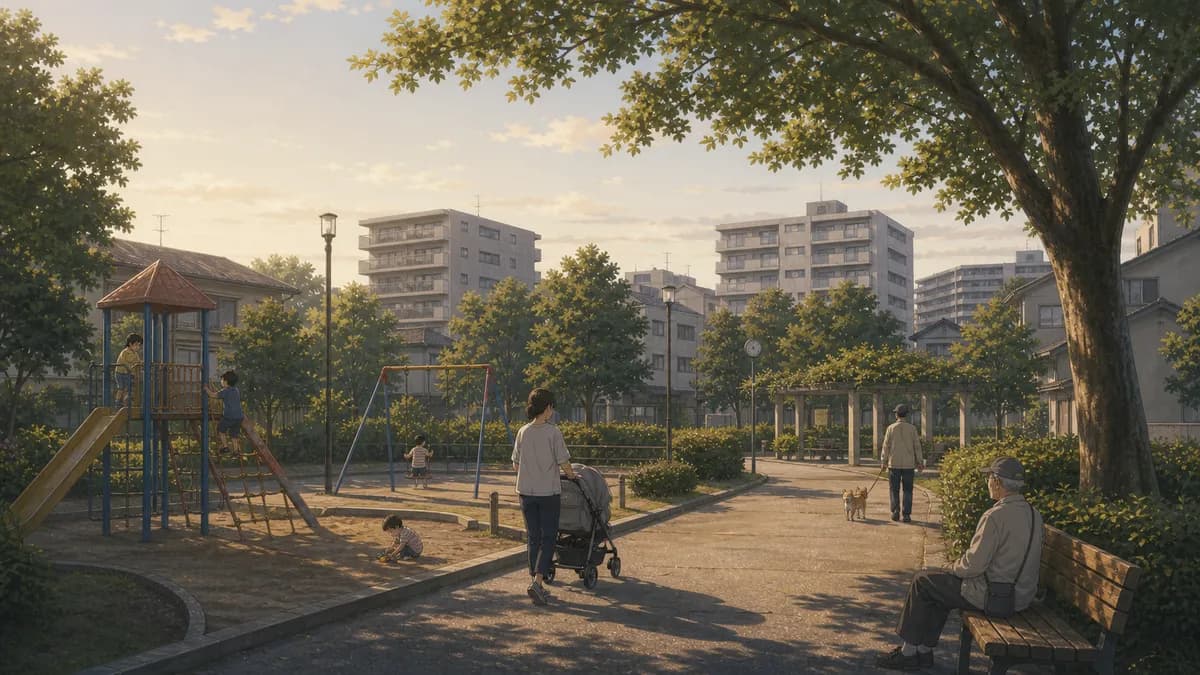
You're walking through a residential neighborhood in Japan sometime around five o'clock. The light has gone amber. A few schoolchildren are still out. Then, from somewhere above — a utility pole, a park loudspeaker — a melody starts. It lasts maybe thirty seconds. Then silence again.
If you've spent time in Japan outside of the main tourist corridors, you've probably heard this. And if you're from abroad, your first thought might be: what is that, and why does it feel so significant?
The Simple Answer
The melody you're hearing is a daily test of the bōsai gyōsei musen hōsō — the municipal disaster prevention wireless broadcast system. It's a practical signal: the outdoor speakers work.
That's the infrastructure answer. But infrastructure alone doesn't explain why the sound feels like it means something.
What You're Actually Hearing
Japan's outdoor municipal broadcast network was expanded significantly in the 1960s following a series of major earthquakes, most notably the 1964 Niigata earthquake. The goal was to create a direct line between local governments and residents outdoors — something that could cut through noise and reach people whether they were near a TV or not. If a major tremor hits, if a river is rising, if an evacuation order is issued: the speakers on the poles will carry it before anything else.
The daily chime at 5 PM — or 6 PM in some areas, or adjusted by season and sunset time in others — exists simply to confirm that the system is functioning. If the sound doesn't play, someone investigates. It is, in essence, a daily proof-of-life for the network.
What the chime sounds like varies by municipality. Some towns play Yūyake Koyake (夕焼け小焼け), a beloved Japanese nursery rhyme whose title translates roughly as "Evening Glow." Others play "Moon River," "Edelweiss," or the "Colonel Bogey March." Some use only a simple tone. The local government decides, and residents grow up with their town's particular sound.
The Part About Children
The chime's second purpose emerged organically from the first.
Children playing outside, especially in residential neighborhoods and parks, often don't carry watches and can't reliably judge time. The 5 PM broadcast became a widely understood signal: time to go home. Parents in some areas relied on it explicitly. School authorities incorporated it into their guidance. Over decades, the sound became a kind of communal curfew — not enforced, not official, but broadly understood.
You may have seen this in anime. In countless slice-of-life stories, a group of children playing outdoors hears the chime and scatters, each one heading toward a different door. The scene is small, always a little wistful. It borrows from something real.
To offer my own memory of it: the melody my town played wasn't Yūyake Koyake but Hotaru no Hikari — the Japanese setting of "Auld Lang Syne," the same tune shops use at closing time. By the time it drifted over the neighborhood, the light was usually already fading, and I still wasn't done playing, so I'd stay out until it was almost fully dark. The song was never a strict curfew, exactly. But it was, without question, the rough marker: about time to head back. Five in the evening, and that sound.
In many anime set in suburban or rural Japan — Ano Hi Mita Hana (AnoHana), Clannad, Tamako Market — the late-afternoon light and the distant chime form a pair. Afternoon is ending. The ordinary day is closing. Someone is about to go home to something, or leave something behind.
A Deeper Reading — Held Loosely
Here's where I want to be careful not to overreach — but here's how I see it, for what it's worth.
There's something unusual about a sound that exists for safety reasons but lands, in daily life, as a kind of benediction. The system was designed to say we can reach you in an emergency. But what most people hear, on most days, is simply: the day is ending, go home.
That gap between designed function and lived meaning seems to me very Japanese — and I mean that with real care, not romanticism. Japan has a long-standing practice of building things for practical reasons that then become woven into social rhythm. Train schedules. Shop closing announcements. The sound of a crossing signal. None of these were designed to be beautiful or emotionally resonant. They became that way because they showed up reliably, every day, for decades.
The 5 PM chime didn't set out to mean anything beyond "the speakers work." But because it arrives at a specific, predictable hour, and because that hour happens to be the threshold between afternoon and evening, between being out and coming in, it absorbed meaning from the lives lived around it.
I can't tell you that's why it feels significant when you hear it. I suspect it does because familiar sounds at the same time each day become part of how we understand where we are in a day. But I don't want to make that claim for everyone who hears it.
The Other Side
Not every resident finds it charming.
In dense residential areas, loud outdoor speakers playing the same melody every single day can be — to be direct about it — an irritant. There have been formal complaints to municipalities. Some local governments have reduced the volume or, in urban areas, discontinued the chimes entirely in response.
And the test-broadcast system itself, though clearly useful, is occasionally a reminder of what it was built for. The speakers that play a nursery rhyme at 5 PM are the same ones that, during Typhoon season or after a significant earthquake, issue evacuation orders. That layering — comfort and readiness existing in the same object — is something Japan manages quietly throughout daily life. Most days, the chime is just a chime. Some days, it isn't.
Where to Feel This
If you're visiting Japan, the chime is easiest to hear in residential neighborhoods, smaller cities, and anywhere outside central urban districts. An afternoon walk through a town around 5 PM in almost any prefecture will likely give you a version of it.
In anime, look for scenes set in the "golden hour" of slice-of-life stories — that late-afternoon light, children on bikes, a protagonist standing still for a moment. The chime doesn't always appear explicitly, but the emotional beat it marks is everywhere in the genre. Ano Hi Mita Hana, Clannad, Tamako Market, and Non Non Biyori all use this register well.
If you want to read more about the system itself: The Japan Times published a short piece on bōsai musen in April 2013 (the article is archived as "The 5 p.m. bell") that covers the official purpose clearly. Amusing Planet's 2020 piece ("Bōsai Musen: Japan's 5 PM Chime") gives a good overview of the history and regional variation.
A Last Thought
There's something quietly honest about a safety system that most people experience as a lullaby.
Japan built the infrastructure to reach its citizens in moments of real crisis. Every day, around 5 PM, it tests whether the connection still holds. What most people feel when they hear it isn't preparedness — it's something closer to the shape of an ordinary day closing.
Maybe that's what safety actually feels like, most days. Not a warning. Just a sound that tells you where you are.
What does the end of an afternoon sound like where you live?
Sources & References
- Bōsai gyōsei musen hōsō (防災行政無線放送): municipal disaster prevention wireless broadcast system, operated by local governments across Japan. Expanded significantly following the 1964 Niigata earthquake.
- "The 5 p.m. bell," The Japan Times, April 16, 2013.
- "Bōsai Musen: Japan's 5 PM Chime," Amusing Planet, June 2020.
- Regional variation in chime melodies and timing confirmed via municipal practice; specific choices vary by local government.
A Geek in Japan (Revised & Expanded)
A wide-angle introduction to the 'why' of Japanese culture — manga, anime, Zen, the tea ceremony and more. A natural companion to the topics Naze explores.
Japanese Soul Cooking
Ramen, tonkatsu, tempura, gyoza and 100+ recipes for Japan's everyday comfort food — with the surprising origins behind each dish.
Share this article
Read Next
- Local LifeWhy Does Japan Still Pass Paper Notices Door to Door?Japan's kairanban — a paper folder passed sequentially from house to house — is still active in the …
- Local LifeWhy Are Osaka and Tokyo So Different? — Merchants, Samurai, and the Candy AuntieEscalators, comedy, candy from strangers: Osaka and Tokyo feel like different countries. The gap tra…
- Local LifeWhy Are Japan's 'Michi no Eki' Roadside Stations So Much Fun?Japan's michi no eki roadside stations are more than highway rest stops — they are the country's mos…
- Local LifeWhy Does the Unmanned Vegetable Stand in Rural Japan Actually Work?The unmanned vegetable stand — a shelf, some produce, and a tin box for coins — seems to run on pure…
- Local LifeWhy Do Japanese Construction Signs Apologize So Politely?Before the work begins, before anyone is inconvenienced, a sign already says sorry — with a bowing c…
Related Articles
Articles in the same category: