Why Is Anime So Popular in Japan? The Circuit Nobody Talks About
Stories & Characters · 2026-06-11 · ~1,500 words · ~5 min read
Contents (6)
- The Machine Behind the Ubiquity
- From Children's TV to Late-Night Adults
- What I Think Is Really Going On (One Reading, Not a Verdict)
- The Shadow in the Frame
- Where to Feel It
- A Question I Can't Answer
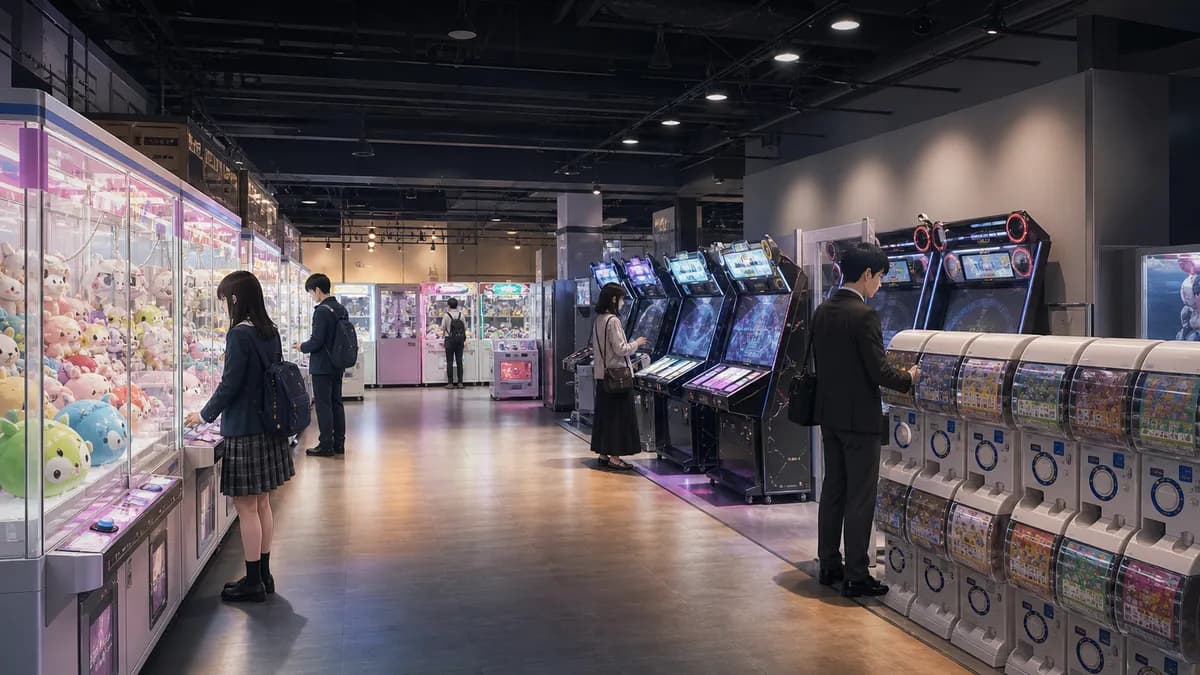
Walk into a Lawson at 11 p.m. on a Tuesday. There's a tower of ichiban kuji lottery prizes near the register — characters from a currently-airing show, a collaboration between the convenience store chain and an anime studio that launched the same week the new season did. The station you just came from had a full-platform wrap: a streaming service's newest title, characters staring down at the commuters. The free magazine by the door has an anime girl on the cover, advertising a pachinko machine.
This is not a special event. This is a Tuesday.
The Machine Behind the Ubiquity
The honest answer to "why is anime so popular in Japan" starts not with culture or deep aesthetics, but with infrastructure.
Japan built a delivery circuit for anime that reaches every age group, at every price point, through channels already baked into daily life. Manga runs in weekly magazines sold at every convenience store for under 500 yen — those serializations create story attachment over months or years. When a title earns enough readers, it becomes an anime. The anime airs on late-night TV (free), drives streaming subscriptions, and immediately spins into merchandise: figures, keychains, the ichiban kuji lottery stacked at Lawson and 7-Eleven. A child can enter at the coin-toy level; an adult collector can exit having spent forty thousand yen on a limited figure.
The circuit runs like this: manga → anime → merchandise → event → manga again. Each ring reinforces the others.
This is what makes Japan unusual. It isn't that Japanese people love animation more than anyone else in some deep, innate way. It's that the industry built a machine that makes anime impossible to avoid. The ubiquity is, at least partly, an infrastructure story.
From Children's TV to Late-Night Adults
One detail that surprises many people: anime in Japan was not always adult-facing. The classic postwar trajectory — Astro Boy on Fuji TV in the early 1960s, Doraemon, Dragon Ball — was children's television. The shift toward late-night adult anime came later, roughly from the mid-1990s onward, when broadcasters discovered that niche late-night slots could carry serializations targeted at teenagers and twenty-somethings who had grown up on anime and simply didn't stop watching.
That generational continuity matters more than it looks. People who watched Sailor Moon as kids in the nineties are now in their thirties and forties — still watching, and now their kids watch too. The audience didn't age out; it layered. Which is why you'll see a forty-year-old salaryman with a nendoroid figure on his work bag, entirely without self-consciousness.
If you're learning Japanese, you've probably already sensed this: anime is not a subculture marker in Japan the way it can still be in some Western countries. It's just a medium. Like saying you watch TV.
What I Think Is Really Going On (One Reading, Not a Verdict)
Here's how I see it — not as an authority, just one way of reading it.
The delivery circuit explains ubiquity. But there's something else I keep coming back to: anime tends to treat ordinary life as worth depicting. A bowl of rice in a school cafeteria, rendered with visible steam and individual grains. A cramped apartment in a late-night slice-of-life show that looks exactly like the cramped apartment the viewer actually lives in. The genre called iyashikei — loosely, "healing-type" — is built entirely on this premise: the comfort of the familiar, made slightly more beautiful by being drawn.
Perhaps that resonates here in a particular way. A lot of social life in Japan involves reading the room, staying on the right side of unspoken rules, performing composure. Anime — even mainstream anime — often offers characters who name what they feel, cry without apology, say the thing they were supposed to leave unsaid. Whether that's what makes it emotionally sticky, I genuinely can't say. It's a reading I keep returning to, not a conclusion I'd stake anything on.
Of course, not everyone feels this. Plenty of people in Japan find anime childish, embarrassing, or simply uninteresting. Ubiquity doesn't equal universal love.
The Shadow in the Frame
This is the part that tends to get left out of "Japan loves anime" takes, and it doesn't sit right to skip it.
The same industry that generates billions of yen per year in merchandise, licensing, and overseas streaming revenue has a well-documented labor problem at the production level. Key animators — the people who actually draw the frames — have historically been paid per drawing, at rates that make the effective hourly wage extremely low by any standard. Long hours, unstable contracts, and high turnover are common at many studios. The Japan Animation Creators Association (JAniCA) has published animator surveys since 2009; the numbers vary by studio and role, but the structural problem is acknowledged by industry bodies themselves.
The convenience-store lottery is genuinely fun to look at. The figure you're holding was made possible by a system that, somewhere in the chain, is asking a great deal of the people who drew it.
Both things are true. I don't think appreciating the medium means ignoring this — it means holding both at once.
Where to Feel It
If you want to experience how anime lives in Japan beyond a screen:
Animate — the major anime retail chain, with branches in most large cities — is worth walking through even if you buy nothing. The layout of the space tells you a lot about how the industry packages itself by franchise, by season, by collector tier.
Ikebukuro and Akihabara are the obvious poles, but Nakano Broadway and Den-Den Town in Osaka carry their own quieter energy. Worth at least one afternoon of wandering.
The phenomenon I find most interesting as a window into all of this, though, is seichi junrei — sacred place pilgrimage, 聖地巡礼. This is the practice of visiting the real locations that anime uses as reference for its backgrounds. Washinomiya Shrine in Saitama after Lucky Star. The quiet seaside town of Nagahama for Ano Hi Mita Hana. The hillside stairs in Shinjuku for films by a certain director. Fans travel specifically to stand in front of an entirely ordinary place that became, for a few thousand frames, something they'll remember.
It's a strange and specific thing. And I think it's one of the more honest ways to understand what anime asks of its viewers: take the ordinary seriously. Look at the steam from the rice. Notice the apartment.
A Question I Can't Answer
I started this piece trying to explain why anime is so embedded in Japanese life. The honest version is: partly infrastructure, partly generational continuity, partly the way the medium frames ordinary things.
But every person I could ask would give a different weight to those three. The person who watches anime as pure escapism and the person who finds it a document of the everyday are both right. Their reasons don't cancel each other out.
Speaking for myself, I honestly can't remember where my own "entry point" was. By the time I noticed, there was already an enormous amount of it around me — manga even more than anime. Volumes at home, volumes at friends' houses, copies passed around and read in class. One of the constant centers of conversation at school was always manga and anime; someone would say "did you read the next chapter?" and the talk would spread from there. Maybe I can't remember the entrance because I grew up in a room that never had a door.
If you're reading this in Japan — does the omnipresence of anime still register as unusual to you, or did it stop registering a long time ago? And if anime brought you here in the first place: what was the scene, or the show, that made the ordinary suddenly worth noticing?
Sources & References
- Japan Animation Creators Association (JAniCA) — animator status surveys (アニメーション制作者実態調査), published periodically since 2009
- Association of Japanese Animations (AJA) — Anime Industry Report, annual editions
- NHK documentary coverage of animation production conditions (various broadcast years, publicly cited)
- Observational notes from public commercial spaces; no fabricated statistics cited
A Geek in Japan (Manga, Anime, Zen & Tea)
Why anime and manga took such deep root in Japan, explained from the cultural soil up — broad context for the stories-and-characters 'why.'
The Art of Spirited Away
A large-format art book of concept sketches, background paintings and storyboards from Miyazaki's Spirited Away — the craft behind the frames.
The Art of My Neighbor Totoro
Character art, background paintings and staff commentary from My Neighbor Totoro — how that nostalgic look was actually built.
Share this article
Read Next
- Stories & CharactersPILLARWhy Do Small Details Carry So Much Weight in Japan?In Japanese anime and daily life, small things — a half-finished cup of tea, shoes lined up facing t…
- Stories & CharactersWhy Are There So Many Cats in Japanese Anime?From the Catbus to Nyanko-sensei, anime is full of cats — Japan has long placed them at the border b…
- Stories & CharactersWhy Are Anime Openings So Incredibly Well-Made?Anime OPs are 90-second emotional blueprints — here's what studios pack into each cut, and why the b…
- Stories & CharactersWhy Do Anime Characters Have Such Big Eyes?Anime eyes aren't just a style quirk — they're a visual grammar. Here's how highlights, tear lines, …
- Stories & CharactersWhy Do Mundane Moments in Anime Look So Alive?Anime lingers on steam rising from rice and shoes lined at the door — not as decoration, but as proo…
Related Articles
Articles in the same category: