Why Is Spirited Away a Masterpiece? — What the Film Shows Without Explaining
Stories & Characters · 2026-06-09 · ~1,700 words · ~7 min read
Contents (6)
- What the Film Actually Does
- The Japan Inside the Frame
- Eight Million Gods, No Footnotes
- The Bathhouse Is Also a Workplace — and It's Not All Beautiful
- Where to Feel This More Deeply
- Not a Verdict — A Lingering Question
A ten-year-old girl steps through a dark tunnel and comes out somewhere else. Steam rises from a wooden bridge at dusk. A bathhouse towers against the night sky, lit in every window. Enormous, slow figures in layered robes file silently toward the entrance. Her parents stop at an unattended food stall, reach for something that wasn't offered to them, and — quietly, without fanfare — become pigs.
Within twenty minutes of Spirited Away, the world is fully inhabited. No narrator has explained it. No character has paused to say: here is how this place works. And somehow, none of it needs explaining.
That might be the whole answer, right there.
What the Film Actually Does
Most fantasy stories front-load their mythology. There's a narrator, a wise elder, or a scene where someone explains the rules to someone who doesn't know them yet. Spirited Away skips almost all of that. The frog-man at the front desk, the witch Yubaba behind her mountain of paperwork, the river spirit who arrives caked in mud and pollution — they exist as observed details first, explained facts second, and sometimes never explained at all. You don't learn this world through exposition. You learn it the way Chihiro does: by watching, making mistakes, trying to survive, doing the work.
And the work is specific. The steam-filled corridors have real weight. The staircase sounds like wood when you walk on it. The water that floods the road at dusk rises slowly, the way actual tidal paths flood in certain Japanese coastal towns. The food at the market stalls looks like food that would taste like something — steam rising in small curling wisps, colors too vivid to be accidental.
The film earns belief the way any real world earns it — through texture, not explanation. A door that sounds like wood. Steam that makes the air feel present. A bowl of something that makes your mouth remember hunger. These are the signals that tell a viewer's nervous system, anywhere in the world: this is real, keep watching.
The result is a world that is, at the level of imagery and structure, deeply Japanese — and that still travels to audiences in São Paulo or Oslo or Nairobi who have never been anywhere near an onsen. That's a harder trick than it sounds.
The Japan Inside the Frame
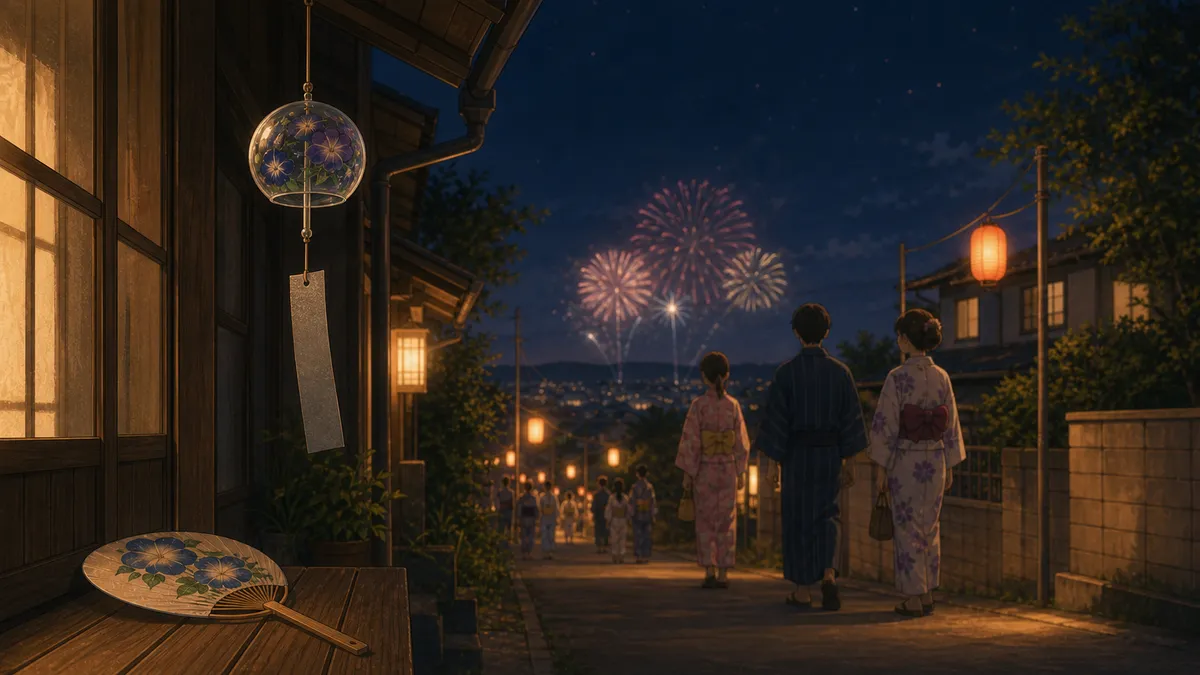
If you've ever walked into an old onsen town at dusk — the kind with wooden inns stacked against a hillside, paper lanterns, sulfur in the evening air, and a street that hasn't seemed to change much in a long time — something in the bathhouse scenes will pull at something you can't quite name.
This isn't invented atmosphere. The narrow wooden corridors, the deep communal baths, the steam rising from every surface, the hierarchy of workers moving through a building that runs on service and precision — these are real. Japan still has onsen towns where the aesthetic of what Miyazaki drew feels continuous with the present. Ginzan Onsen in Yamagata prefecture, lit at night in winter by gas lamps, is the one most often cited — and the resemblance is genuinely striking if you see it in person. Kinosaki, in Hyogo prefecture, has a similar quality. So does Kurokawa in Kumamoto, where inns tuck into a narrow valley and steam rises out of the hillside.
Walk through any of these towns in yukata after dark and something clicks. Not because the film was shot there — it wasn't — but because the film drew on the same texture of how these places feel.
The food stalls where Chihiro's parents stop are real in this sense too: the feeling of unattended food at festival approaches, of abundance that seems to belong to someone other than you, of the smell of something cooking you haven't been invited to share. The way the bathhouse staff move, with practiced, precise deference, is the omotenashi of Japanese hospitality rendered slightly strange — as if you were seeing it for the first time through eyes that have no category for it yet.
If you're an anime fan who first encountered this film before ever visiting Japan, you've probably had the experience of arriving in Japan later and finding that certain places looked exactly like what you remembered from the screen. That's not coincidence. Animation like this draws on real textures of Japanese spaces, and the real spaces give you the déjà vu.
Eight Million Gods, No Footnotes
If you've spent any time with Japanese language or culture, you may have come across the phrase yaoyorozu no kami (八百万の神) — literally "eight million gods." It's the idea, rooted in Shinto tradition and woven into everyday Japanese life, that divinity isn't reserved for formal sacred places. It lives in rivers, in old trees, in the spirit of a place, in things that have simply been here a long time.
The gods who come to Yubaba's bathhouse to be cleaned and restored aren't invented beings. They are, in some sense, this sensibility made visible.
My own favorite part is that very bathhouse. Every kind of god imaginable turns up at that huge, steam-filled bathhouse and settles into the water, each in their own way. That sense that there's a god in anything at all — the whole yaoyorozu no kami worldview — is something I just can't help loving. There's something dwelling in rivers, in stones, in old tools. It isn't a thing you can argue into place, but watching the bustle of that bathhouse, the feeling settles in on its own.
I want to be careful here. I'm not going to claim to speak for Shinto theology, or for how Japanese people universally understand this — there are many views within Japan itself, and I'd be the last person to flatten them into a single reading. But one way to see it: the film takes something present in the texture of ordinary Japanese life — the sense that certain old places carry weight, that a building deserves acknowledgment, that something was here before you arrived — and makes it visible to people who may never have had a word for it.
You don't need to know what kami means for the river spirit's arrival scene to land. A figure caked in centuries of accumulated pollution. The bathhouse workers straining to hold it in place. And then, underneath: something enormous, old, and clean. The image does the explanatory work. The film trusts it to.
Here's how I see it — and I want to be clear, this is a reading, not a verdict: the film works globally not because it packages "Japanese culture" for export. It works because it builds a specific world at the level of texture and trusts a viewer anywhere to find their footing inside it. The universal feeling is carried by the specific detail. That's rare in any film, in any language.
The Bathhouse Is Also a Workplace — and It's Not All Beautiful
There's a shadow this film carries honestly, and it seems worth saying out loud.
The bathhouse is rendered beautifully. But it is also, unmistakably, a workplace with rigid hierarchy — a boss who can turn workers into pigs for slacking off, a child who has to accept whatever job she's given or lose her name entirely. No negotiation. No orientation. Work, or disappear.
Japan's service and hospitality industries are famously demanding. The culture of omotenashi — total dedication to a guest's comfort — can feel like warmth and grace from the outside. From the inside, depending on where you're standing, it can carry a different weight: long hours, strict protocols, the expectation that your own feelings stay secondary to the performance of care. Not everyone in those jobs experiences it as beautiful. It would be dishonest to suggest otherwise.
The film doesn't resolve this. Chihiro doesn't come to love the bathhouse. She gets tired, makes mistakes, cries more than once. She earns her way out through stubbornness and genuine care for other people — not magic, not special talent, just the unglamorous labor of showing up and doing the work.
Both things are true in the film: the spirit world is genuinely beautiful, and working inside it is genuinely hard. That honesty is part of why the film holds up after more than twenty years.
Of course, not everyone watches it as a labor metaphor. The layers are there if you look for them. If you don't, the surface is extraordinary enough on its own.
Where to Feel This More Deeply
If the film made you curious about the Japan it draws from:
Onsen towns at dusk: Ginzan Onsen (Yamagata) in winter, Kinosaki Onsen (Hyogo), Kurokawa Onsen (Kumamoto). Arrive in the late afternoon. Walk the main street after dark. The steam, the wooden architecture, the lanterns — it's continuous with what you've seen on screen in a way that's quietly startling.
Old neighborhood shrines: Almost any old shrine in a Japanese city, just before dark. The torii gate, the gravel, the small wooden offering box, the way the space feels distinct from the street outside. The sense that something was here long before the city around it arrived. That feeling is real, and the film is drawing on it.
The Ghibli Museum in Mitaka, Tokyo: small, carefully made, deliberately hard to navigate efficiently. Low ceilings, hand-painted details throughout. It won't explain the films. It feels continuous with them.
And if you want to watch Spirited Away again: try it in Japanese, without subtitles, and see how much you understand through image and sound alone. More than you'd expect. Possibly everything that matters.
Not a Verdict — A Lingering Question
Spirited Away won the Academy Award for Best Animated Feature in 2003 — the first non-English-language film to do so, and as of this writing, still the only one. It has been watched in countries where no one has visited an onsen, by people who have never heard the word kami, and it has landed in all of them.
I won't tell you exactly why. I'd be suspicious of anyone who claimed to know precisely why a piece of art moves the people it moves.
But the observable fact is there: a film that explains almost nothing about the world it inhabits, that shows a tired child doing unglamorous work in a beautiful and frightening place, that asks you to trust your own attention — that film traveled everywhere.
How does it look from where you're watching?
Sources & References
- Spirited Away (千と千尋の神隠し), dir. Hayao Miyazaki, Studio Ghibli, 2001
- Academy of Motion Picture Arts and Sciences: 75th Academy Awards (2003), Best Animated Feature category record
- Yaoyorozu no kami (八百万の神): standard concept in Shinto tradition; see general Shinto reference works and Kojiki scholarship
- A personal reading from film viewings and everyday observation; no statistical sources cited
A Geek in Japan (Manga, Anime, Zen & Tea)
Why anime and manga took such deep root in Japan, explained from the cultural soil up — broad context for the stories-and-characters 'why.'
The Art of Spirited Away
A large-format art book of concept sketches, background paintings and storyboards from Miyazaki's Spirited Away — the craft behind the frames.
The Art of My Neighbor Totoro
Character art, background paintings and staff commentary from My Neighbor Totoro — how that nostalgic look was actually built.
Share this article
Read Next
- Stories & CharactersPILLARWhy Do Small Details Carry So Much Weight in Japan?In Japanese anime and daily life, small things — a half-finished cup of tea, shoes lined up facing t…
- Stories & CharactersWhy Are There So Many Cats in Japanese Anime?From the Catbus to Nyanko-sensei, anime is full of cats — Japan has long placed them at the border b…
- Stories & CharactersWhy Are Anime Openings So Incredibly Well-Made?Anime OPs are 90-second emotional blueprints — here's what studios pack into each cut, and why the b…
- Stories & CharactersWhy Do Anime Characters Have Such Big Eyes?Anime eyes aren't just a style quirk — they're a visual grammar. Here's how highlights, tear lines, …
- Stories & CharactersWhy Do Mundane Moments in Anime Look So Alive?Anime lingers on steam rising from rice and shoes lined at the door — not as decoration, but as proo…
Related Articles
Articles in the same category:
- Why Are There Fox Statues at Inari Shrines? — The Messenger, Not the God
- Why Do Jizō Statues Wear Red Bibs? — The Prayer Stitched Into the Cloth
- Why Does Japan's Lucky Cat Raise Its Paw? — Right, Left, and What They Actually Mean
- Why Are Mascots Everywhere in Japan? — The Logic Behind Yuru-Chara Culture