Why Do You Have to Wash Before Getting in a Japanese Onsen?
Gestures & Manners · 2026-06-03 · ~1,600 words · ~6 min read
Contents (7)
- The Bath Is Not for Getting Clean
- A Scene You May Have Seen Before
- The Person Who Benefits Most Is Not You
- Here's How I See It — Not as a Verdict
- The Shadow Side — Worth Naming Honestly
- Where to Feel It
- The Water in Common
You step into the changing room of a Japanese bathhouse for the first time. Someone nearby — quietly, without making a scene — gestures toward the row of low plastic stools and tiny showerheads along the wall. Wash first. Before the soak. Before the steaming water you came all this way for.
If you grew up with a private bathtub at home, this feels backwards. The whole point of the bath was to get clean in it, wasn't it?
Here, the premise is different. And once you understand it, the whole logic of the onsen falls into place.
The Bath Is Not for Getting Clean
The first thing to grasp: in Japanese bathing culture, the communal bath — 湯船, yubune — is for soaking, not cleaning. Cleaning happens at the shower station before you ever touch the shared water.
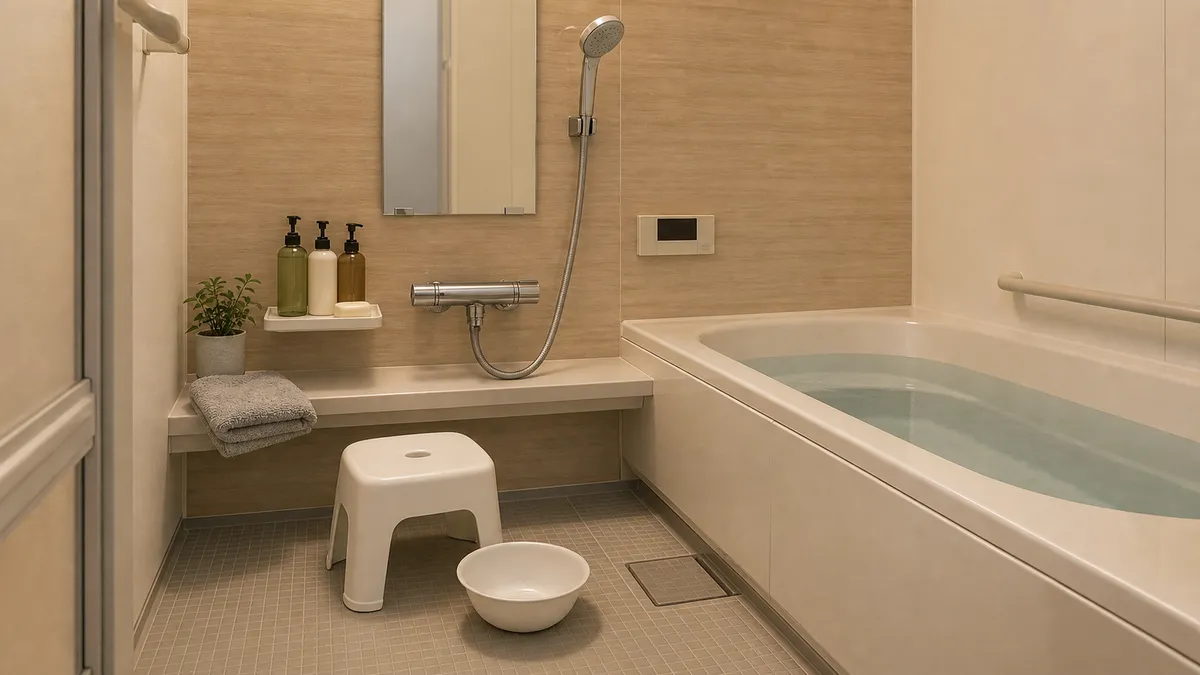
The setup is specific. You sit at a low stool, take the handheld showerhead or pour from a small wooden or plastic bucket called a 桶 (oke), rinse yourself down, soap up properly, then rinse again. Only then do you lower yourself into the communal bath.
The water in that bath belongs to everyone in the room. Not just the people you can see right now — also the strangers who will arrive in an hour, after you've already gone home. The same water. You're not renting a private tub; you're entering a shared one.
Washing before you enter is the price of admission. Not in money — in cleanliness.
A Scene You May Have Seen Before
If you've watched any anime set at a traditional inn (ryokan) or a rural bathhouse, you've already seen this sequence: characters sit at the low stool, rinse from a bucket, then ease into the bath. It isn't just animation convention. It's the real thing, reproduced accurately, because the act is so embedded in Japanese life that any other depiction would look wrong to a Japanese viewer.
The small washing ritual has a specific, unhurried texture to it. The steam. The sound of water on tile. The bucket set down with a hollow knock. In a good neighborhood sento (public bathhouse) or a well-kept onsen, you take your time at the station. Nobody rushes. There's a quality to the moment that's neither ceremonial nor casual — it just is.
The Person Who Benefits Most Is Not You
Here's what I find genuinely interesting about the underlying logic: the person who benefits most from your washing is not you.
You're already clean before you step in. The person who benefits is the stranger who enters the bath after you leave. That anonymous person — whose name you'll never know, whose face you may never see — gets cleaner water because you rinsed first. That's the whole thing.
The simplest way to feel the logic is to run it in reverse. When it's your turn to enter the bath and the person before you used it cleanly — it's just plainly pleasant. You know that feeling. Which means that right now, at the stool, you're handing that same pleasantness forward to the next stranger. If I had to explain the whole custom in one line, it would be this: you're keeping the relay going. Cleanliness here isn't a state; it's a baton. You received it, so you pass it on. I wrote the same thing about Japanese toilets — most of the comfort of Japan's shared spaces is built from exactly this kind of small relay.
I won't claim this is the deep philosophical root of the custom. Honestly, I'd be suspicious of anyone who states the origin too confidently — these things accrue meaning over centuries in ways that resist clean explanations. But that's what the rule produces in practice, whatever its historical beginning.
There's a long tradition of shared bathing in Japan, going back at least to the communal bathhouses of Edo-period cities. In those spaces — with no filtration systems, no chemical treatment — the cleanliness of the water was entirely dependent on the behavior of the people entering it. Washing first may have begun as straightforward hygiene management and carried forward, generation to generation, until it became instinct.
For me personally, washing the body first was less something I learned as a rule than something taught as simply obvious — of course you consider the other guests, and you rinse before you get in. So sitting at the washing station and cleaning myself off before heading to the bath has, at some point, become part of the body. It isn't that someone is watching; the sense that this is just what you do comes first.
Here's How I See It — Not as a Verdict
One reading I keep coming back to, offered as a personal interpretation rather than a conclusion:
Perhaps what the washing ritual does, quietly and without anyone framing it this way, is mark a transition. You're not entering your own tub. You're entering something held in common. The moment at the stool might function — below conscious thought — as a small acknowledgment: I'm about to join something that isn't mine alone. I'll arrive clean.
There are many ways to read it, of course. Someone who grew up going to the sento every week probably doesn't think about it at all. It's just what you do, as automatic as removing your shoes at the door. The quiet meaning, if it exists, lives below the surface of habit.
I suspect this connects to a broader pattern in how Japanese communal spaces tend to work — the idea that how you behave in a shared place is an act of care for people you'll never meet. Not a dramatic act. A small one. Thirty seconds at a low stool, for a stranger who arrives after you're gone.
Of course, not everyone approaches it this way. Most regulars are just following the routine.
The Shadow Side — Worth Naming Honestly
This is a warm custom. It's also largely an unspoken one. Those two things live in the same place.
And let's say the more basic thing plainly: being naked among strangers takes some getting used to for nearly everyone. That isn't a foreigner problem; it's a human one. Onsen also still tend to live in the countryside, where visitors from abroad are uncommon enough to draw a few unguarded glances. Feeling watched — or feeling like you might be — while decoding unwritten rules, undressed, is a real hurdle. It deserves acknowledging before anything else.
Most traditional bathhouses do not hand you a rulebook at the entrance. Many tourist-facing facilities have begun posting multilingual signs — and that's a genuine improvement. But in a neighborhood sento, or at a small inn's private spring, the assumption often remains: you already know this. It goes without saying.
What happens when someone doesn't know? A visitor from abroad, or anyone trying a communal bath for the first time, might walk straight past the stools and step into the water. The response from other bathers can range from a pointed stare to a sharp verbal correction from a complete stranger.
The person who simply didn't know the rule ends up treated as if they broke it on purpose.
It isn't only a welcoming tradition. For someone who arrives without the knowledge, the silence around the rules can feel like a test they didn't know they were taking. The warmth of shared bathing and the strictness of its unspoken code exist in the same water, at the same time. Both are true, and it's worth sitting with that honestly rather than smoothing it over.
Where to Feel It
The best way to experience the logic of washing-first isn't at a resort onsen with full tourist infrastructure. It's at a neighborhood sento — the kind of place where the same regulars show up every evening after work, where the owner has been managing the same bath for decades.
If you're visiting Japan and want to try: bring a small towel (a thin tenugui works well). Sit at the stool before anything else. Rinse down thoroughly. Soap up. Rinse again. Then lower yourself into the water slowly, without splashing.
That's the whole ceremony. No secret knowledge required beyond this one preparatory act.
The Water in Common
I keep coming back to the image of the shared water. It's maintained and filtered and refreshed — but for the hour you're in it, it's the same water everyone in that bath is sharing.
Washing first is a small act. Maybe a minute, once you know what you're doing.
Whether that act is rooted in hygiene history, in long-practiced courtesy for unknown strangers, or in something I'm not naming quite right — I genuinely don't know. But it produces something measurable: a bath that, despite being fully communal, feels calm. Everyone arrived clean. Nobody is the problem.
If you travel in Japan, go to a real onsen at least once. Sit on that low stool, ladle water over your shoulders, rinse clean — and only then lower yourself into the wide bath. Trace that order with your body, and the quiet pleasure of it lands: the courtesy of sharing water with strangers you'll never meet, felt before it's ever explained.
Sources & References
- Japan's Hot Spring Act (温泉法), e-Gov law database — under Ministry of the Environment jurisdiction; general public bathing facility sanitation context
- Standard onsen and sento etiquette guidance from public tourism bodies and facility signage (observational)
- This article is primarily a personal reading from everyday observation; no statistical or demographic claims are made
The Japanese Mind: Understanding Contemporary Japanese Culture
Chapters on aimai (ambiguity), amae, giri, wa and more — the values beneath the gestures and words. For readers who want to go deeper into the 'why.'
A Geek in Japan (Revised & Expanded)
A wide-angle introduction to the 'why' of Japanese culture — manga, anime, Zen, the tea ceremony and more. A natural companion to the topics Naze explores.
Share this article
Read Next
- Gestures & MannersPILLARWhat Is Omotenashi — And Why Does Japanese Hospitality Feel Different?Omotenashi is Japanese hospitality that anticipates what you need before you think to ask — and make…
- Gestures & MannersWhy Don't Japanese People Linger After Eating?Japanese diners tend to leave fairly soon after finishing, especially when it's busy. Here's the qui…
- Gestures & MannersWhy Do Japanese Restaurants Give Free Water and Oshibori?Sit down at almost any Japanese restaurant and cold water, tea, and an oshibori appear before you've…
- Gestures & MannersWhy Does Japan's School Year Start in April?Japan's school year opens in April because its fiscal year does — a calendar fixed in the Meiji era,…
- Gestures & MannersWhy Do Japanese Train Workers Point and Call? — The Science Behind Shisa KankoStation workers who point firmly at signals and call out their status aren't performing a ritual — t…
Related Articles
Articles in the same category: