Why Does Japan Have Special Slippers Just for the Toilet?
Gestures & Manners · 2026-06-30 · ~1,550 words · ~6 min read
Contents (6)
- The Floor Is a Map
- Why the Toilet, Specifically?
- The Thing Nobody Advertises
- The Other Side
- Where to Feel It
- A Thought to Leave With
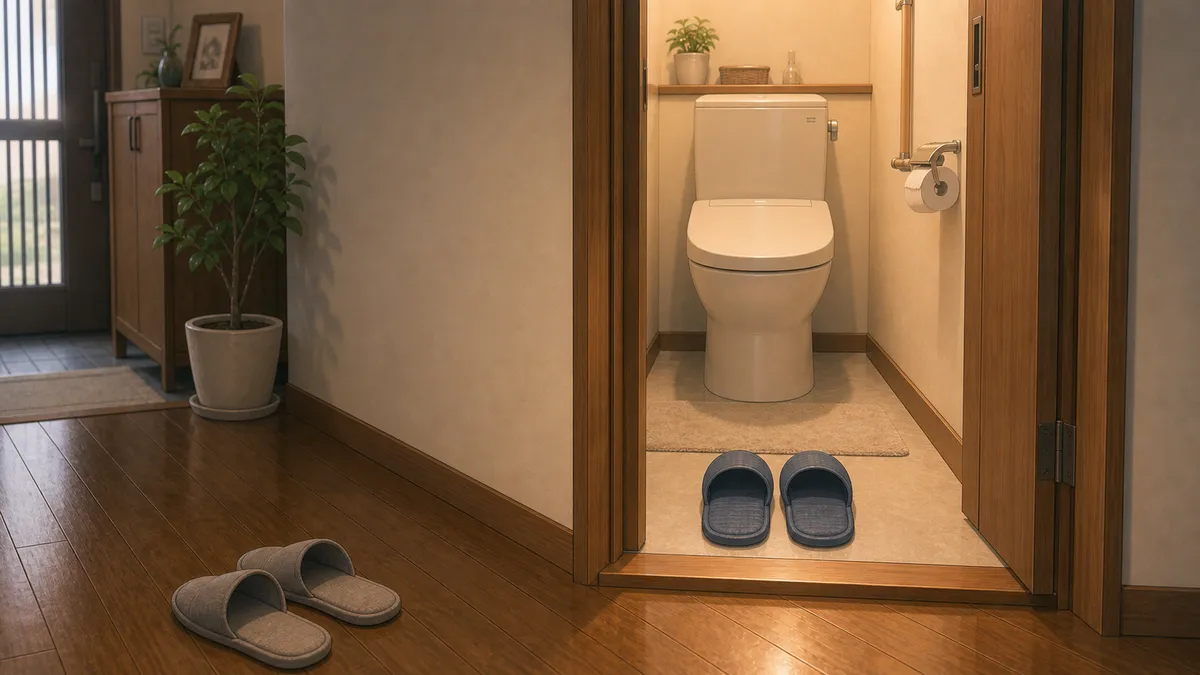
You've taken off your shoes at the genkan. You've been handed a pair of indoor slippers. You shuffle down the hallway to the bathroom — and there, sitting just inside the toilet door, is another pair of slippers. Smaller, usually white or pale blue, positioned to face outward, waiting.
So Japan already asked you to take your shoes off. Why does the toilet get its own dedicated pair on top of that?
The Floor Is a Map
Here's the core idea: Japan doesn't draw the line between clean and unclean once at the front door and call it finished. The floor of a Japanese home works more like a map — different zones sitting at different levels of cleanliness — and crossing from one zone into another means changing your footwear.
The toilet slippers are not a stand-alone quirk. They're one layer in a system that runs throughout the whole house:
- Outside (street, garden): shoes.
- Genkan (the entrance step): the first threshold. Shoes come off here and stay here.
- Indoor hallway and main rooms: slippers, or socks, or bare feet.
- Tatami rooms: no slippers at all — tatami is treated as the cleanest surface in the home.
- Toilet room: dedicated toilet slippers only. Your regular indoor slippers stay outside the door.
- Bathroom/shower room: a different logic again — a wet cleaning space, typically no slippers.
Once you see the full map, the toilet slippers stop being a puzzle. They are the system's next step, applied to the room where the cleanliness expectation drops most sharply.
The core line I'd offer: Japan doesn't draw one cleanliness line. It draws several — one for every threshold where the definition of "clean" changes.
Why the Toilet, Specifically?
In older Japanese homes — and many traditional apartments — the toilet and the bathroom are physically separate rooms. Worth pausing on: this is already a spatial decision built into the architecture. The two rooms are treated as having different natures, so they are kept apart. The bathroom is where you remove dirt. The toilet room carries a different status entirely.
The concept that often comes up in discussions like this is kegare (穢れ) — a kind of ritual impurity in Japanese folk practice, the idea that certain spaces or acts carry a contaminating quality that needs to be spatially contained. The toilet has historically been the room in the home with the strongest kegare association.
I'd offer that as one reading, not a verdict. Whether anyone in 2026 is consciously thinking about ritual impurity on a Tuesday morning before work is a genuinely separate question — probably not. A simpler, equally valid explanation is purely practical: toilet floors get wet and dirty in ways hallway floors don't, and a dedicated pair prevents tracking that back through the house.
Honestly, I suspect it's both, layered over generations of living. The spatial logic made hygienic sense, and a cultural logic gave it staying power. I'd rather leave both on the table than pretend I know which one "really" explains it.
Personally, the toilet was a slightly frightening place for me as a child, too. It sat at the far end of the house, dark, with a faint sense of not-quite-this-side about it. It's probably no accident that ghost stories like Hanako-san — the spirit said to haunt a school toilet stall — have been passed down set in exactly that room. There was, somewhere in me, a sense of the toilet as kakuriyo, the hidden world — a place a little apart from this one. Changing your footwear at the door may be, in part, a small way of getting ready to step into that other place.
The Thing Nobody Advertises
Here is where theory meets reality — and reality wins without trying.
Everyone has walked out of the toilet wearing the toilet slippers. Japanese people included.
You finish. You open the door. You walk back down the hallway. You return to the table. And then someone glances at your feet, or you glance down yourself, and there they are: the white slippers, still on your feet, far from where they belong.
If you've walked back onto tatami while wearing them, you already know exactly how that moment feels.
This scenario is so reliably universal that some households — and many traditional ryokan — hang a small sign on the toilet door handle: "Please remember to switch your slippers." That sign exists because people forget. Constantly. It doesn't matter how long you've lived in Japan or whether you grew up with this system. The slippers are small, the habit is quick and automatic, and the forgetting is equally automatic.
The system is well designed. The human using it is, as ever, not.
At a ryokan once, I watched a guest from abroad wander the halls in the toilet slippers. A tatami inn is where this boundary runs deepest — and yet what I remember is what happened next. A member of the staff walked over quietly, no fuss, no scolding, and let them know in a voice pitched to spare any embarrassment. In fairness, toilet slippers and room slippers look nearly identical; if nobody has told you, mixing them up is the natural outcome. And I've come to think the real heart of this custom lives less in the rule than in that way of telling someone. The boundaries exist to be kept — not to punish the people who never knew they were there.
The Other Side
One more thing worth saying plainly: as Japanese homes modernize — better ventilation, heated floors, different tile standards, western-style integrated bathrooms — some households have quietly dropped the separate toilet slippers altogether. The logic behind them is real; the practice is evolving. Of course, not every home still does this.
And the cleanliness-consciousness that produces the slippers has a quieter shadow. When guests are coming over, there's often a small moment of anxiety: are the toilet slippers presentable? Worn-down, mismatched, or graying slippers become a social signal you never intended to send. A design that organizes cleanliness also becomes something people feel judged by. That's not a reason to dismiss the system — just an honest acknowledgment that the two sides tend to come together.
And this isn't only about slippers, but whether a shop's toilet is clean weighs on my impression of the whole place more than you'd expect. Even if the food and the service are good, a neglected toilet somehow drags the whole place down a notch. Conversely, a shop that has tended even the parts nobody sees earns a kind of trust just for that. How a place handles what's out of view tends to reveal its whole attitude.
Where to Feel It
If you're visiting Japan, a traditional ryokan (Japanese inn) is the most reliable place to encounter the full layered system in one building: genkan step, indoor slippers, toilet slippers, tatami threshold where all slippers stop. The whole sequence, in order.
For anyone staying in a Japanese home, guesthouse, or language-school homestay: the single most practical thing to know is to switch the slippers at the toilet door both ways — going in and coming out. The "coming out" is the one people miss.
In slice-of-life anime — Yotsuba&!, Barakamon, almost any show set in an ordinary family home — you'll spot the toilet slippers positioned just inside the door as a background detail. Animators include them because their absence would look wrong to a Japanese viewer. Now that you know to look, you'll start catching them.
A Thought to Leave With
What I find genuinely interesting here, stepping back: Japan encoded cleanliness into the design of domestic space rather than into rules people must consciously remember. The genkan step makes you take your shoes off. The toilet slippers are already there, pointed at you, doing the thinking. The tatami threshold stops slippers at the edge. The logic is built into the architecture, not stored in someone's head.
Whether that reflects something lasting about how purity and space are understood in Japanese home life, or whether it's just durable practical design that got inherited across enough generations to feel natural — I honestly don't know. Probably both. What I do know is that once you've seen the full map, you start noticing how many thresholds most other domestic spaces simply don't bother to mark.
How many does your floor have?
Sources & References
- On the separation of toilet and bathroom in Japanese housing: widely documented in Japanese home-design literature; no single authoritative source; treated as general cultural knowledge
- On kegare as a concept in Japanese folk and religious practice: Kokugakuin University Encyclopedia of Shinto (general reference; cited as one interpretive lens, not the definitive explanation)
- A personal reading from everyday observation; no statistical claims are made
The Japanese Mind: Understanding Contemporary Japanese Culture
Chapters on aimai (ambiguity), amae, giri, wa and more — the values beneath the gestures and words. For readers who want to go deeper into the 'why.'
A Geek in Japan (Revised & Expanded)
A wide-angle introduction to the 'why' of Japanese culture — manga, anime, Zen, the tea ceremony and more. A natural companion to the topics Naze explores.
Share this article
Read Next
- Gestures & MannersPILLARWhat Is Omotenashi — And Why Does Japanese Hospitality Feel Different?Omotenashi is Japanese hospitality that anticipates what you need before you think to ask — and make…
- Gestures & MannersWhy Don't Japanese People Linger After Eating?Japanese diners tend to leave fairly soon after finishing, especially when it's busy. Here's the qui…
- Gestures & MannersWhy Do Japanese Restaurants Give Free Water and Oshibori?Sit down at almost any Japanese restaurant and cold water, tea, and an oshibori appear before you've…
- Gestures & MannersWhy Does Japan's School Year Start in April?Japan's school year opens in April because its fiscal year does — a calendar fixed in the Meiji era,…
- Gestures & MannersWhy Do Japanese Train Workers Point and Call? — The Science Behind Shisa KankoStation workers who point firmly at signals and call out their status aren't performing a ritual — t…
Related Articles
Articles in the same category:
- Why Shinto Shrines Have Torii Gates — The Feeling of Crossing a Boundary
- Why the Japanese Tea Ceremony Is Never Just About Drinking Tea — Gesture, Silence & Ichigo Ichie
- Why Do You Have to Wash Before Getting in a Japanese Onsen?
- Why Wrapping Things So Carefully Matters in Japan — Furoshiki, Gifts & the Art of Consideration