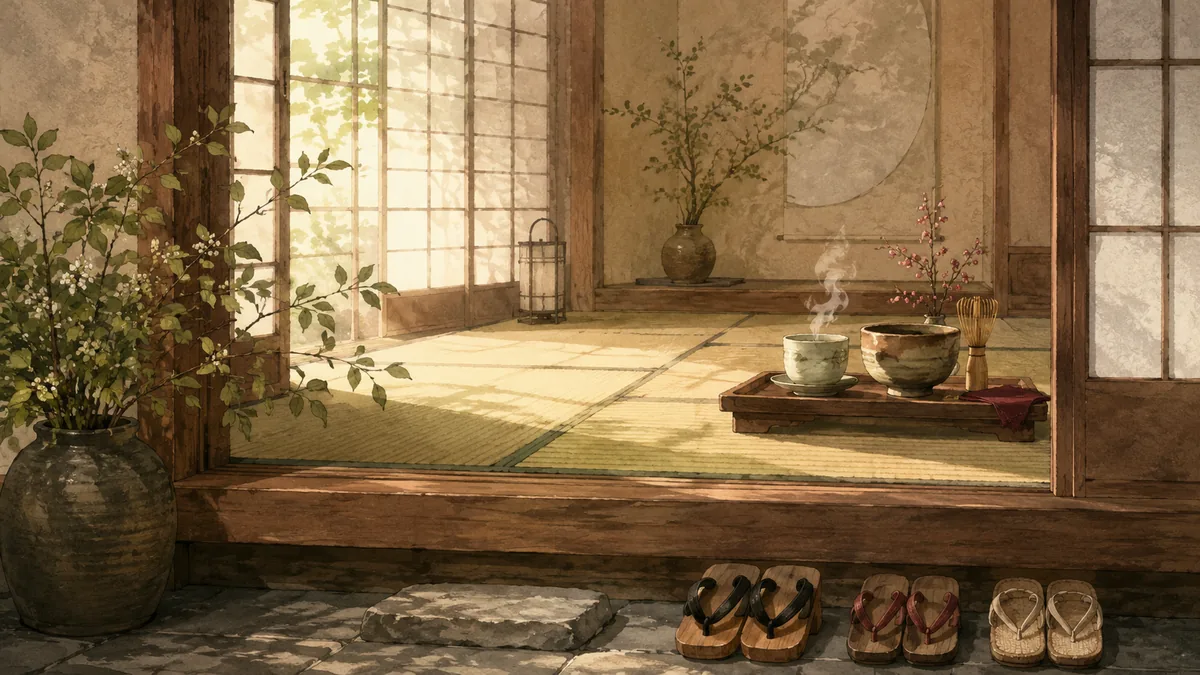
Why the Japanese Tea Ceremony Is Never Just About Drinking Tea — Gesture, Silence & Ichigo Ichie
Gestures & Manners · 2026-06-08 · ~1,900 words
Almost everyone who steps into a traditional tea room for the first time says some version of the same thing: "Why does it take two hours to drink one cup of tea?"
And it's a fair question. You rinse your hands before entering, you crouch through a low doorway designed to make everyone bow whether they mean to or not, you spend time looking at a hanging scroll you may not be able to read. You watch the host move with deliberate, unhurried precision — folding a cloth, ladling water, whisking matcha into foam. The moment when the bowl actually reaches your lips and you drink probably lasts thirty seconds. Everything else is the ceremony.
So what is everything else for?
A Space Constructed Around a Single Bowl
Chadō — the way of tea — is often described as a total art form, one that layers gesture, objects, spatial arrangement, and seasonal awareness around the act of preparing and sharing matcha. That description sounds grand, but the basic logic is accessible enough: if you just wanted to drink tea, you'd make it at home. Tea ceremony is attempting something different. It's trying to make the time itself into something you can taste.
Every element in the room has been chosen for that particular gathering. The hanging scroll in the alcove, the single flower in the vase, the shape of the iron kettle, the choice of sweets — each carries a reference to the season, or to something the host wants the guests to notice. None of it is accidental, and none of it is meant to be invisible. Part of being a guest is taking time to see it.
This is why the ceremony can't be condensed into fifteen minutes without losing most of what it's doing. The slowness is structural.
What Tends to Surprise People From Outside Japan
I've heard a few consistent reactions from non-Japanese friends who've attended a tea experience, and they cluster around the same things.
The precision of physical movement. There are established forms for how to hold the bowl, how to rotate it before drinking, how to place it back down. These aren't arbitrary etiquette rules — they're closer to choreography, and watching a practiced host move through them is genuinely absorbing in the way watching skilled hands do anything is absorbing.
How little anyone talks. In most social settings, silence is something to fill. In a tea room, silence is part of the material. What you hear instead: the low simmer of water in the kettle, the soft sound of the chasen (bamboo whisk) working the matcha, the occasional rustle of fabric. For many visitors from cultures where ambient noise is the default, this registers as remarkable — and sometimes unexpectedly moving.
The relationship to objects. The tea bowl being used might be several hundred years old. It might have been repaired with gold lacquer — a practice called kintsugi — in a way that makes the crack part of its history rather than a flaw. Worth here isn't measured in newness or monetary value. It's measured in accumulated time and care. That's a different framework than most of us apply to everyday objects, and it takes a moment to recalibrate.
The Idea Behind It: Ichigo Ichie
The phrase most often invoked to explain the philosophy of tea ceremony is ichigo ichie — loosely translated as "one time, one meeting" or "this encounter, only once."
The idea is something like this: even if the same host, the same guests, the same utensils, and the same season all reconvene tomorrow, the gathering that happened today will never happen again. The specific quality of that afternoon — the light, who was tired, what was unsaid, what was said — is unrepeatable. So the instruction is to be fully present to it, because it won't come back.
The phrase is often traced to a passage in Chato Ichie-shū, a text associated with Ii Naosuke, a powerful 19th-century official who was also a serious practitioner of tea. Scholars debate the exact origin and how the concept evolved, and I'm not going to claim the history is straightforward. But the idea has clearly outlasted its historical moment — it circulates in contemporary Japanese life far beyond anyone who's ever attended a formal tea ceremony.
My own reading of the ceremony's slowness is that the long duration functions as a kind of enforcement mechanism for ichigo ichie. Rush it, and the feeling doesn't land. The gestures, the silence, the careful attention to objects — they're all ways of making your body agree with what your mind has been told: this is the only time this will happen.
Tea ceremony is also frequently discussed alongside Zen Buddhism and the aesthetic of wabi — an appreciation for impermanence, asymmetry, and understated beauty. These connections are real, but they've also been simplified into a convenient package that doesn't always hold up to scrutiny. I'd treat them as a useful entry point rather than the complete explanation.
Where It Lives in Contemporary Japan
Here's something worth being honest about: the majority of people in Japan today do not practice tea ceremony regularly. It's not a skill most households maintain. Many younger Japanese people have never been to a formal tea gathering at all, and a significant number associate it with stiff formality, sore knees from sitting in seiza, and a set of rules too elaborate to be worth learning.
"All Japanese people can prepare matcha" is a myth. Preparing matcha at home is genuinely uncommon outside of families with an active connection to the practice.
And yet tea ceremony has distributed its influence into everyday Japanese life in ways that don't always announce themselves. The seasonal wagashi — traditional sweets — sold at Japanese confectionery shops follow the same logic as tea ceremony's seasonal awareness. The way a ryokan arranges a room, the flower in a tokonoma alcove, the timing of when tea is brought to a guest, the ritual exchange of cups at certain wedding ceremonies — these aren't tea ceremony, but they carry the same underlying sensibility about deliberate, considered presentation.
Tea ceremony clubs exist in many Japanese middle and high schools. Cultural experience venues in tourist areas report that younger visitors, both Japanese and international, are increasingly interested in trying it. The form hasn't disappeared — it's migrated.
What Visitors Actually Experience
If you're traveling in Japan and curious, access is genuinely easier than it used to be. Many tea experience venues in Kyoto, Tokyo, and other cities now offer sessions with English explanation, and the expectation is explicitly that guests won't know the forms. You won't be corrected for holding the bowl the wrong way. A sincere bow goes a long way.
Places like Kenninji in Kyoto or various experience studios near Asakusa in Tokyo offer this kind of introduction. The setting varies — some are in historically significant rooms, others are purpose-built for tourists — but the core of the experience, sitting quietly with a bowl of matcha and something sweet, tends to be consistent.
What visitors most often mention afterward isn't the taste of the tea (though good matcha is genuinely good). It's the silence. The rare experience of being in a social situation where no one is performing busyness or filling space with talk. That seems to land regardless of cultural background.
On Matcha Itself: Where It Comes From
The vivid green in the bowl comes from tencha — shade-grown tea leaves that are dried without rolling, then stone-ground very slowly into a fine powder. The shading process increases chlorophyll and certain amino acids, which is partly why matcha has a different flavor profile from steeped green tea.
A few regions in Japan are particularly associated with matcha production:
- Uji, Kyoto — probably the most recognized name in matcha, with a history tied directly to the development of tea ceremony culture
- Nishio, Aichi — a major production area whose soil and river mist are said to produce a distinctive flavor; reportedly one of the highest-volume producers in Japan
- Yame, Fukuoka — one of Kyushu's significant tea regions, known for a somewhat different character
The same word, "matcha," covers a wide range — from ceremony-grade powder used in formal contexts to the flavoring in convenience store lattes. They're not the same thing, and practitioners are generally precise about the distinction.
A Note on Who This Is (and Isn't) For
It would be dishonest to frame tea ceremony as a universal Japanese experience or a practice everyone feels warmly about. The formality is a genuine barrier for many people. The time investment is real. And there's a version of tea ceremony discourse that can tip into mystification — treating every aspect as profound in ways that start to feel like performance rather than presence.
What I find more interesting than the ceremony as aesthetic object is the underlying question it keeps asking: can you be here for this, just this, without rushing toward what's next? That question doesn't require a tea room. But the tea room is one of the more elaborate answers to it that humans have designed.
To be honest, I have no real training in tea ceremony myself. My own tea-drinking goes no further than brewing something I picked up at a local tea shop and drinking it normally. Even so, what always strikes me as extraordinary is the plain fact that a mere drink was elevated all the way into a system of manners and values. Prized tea utensils were coveted, I've read, to the point of conflict — that much weight settling onto the tools for a single bowl of tea. And that whole world still survives, even in an age that changes as fast as ours. Wabi and sabi really are, I think, indispensable if you want to talk about Japanese culture at all.
The phrase ichigo ichie has traveled far beyond its origin. People in Japan who've never held a chasen still use it — at the end of trips, before saying goodbye to someone, at the close of a project. The ceremony might be unfamiliar, but the feeling it's trying to cultivate turns out to be recognizable almost anywhere.
When did you last feel it — that specific sense that this particular moment won't come back?
Sources & References
- Sen Sōshitsu XV, general introductory texts on chadō; public materials from Kenninji Temple, Kyoto. Historical interpretation of tea ceremony's development involves multiple scholarly perspectives and should not be attributed to any single source.
- Regional matcha production information (Uji/Kyoto, Nishio/Aichi, Yame/Fukuoka) drawn from publicly available materials from respective municipal and tea industry associations. Production figures and historical claims vary by source.
- The association of ichigo ichie with Ii Naosuke's Chato Ichie-shū is widely cited but debated in academic contexts; treat as a common account rather than settled history.
A way into the world of tea. A matcha-and-whisk set lets you prepare a bowl at home.
The Japanese Mind: Understanding Contemporary Japanese Culture
Chapters on aimai (ambiguity), amae, giri, wa and more — the values beneath the gestures and words. For readers who want to go deeper into the 'why.'
A Geek in Japan (Revised & Expanded)
A wide-angle introduction to the 'why' of Japanese culture — manga, anime, Zen, the tea ceremony and more. A natural companion to the topics Naze explores.
Share this article
Read Next
- Gestures & MannersPILLARWhat Is Omotenashi — And Why Does Japanese Hospitality Feel Different?Omotenashi is Japanese hospitality that anticipates what you need before you think to ask — and make…
- Gestures & MannersWhy Don't Japanese People Linger After Eating?Japanese diners tend to leave fairly soon after finishing, especially when it's busy. Here's the qui…
- Gestures & MannersWhy Do Japanese Restaurants Give Free Water and Oshibori?Sit down at almost any Japanese restaurant and cold water, tea, and an oshibori appear before you've…
- Gestures & MannersWhy Does Japan's School Year Start in April?Japan's school year opens in April because its fiscal year does — a calendar fixed in the Meiji era,…
- Gestures & MannersWhy Do Japanese Train Workers Point and Call? — The Science Behind Shisa KankoStation workers who point firmly at signals and call out their status aren't performing a ritual — t…
Related Articles
Articles in the same category: