Why Do Japanese People Always Bring Souvenirs Back from Trips? — The Logic of Omiyage
Gestures & Manners · 2026-06-08 · ~1,450 words · ~5 min read
Contents (5)
- The Box on Monday Morning
- The Direction Is Reversed
- Omiyage as Re-Entry — My Reading, Not a Claim
- The Obligation That Weighs on People
- Where to Feel It
A colleague returns from a three-day trip to Kyoto. On Monday morning, a flat box of individually wrapped yatsuhashi appears on the shared desk — sixteen pieces, one for each person in the office, arranged neatly in the centre. Your colleague says almost nothing about the trip itself. The box does the talking.
This is omiyage. And it is not quite a souvenir in the way English speakers use the word.
The Box on Monday Morning
Souvenirs are typically something you bring back for yourself: the magnet, the keychain, the printed mug — evidence of having been somewhere. They point inward.
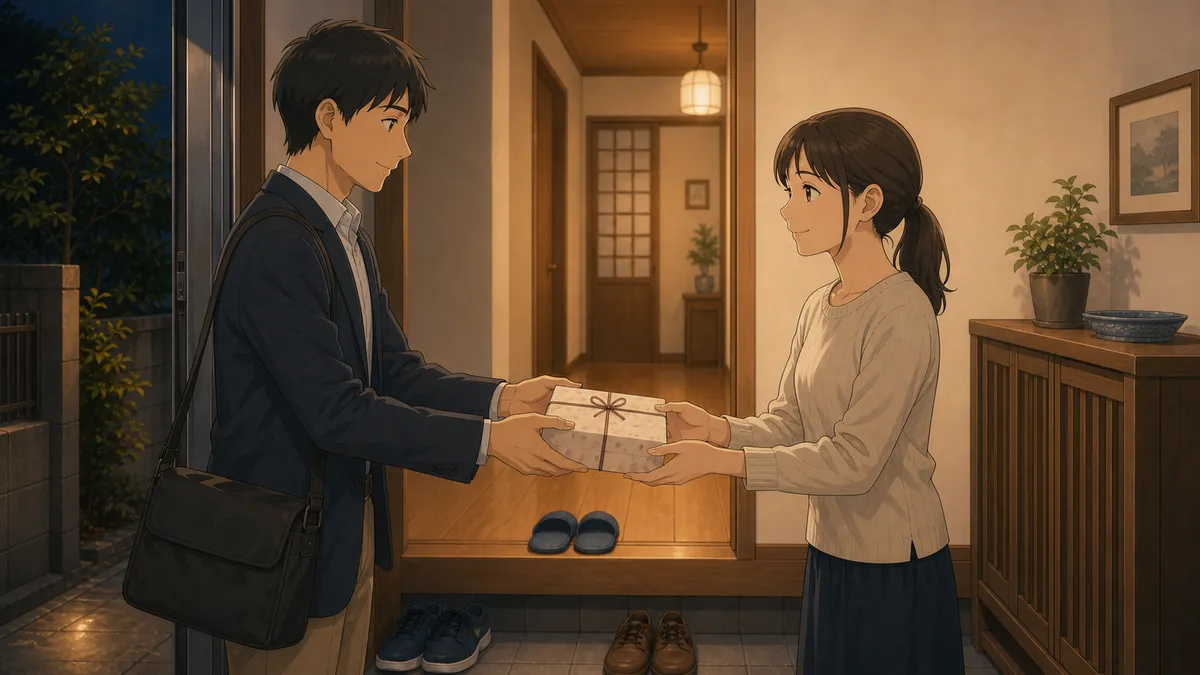
Omiyage points outward. The traveller brings it back for the people who didn't come along — colleagues, family, neighbours. The rule of thumb is simple: you go somewhere, you bring something back for everyone who didn't.
The gift is almost always food, almost always locally specific, almost always individually wrapped so it can be distributed without ceremony.
Which means what's happening at the shop shelf, in practice, is arithmetic. The office has sixteen people. This box holds twelve; that one, fifteen; the big one, eighteen. Buy a box that doesn't divide evenly and you've scheduled a small game of musical chairs for Monday morning. If you ever see someone frozen in a souvenir shop, staring at the piece-count on the back of a box — that's the calculation running. I do it every time.
The Direction Is Reversed
In a Japanese office, the omiyage rhythm runs on autopilot. Someone returns from Hokkaido — white chocolate from Shiroi Koibito. A domestic conference in Fukuoka — hakata torimon. A family trip to Okinawa — benimo tart in a purple box.
The item goes on the shared table. No announcement is strictly required. People pass by, take one, and say thank you to nobody in particular. The transaction is complete.
Japan Switch notes that the tradition may trace its origins to pilgrims returning from sacred sites — carrying back o-mamori (protective charms) or local goods as tangible evidence of a journey for those who could not make it. The modern omiyage retains this structure even when the journey is a sales trip to Osaka.
Omiyage as Re-Entry — My Reading, Not a Claim
Here's how I see it — and I want to be honest that this is an interpretation, not a documented fact.
Omiyage is partly an apology. When you leave the group — even for something good, even for a holiday — you create an absence. The person who covered your desk had to handle your calls. The household ran without you. The gift, on return, is a kind of re-entry: I was away, and I thought of you while I was gone, and here is the evidence.
One way to read it is as a physically portable version of the same impulse that makes Japanese people preface a phone call with an apology for interrupting — not for the content of the call, but for the intrusion of the call itself. The omiyage apologizes for the disruption of the absence.
Though my own feeling sits a little on the brighter side of "apology." On a work trip, the box is a thank-you — to the people who kept things running while I was away. And since work lets me travel to all these places to begin with, the least I can do is share a piece of the place with the people who couldn't come. That's roughly the feeling in my hands while I'm choosing.
Whether this reading is accurate, or whether it's a story I'm layering over what is, for most people, a simple unreflective habit — I genuinely don't know. Many Japanese people bring omiyage without thinking about any of this. It is simply what you do.
The Obligation That Weighs on People
The obligation aspect of omiyage has its critics inside Japan. Zooming Japan and several Japanese-language discussions describe growing reluctance among younger workers to spend money and mental energy on workplace omiyage — particularly when the social expectation doesn't match the actual warmth of the relationship.
"Omiyage fatigue" is real: the sense that bringing a box of sweets for people you barely know is a performance of closeness rather than an expression of it. Some companies have quietly moved away from the practice. Some workers report feeling relief when they return to offices where nobody expects anything.
The gift-giving tradition in Japan, elaborate as it is, can also create its own hierarchies: which omiyage brand is considered prestigious, which is considered cheap, which region's products carry implied social weight. A poorly chosen box can carry its own signal, unintended.
I've been on the receiving end of the reverse journey, too. A visitor from abroad once gave me a bottle of whisky. I don't drink. But the packaging was so handsome that it now lives on my shelf as a small piece of interior decor — and I don't think that makes it a failed gift. Every time it catches my eye, I think of the person who gave it, and of their country. The job of an omiyage isn't to be consumed. It's to remind.
Personally, I have a fairly firm view about the obligation part: if it feels like a duty, you don't have to buy it at all. An omiyage is something you choose while picturing the other person's pleased face — and the moment you hand it over, it's already finished on your end. Whether they're actually delighted is entirely up to them; it isn't a transaction that expects something back. If I can share a little of what I enjoyed on a trip with someone I like, that's enough to make me happy too. That, I think, is the most honest core of the custom — and the instant it becomes an obligation, that core quietly disappears.
Where to Feel It
- To notice it in person: arrive at any Japanese train station departures area on a Friday afternoon. The souvenir shops near the departure gates sell gifts formatted exactly for omiyage — individual portions, elegant boxes, regional branding — and the buyers are almost all domestic travellers on their way home.
- In film: Shoplifters (Hirokazu Kore-eda, 2018) is not about omiyage, but it traces a family whose warmth for each other is expressed through small material gifts and shared meals rather than words — a related emotional register.
- To explore further: A Geek in Japan by Hector Garcia (ISBN 4805313919) covers Japanese gift-giving culture in the context of everyday social life.
Sources & References
- Wikipedia, "Omiyage" — origin and general overview
- Zooming Japan, "Omiyage: The Culture of Souvenirs in Japan" — younger generation shifts
- Japan Switch, "Ultimate Guide to Giving Japanese Omiyage" — practical explanation of the custom
The Japanese Mind: Understanding Contemporary Japanese Culture
Chapters on aimai (ambiguity), amae, giri, wa and more — the values beneath the gestures and words. For readers who want to go deeper into the 'why.'
A Geek in Japan (Revised & Expanded)
A wide-angle introduction to the 'why' of Japanese culture — manga, anime, Zen, the tea ceremony and more. A natural companion to the topics Naze explores.
Share this article
Read Next
- Gestures & MannersPILLARWhat Is Omotenashi — And Why Does Japanese Hospitality Feel Different?Omotenashi is Japanese hospitality that anticipates what you need before you think to ask — and make…
- Gestures & MannersWhy Don't Japanese People Linger After Eating?Japanese diners tend to leave fairly soon after finishing, especially when it's busy. Here's the qui…
- Gestures & MannersWhy Do Japanese Restaurants Give Free Water and Oshibori?Sit down at almost any Japanese restaurant and cold water, tea, and an oshibori appear before you've…
- Gestures & MannersWhy Does Japan's School Year Start in April?Japan's school year opens in April because its fiscal year does — a calendar fixed in the Meiji era,…
- Gestures & MannersWhy Do Japanese Train Workers Point and Call? — The Science Behind Shisa KankoStation workers who point firmly at signals and call out their status aren't performing a ritual — t…
Related Articles
Articles in the same category: