Why Japanese Gardens Leave So Much Empty — The Aesthetics of Ma and Mitate
Gestures & Manners · 2026-06-08 · ~1,800 words
The first time I stood in front of the rock garden at Ryōan-ji in Kyoto, my honest reaction was something close to confusion. Fifteen stones arranged in five clusters, a rectangle of raked white gravel, and walls that have turned amber with age and lichen. That's more or less it. No water. No flowers. No towering trees. A significant portion of what you're looking at is, by any ordinary measure, just empty ground.
And yet people travel across the world to stand there for ten, twenty, thirty minutes — longer than they'd spend in front of most paintings in a museum. Something is happening in that emptiness. I've been trying to understand what, and this article is my attempt to think it through honestly, without overclaiming.
What We Actually Mean by "Empty Space" in These Gardens
Japanese gardens — and I'm speaking broadly here, because there are many styles — often seem to resist filling every available surface. Gaps are left between plantings so the ground shows through. A stretch of moss or gravel sits in front of a pond without any objects interrupting it. A stone grouping has breathing room around it rather than being crowded by other stones.
This isn't neglect, or a budget constraint. From what I've read and observed, the deliberate decision about where to leave space is considered one of the central acts of garden design in many Japanese traditions. The empty areas aren't leftover — they're placed.
The word that gets used most often in this context is ma (間) — a concept that roughly translates to negative space, pause, or interval. It comes up in music (the silence between notes), in architecture (the threshold between rooms), and in conversation (the beat before answering). In a garden, ma is the portion of the composition that isn't occupied by anything, and which makes the occupied parts readable.
What Makes This Feel Distinctly Japanese (With Some Caveats)
If you've visited gardens in France, England, or the formal Islamic tradition, you'll notice some surface-level differences fairly quickly. Many Western formal gardens tend to favor symmetry — mirrored plantings, central axes, geometric beds. The space is organized to demonstrate control and proportion.
Many Japanese garden styles instead lean toward asymmetry. Stones and trees are often placed off-center, weighted to one side, so that the other side reads as intentional openness rather than vacancy. The eye moves differently — there's no single vanishing point pulling focus.
The other thing that strikes visitors is what I'd describe as "crafted wildness." These gardens don't look untended, but they also don't look clipped and geometric. They aim for something in between: the appearance of nature arriving at a particularly composed moment, with a considerable amount of human labor involved in maintaining that appearance. Gardeners I've read about describe this as one of the harder balancing acts in the craft — making intervention invisible.
That said, I want to be careful about drawing too clean a line between "Japanese" and "Western" garden aesthetics. Both traditions are internally diverse, have borrowed from each other, and have plenty of exceptions. I'm describing tendencies, not rules.
The Idea Behind the Emptiness — Mitate and Imagination
Here's where things get more interpretive, and I'll flag that upfront.
A concept that often comes up when Japanese garden designers and scholars talk about these spaces is mitate (見立て) — a kind of creative substitution or imaginative stand-in. In a dry landscape garden (karesansui), raked gravel is understood to represent water. Certain stone groupings suggest mountains or islands. A patch of moss stands in for a dense forest. None of these things are literally what they resemble — but the garden is designed so that the association is available to you if you let it land.
For mitate to work, you need space. If every inch is occupied with literal objects, there's no room for the imagination to complete the picture. The empty gravel at Ryōan-ji isn't empty — it's the ocean, or a river, or a mind at rest, depending on what you bring to it. The garden proposes; you finish.
What impresses me most, personally, walking through a famous garden, is exactly this: the tending is meticulous, right into every corner, and yet a large, deliberate emptiness is always left. It isn't empty because it went to seed — it's kept, groomed, and then left open. Care, and the refusal to add more, held together in the same garden. Call it playfulness, call it an aesthetic — either way, in that single choice not to fill, you feel a clear intention.
This pattern — communicating by not filling in — appears in other Japanese art forms in ways that feel related. Ink wash painting (sumi-e) leaves much of the paper bare, with a few brushstrokes doing enormous work against the white ground. Classical poetry forms like haiku point at a moment without explaining it. The noh theater stage is nearly empty; what happens there gains weight partly from what isn't there.
Some scholars describe this as a coherent aesthetic thread running through many Japanese art forms. Others are more cautious about treating it as a unified philosophy. I find the connections genuinely interesting without being certain they all trace back to a single source.
One framing I'd push back on gently: the tendency in some travel writing to collapse all of this into "Zen minimalism" as if it's a single, unified Japanese worldview. The dry garden tradition is associated with Zen Buddhism, but many Japanese gardens have nothing to do with Zen, and plenty of Japanese people have never thought particularly hard about ma as a concept. It's a real thread — just not the whole fabric.
Where This Sensibility Shows Up Outside Gardens
What I find more convincing than grand cultural theories is the way this aesthetic keeps appearing in mundane, everyday contexts that have nothing to do with temple grounds.
In traditional Japanese inn (ryokan) lobbies, you often encounter a single flower arrangement, a small stone, and a lot of unoccupied floor. The entrance to a high-end restaurant might have one plant and bare wood. Corporate headquarters in Japan sometimes feature a courtyard garden visible through glass — a few elements, a lot of negative space — where you'd expect the lobby to be maximally branded and busy.
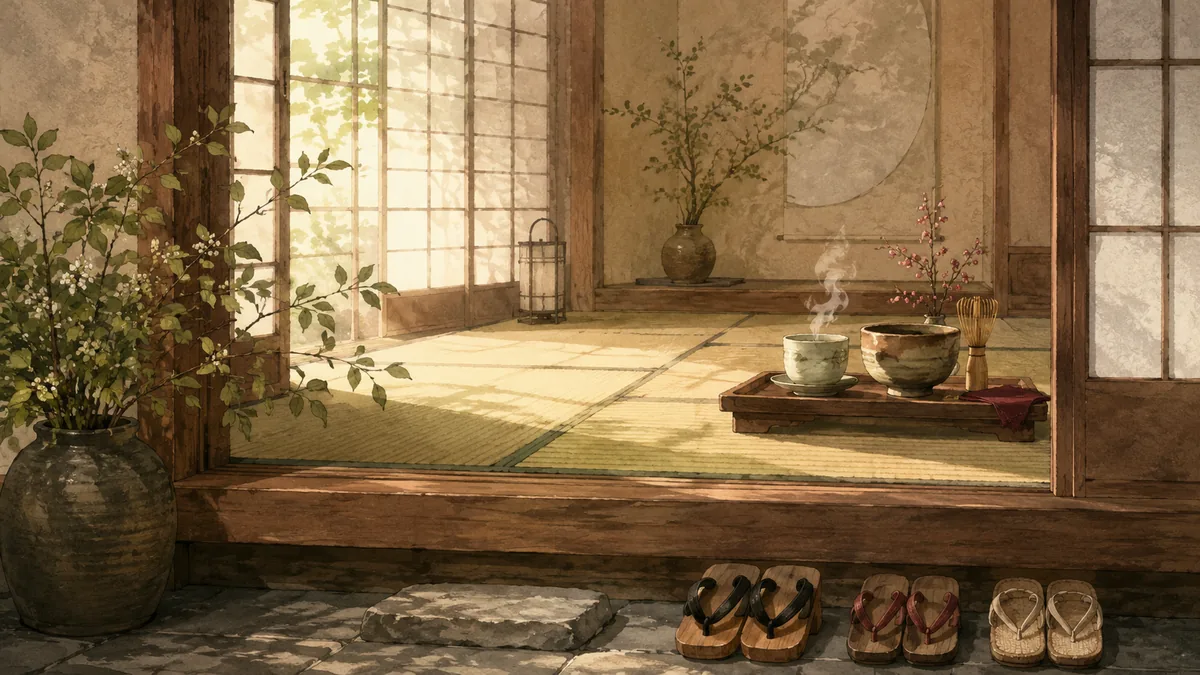
Smaller versions show up in homes. The tokonoma (alcove) in a traditional Japanese room is designed to hold a small number of carefully chosen objects — a hanging scroll, a flower arrangement, maybe one ceramic — and nothing else. The constraint is the point. Putting more things in it would be a misunderstanding of what it's for.
A friend who moved to Tokyo from the US mentioned that she'd started leaving her kitchen counter deliberately emptier after living there for a few years. She didn't frame it as a philosophical choice — it just started feeling right. Whether that's cultural osmosis or just a natural response to smaller living spaces, I honestly can't say.
How It Lands for First-Time Visitors
Something I hear fairly often from people visiting these gardens for the first time: the photographs don't quite capture it.
Shoot the gravel garden at Ryōan-ji on your phone and you might get an image that looks, frankly, underwhelming — a lot of pale ground with some rocks in it. The experience of standing there is different. The emptiness has a spatial quality that doesn't compress well into a rectangle on a screen. Several people have described it to me as feeling like the space is actively doing something to them — a kind of pressure release, or a slowing down.
I think this is part of why these gardens are designed with specific viewing points in mind. At many famous gardens, there's a veranda, a bench, or a designated mat position where you're meant to sit and look. The garden isn't just for walking through — it's for sitting inside for a while. If you visit and stay moving the whole time, you might come away thinking you've been cheated out of content. If you sit, something different tends to happen.
For practical purposes: if you visit gardens like Ryōan-ji, Daitoku-ji, or Katsura Imperial Villa outside Kyoto, try to arrive early (before tour groups arrive around 9–10am), find a seat, and give yourself at least fifteen uninterrupted minutes. It sounds like a small thing. It changes the experience considerably in my observation.
Not Every Japanese Garden Is Like This
I want to close with a correction to any impression I might have given that all Japanese gardens follow this empty-space logic — they don't.
The stroll gardens (kaiyū-shiki) developed by feudal lords in the Edo period are often richly planted, with layered trees, flowering shrubs, and varied terrain that fills your field of vision at almost every turn. These are gorgeous in a completely different register — abundant rather than spare. Regional garden traditions across Japan vary considerably, and some are quite lush.
Nor does every Japanese person walk through life with a highly developed sensitivity to ma. Many people I've spoken with in Japan think of garden aesthetics the way most people think about classical music — they respect it without spending much time with it. Urban apartment life means the majority of people in Japan don't have gardens at all, and those who do often deal more with the practical reality of keeping things alive than with any philosophy of empty space.
What I'd say is this: the tendency to use deliberate emptiness as a compositional element — to let the absence of something carry meaning — shows up enough across Japanese art, design, and everyday objects that it's worth noticing. It isn't a secret key that unlocks Japanese culture. But once you start seeing it, you notice it in places you wouldn't expect. A beautifully wrapped gift with a lot of air inside. A menu with three items. A reply that lets the silence do some of the work.
Is there a corner of your own space that you leave empty on purpose? It might be worth asking why.
Sources & References
- Public visitor information and historical notes from Ryōan-ji, Daitoku-ji sub-temples, and Katsura Imperial Villa (Imperial Household Agency), accessed 2026
- Nitschke, Günter. Japanese Gardens: Right Angle and Natural Form. Taschen, 1993 — a widely cited survey of garden styles and historical periods
- Isozaki, Arata, and others. Writing on ma as architectural and aesthetic concept, particularly the 1978 exhibition catalog MA: Space/Time in Japan
- General reading in Japanese garden history and the karesansui tradition; classifications and historical attributions vary between sources and I've tried to reflect that uncertainty throughout
The Japanese Mind: Understanding Contemporary Japanese Culture
Chapters on aimai (ambiguity), amae, giri, wa and more — the values beneath the gestures and words. For readers who want to go deeper into the 'why.'
A Geek in Japan (Revised & Expanded)
A wide-angle introduction to the 'why' of Japanese culture — manga, anime, Zen, the tea ceremony and more. A natural companion to the topics Naze explores.
Share this article
Read Next
- Gestures & MannersPILLARWhat Is Omotenashi — And Why Does Japanese Hospitality Feel Different?Omotenashi is Japanese hospitality that anticipates what you need before you think to ask — and make…
- Gestures & MannersWhy Don't Japanese People Linger After Eating?Japanese diners tend to leave fairly soon after finishing, especially when it's busy. Here's the qui…
- Gestures & MannersWhy Do Japanese Restaurants Give Free Water and Oshibori?Sit down at almost any Japanese restaurant and cold water, tea, and an oshibori appear before you've…
- Gestures & MannersWhy Does Japan's School Year Start in April?Japan's school year opens in April because its fiscal year does — a calendar fixed in the Meiji era,…
- Gestures & MannersWhy Do Japanese Train Workers Point and Call? — The Science Behind Shisa KankoStation workers who point firmly at signals and call out their status aren't performing a ritual — t…
Related Articles
Articles in the same category: