What Is Omotenashi — And Why Does Japanese Hospitality Feel Different?
Gestures & Manners · 2026-06-03 · ~2,100 words · ~8 min read
Contents (7)
- The Word Itself
- What Omotenashi Actually Looks Like
- One Reading of Why It Feels the Way It Does
- The Eight Million Gods and the Habit of Anticipation
- The Other Side
- Where to Actually Feel It
- A Lingering Thought
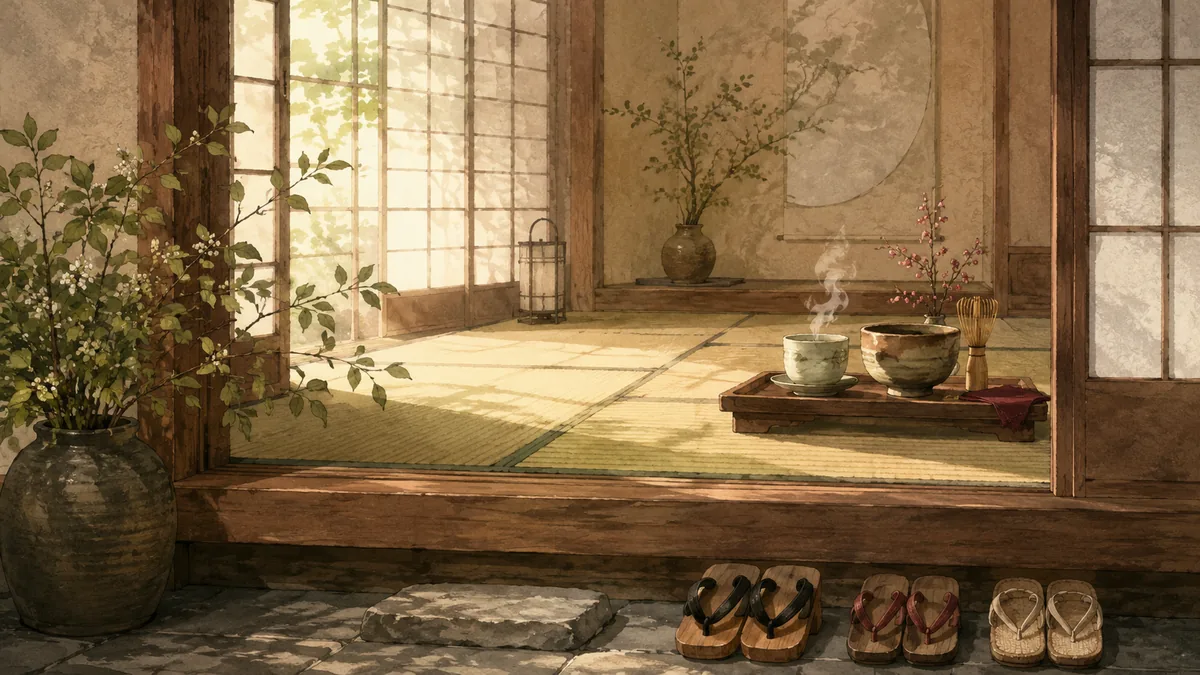
You arrive at a small inn in the early evening. The tea is already poured, still warm. The yukata is folded on the futon at what looks, uncannily, like your probable size. The slippers at the entrance have been turned to face outward — toward you — by someone who was already gone when you stepped inside.
No one asked what you needed. No one waited to be thanked. The room simply said: someone thought about you before you arrived.
That feeling has a name: omotenashi. And once you've experienced it clearly, ordinary service — even good, friendly, attentive ordinary service — starts to feel like it's missing something you couldn't quite name before.
Though, honestly, the omotenashi that has stayed with me longest isn't the grand, cinematic version above. It's something much smaller, almost anticlimactic. I'll come back to what it was.
The Word Itself
Omotenashi (おもてなし) is almost always translated as "Japanese hospitality," but that translation quietly loses the specific gravity of the original.
One reading breaks the word down as omote (表, a front face, a visible surface) + nashi (なし, without) — care given with no front put on for show, no hidden calculation, no expectation of return. Another reading traces it to the verb motenasu, meaning to treat someone, to entertain them, to handle another person's needs fully and attentively.
Neither reading is wrong. Together they point at something consistent: hospitality that calculates nothing back.
The word reached a global audience in 2013 when Tokyo's Olympic bid presentation used it to describe Japan's approach to receiving visitors. But the practice long predates that stage, and the concept runs deep into tea ceremony (chadō) aesthetics — where preparing for the guest was considered a form of art, not a duty. The host considers the season, the light, the specific guests, the choice of ceramic. You are being thought about before you arrive.
For many visitors, the 2013 speech was the introduction. But the word was already doing quiet, steady work long before anyone put it on a screen.
What Omotenashi Actually Looks Like
The clearest signal of omotenashi is that it arrives before you form the thought to ask.
At a ryokan — a traditional Japanese inn — this is most visible. The room temperature is adjusted before you arrive. The seasonal sweet placed beside the tea cup wasn't ordered; it simply appears, correctly. The cushion on the tatami floor has been set at the angle most people naturally want to sit. Nobody narrates any of this. The care is present; its mechanisms are invisible.
But omotenashi isn't only for inns. A department store clerk wraps your purchase and, without comment, slips a small plastic rain cover over the bag — because they glanced outside and it looked like rain. A server at an izakaya quietly refills your water while you're mid-sentence, without interrupting, without drawing attention to the act. A convenience store worker holds the bag open at the top because they noticed, a second before you did, that both your hands were already full.
These are small things. They could easily go unnoticed — which is, in a sense, the point. But they share one quality: the host noticed the need before the guest did.
That is the most honest observable description of omotenashi I can offer. Not luxury. Not ritual formality. Not performance. A specific direction of attention — outward, toward the person in front of you, ahead of the moment they speak.
The kind that genuinely lands for me is always one of the small considerations. Someone remembering my preferences and having them ready the next time I come in. Or accommodating a sudden change on my end cheerfully, without a flicker of annoyance. In those small moments I feel ah, they were actually paying attention to me — and something warms over. Grand staged gestures, honestly, don't stay with me nearly as much. The smallness of "they remembered" lands far harder.
One Reading of Why It Feels the Way It Does
Here's how I see it — not as a verdict, just one way of reading it.
Omotenashi might be understood as a form of care that makes itself disappear. The goal isn't that the guest feels gratitude toward the host; it's that the guest simply feels at ease, ideally without quite knowing why. The host's effort dissolves into the experience. The host becomes, in a sense, background — not absent, but invisible in the best possible way.
There's a phrase that comes up often in Japanese when people talk about this quality: ki ga kiku (気が利く) — something like "perceptive" or "attentive," or more literally, one's ki (awareness, sensitivity) reaching outward and noticing things before being prompted. Omotenashi, in this reading, might be the organized expression of that quality: an environment built by people whose attention kept moving outward, and who acted on what they found there.
I won't claim this is the reason it feels the way it does. There are genuinely many ways to read it, and people who grew up inside this culture often say they can't fully articulate it either — they feel the difference when it's present and when it's gone, but the explanation tends to arrive after the feeling, not before.
For visitors from outside Japan, the feeling can be striking precisely because it doesn't ask for acknowledgment. Much of the hospitality most of us grew up with — in hotels, restaurants, shops — is implicitly a small exchange: I do this, you notice, perhaps you tip, or rate, or return. Omotenashi, at least in its cleaner expressions, removes that transaction from view. Whether the transaction is truly absent or just hidden is, honestly, a question I keep returning to.
The Eight Million Gods and the Habit of Anticipation
That direction of attention — noticing before the guest does — deserves one more turn of the screw.
Because the ones being anticipated were never only human. In Japan, the unseen has long been on the receiving end of the same care: yaoyorozu no kami, the eight million gods — an old sensibility by which some presence dwells in nearly anything. I can't claim this explains omotenashi. But look at omotenashi from that side, and the source of its "specialness" comes a little more into view —
If you grow up in a world where minding even the things you can't see is ordinary, then anticipating the person right in front of you is probably continuous with that. The cup of water set on the household altar and the cup of tea placed before a guest are, at their core, strangely alike: both are offered before they are requested. Arranging things before the other person puts the need into words — that direction of attention may share a root with the assumption that something dwells even in the places you cannot see.
Whether the one being received is the guest in front of you or the presence in the room is, honestly, not a clean line. And maybe that's exactly why omotenashi reads as "special": behind it sits a width of attention that turns toward people, objects, and places alike, keeping no score. It isn't a question of luxury. It's a question of how far the attention reaches.
The Other Side
Of course, not everyone experiences omotenashi as purely warm, and it would be incomplete not to say so.
For a first-time visitor from outside Japan, the seamless anticipation can carry a faint, unexpected unease — a sense that every detail is being quietly watched. That isn't the intention. But the feeling is real, and worth naming honestly.
For the people doing the anticipating, the more complicated shadow lives closer to home. When a culture places high value on reading the room, noticing unspoken needs, and preparing without being asked — those become expected skills. The Japanese word sassuru (察する) — to intuit, to perceive someone's unspoken wish before they form it — is widely praised as a social virtue. In the right context, it produces exactly the warmth we're describing.
But when that expectation is constant and unspoken, it places the full weight of maintaining comfort on whoever is doing the noticing: invisibly, without acknowledgment, without a clearly stated limit. Omotenashi at its best is a gift freely given. But it isn't always free. In service roles and in everyday domestic life, it can become a standard set so high it tips quietly into self-sacrifice — with the effort never named, and the gap between what is given and what is acknowledged never fully closed.
Both of those things are true at once. The warmth is real. So is the weight.
Where to Actually Feel It
If you want to experience omotenashi in a deliberate, unhurried form, a one-night stay at a small ryokan — particularly one not oriented toward large tour groups — is the most direct version. It doesn't need to be expensive. The feeling tends to come from scale and the density of attention, not from price.
Outside of inns: a proper tea ceremony, even a short introductory one, is built almost entirely on this principle. Before you arrive, you are already the consideration. That's the core of it, and you can feel the structure even in a one-hour beginner session.
If you've encountered this idea through anime — which for many readers is the first introduction — you may have noticed it working quietly in the background. The grandmother who has already placed exactly the snack you were about to want. The innkeeper who set the futon before you asked. The shopkeeper who wrapped your purchase before you finished the sentence. It isn't magic in those scenes; it's attention, rendered visible by the fact that someone noticed it.
And if you're learning Japanese, omotenashi is one of those words that initially appears to mean "hospitality" and gradually reveals more texture the more you encounter it — in tourism contexts, in service training manuals, in quiet everyday conversations about what it means to pay attention to another person. It isn't a slogan. It's an old word that has been doing quiet, steady work for a long time.
A Lingering Thought
Omotenashi is sometimes described as "the Japanese spirit of hospitality" — a phrase that always feels, to me, slightly too tidy to be fully honest.
What I'd say instead: it's a practice of paying close attention to a specific person in a specific moment, and acting on what you notice before they have to ask. Whether that quality comes from a long cultural inheritance, from specific training traditions, from the particular pressures of small-space living, or from something I'm not positioned to name — I genuinely don't know. And I suspect the people doing it most carefully don't spend much time on the question either.
They're too busy noticing if you need more tea.
As for me — that small thing I promised to come back to: it was nothing cinematic. It was noticing, at a place I go to often, that they'd remembered what I like and quietly had it ready. That anticlimactic little moment is the one I still think about. The core of omotenashi, I suspect, lives on the side of the small.
How does this kind of care — anticipated, invisible, unclaimed — look from where you live? I'd genuinely like to know.
Sources & References
- Kōjien (広辞苑), Iwanami Shoten — entries for omotenashi (おもてなし) and motenasu (もてなす)
- Tokyo 2020 Olympic bid presentation, September 2013 — widely reported public record; introduced the word omotenashi to a global audience
- General knowledge of Japanese tea ceremony (chadō) aesthetics and service culture; no statistical figures cited — a personal reading from everyday observation
The Japanese Mind: Understanding Contemporary Japanese Culture
Chapters on aimai (ambiguity), amae, giri, wa and more — the values beneath the gestures and words. For readers who want to go deeper into the 'why.'
A Geek in Japan (Revised & Expanded)
A wide-angle introduction to the 'why' of Japanese culture — manga, anime, Zen, the tea ceremony and more. A natural companion to the topics Naze explores.
Share this article
Read Next
- Gestures & MannersWhy Don't Japanese People Linger After Eating?Japanese diners tend to leave fairly soon after finishing, especially when it's busy. Here's the qui…
- Gestures & MannersWhy Do Japanese Restaurants Give Free Water and Oshibori?Sit down at almost any Japanese restaurant and cold water, tea, and an oshibori appear before you've…
- Gestures & MannersWhy Does Japan's School Year Start in April?Japan's school year opens in April because its fiscal year does — a calendar fixed in the Meiji era,…
- Gestures & MannersWhy Do Japanese Train Workers Point and Call? — The Science Behind Shisa KankoStation workers who point firmly at signals and call out their status aren't performing a ritual — t…
- Gestures & MannersWhy Do Japanese Wedding Gifts Require Brand-New Banknotes?At a Japanese wedding, the cash inside the gift envelope must be brand-new — crisp, unfolded, fresh …
Related Articles
Articles in the same category: