Why Sticking Chopsticks Upright in Rice Is Taboo
Gestures & Manners · 2026-06-28 · ~1,950 words · ~7 min read
Contents (8)
- The Short Answer
- The Funeral Offering Behind the Rule
- The Full Map of Chopstick Taboos
- Why This Makes Sense as a System
- The Shadow Side
- How Late-Night TV Passed the Rule Along
- Where to Feel This Further
- A Closing Thought
You're eating at a Japanese family dinner. The rice is almost gone. Instinctively, you push your chopsticks upright into what remains in the bowl — it seems like a convenient place to rest them. And then the room goes quiet.
Nobody says anything directly. But something shifts.
If you've spent time in Japan — or eaten at a Japanese household, or even watched enough anime — you've probably encountered this rule. Don't stick your chopsticks upright in rice. But the reason given is usually vague: "it's bad manners," "it's disrespectful." That's true. It doesn't quite explain why.
The Short Answer
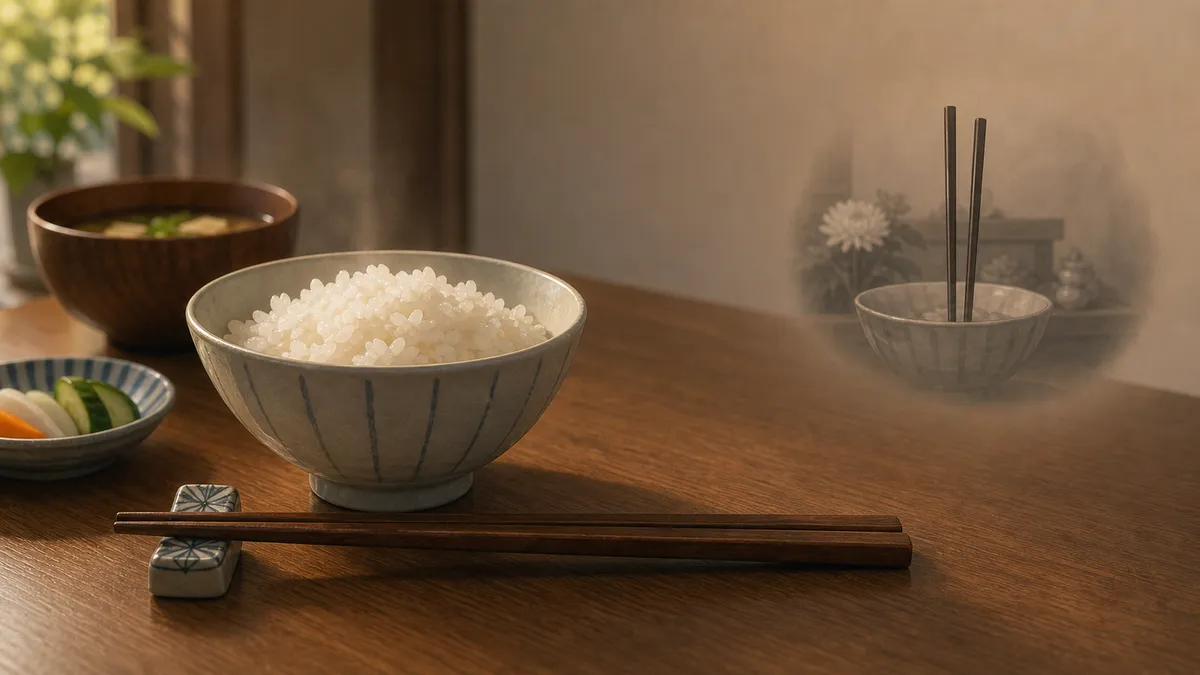
Chopsticks standing upright in rice is the exact posture used to offer food to the dead in Japanese Buddhist funeral rites. The gesture invokes — visually, immediately — a bowl placed at the side of the deceased. That's not a subtle cultural inference. It's a literal match.
Here's the core of it: chopstick taboos at the living table are, almost point for point, the mirror image of the rituals performed for the dead.
The table is for the living. These gestures belong somewhere else.
When I trace my own memory, of all the table manners, standing chopsticks upright in the middle of the rice is the one thing I got scolded for clearly, and firmly. Plenty of the finer rules stayed hazy, but this one came with its reason attached: that's the rice for someone who has died. Even as a child, I caught the tone in it — this was not a thing to be flip about.
The Funeral Offering Behind the Rule
In traditional Japanese Buddhist funerals, a bowl of freshly cooked rice is prepared with chopsticks pushed straight upright into it. This is called makura meshi (枕飯) — "pillow rice" — placed near the head of the deceased as an offering for the journey ahead. It is explicitly food for one who can no longer eat.
The parallel with incense is worth pausing on. Incense sticks are pressed upright into a funeral censer — vertical, rising, directed toward the other side. The visual grammar is the same: upright = ritual space = the dead. When you push chopsticks into a rice bowl at the dinner table, anyone who has attended a Japanese Buddhist funeral will feel that visual echo immediately. Not as paranoia — just recognition.
The Full Map of Chopstick Taboos
The upright position is the most well-known, but the pattern extends further. Several other behaviors are taboo at a Japanese table for the same underlying reason:
刺し箸 (sashi-bashi) — spearing food with a chopstick rather than picking it up. The motion suggests an offering skewer.
渡し箸 (watashi-bashi) — resting chopsticks horizontally across the top of a bowl. This mirrors how chopsticks are placed on a funeral meal setting.
移し箸 (utsushi-bashi) — passing food from one pair of chopsticks directly to another. This is probably the most strongly felt taboo, because it mirrors a specific ritual: kotsuage (骨上げ), the ceremony in which family members pass cremated bones to each other using chopsticks after a cremation. If you've seen or heard about this ceremony, the reason the gesture carries such weight makes immediate sense.
Seen together, these aren't a random checklist of "don't do this at dinner." They map onto the gestures of mourning almost point for point. The living table and the funeral altar share the same materials — rice, bowls, chopsticks — and are distinguished, partly, by direction and gesture.
Why This Makes Sense as a System
Here's how I see it — not as a verdict, just one reading:
Japanese Buddhist funeral practice became deeply embedded in daily household life from roughly the Edo period onward, when the terauke system formally linked every family to a Buddhist temple. Funerary practice wasn't distant or institutional — it happened at home, at the household altar, in the kitchen. Families prepared makura meshi themselves. The gestures were known to everyone in the household.
In that context, table manners aren't only etiquette — they're one way the living table maintains its character as a place for the living. To eat together is an act of being alive together. Gestures that belong to a different register carry a different weight.
I won't say this is the reason. I doubt there's a single, clean origin, and I'd be wary of anyone who claims these taboos carry some unified, ancient spiritual logic — they likely accumulated across regional customs and centuries. But the functional connection to funeral rites is, I think, the most honest explanation available.
Of course, not everyone feels this equally. For plenty of Japanese people — especially younger generations — these rules are half-remembered: "you're not supposed to do that, but I'm not sure exactly why." The feeling behind the rule has, for many, detached from the specific image of makura meshi that originally gave it weight.
The Shadow Side
There's something worth naming honestly here.
When a foreign guest accidentally sticks their chopsticks upright in their rice bowl, the reaction at a Japanese table is rarely a direct correction. More often it's a silence — a breath held, a glance that's quickly looked away from. The guest may feel something shift but not know why.
That silence can be experienced as judgment. And sometimes, honestly, it is. The taboo carries enough gravity that even an accidental version causes genuine discomfort in the host — not performance, not snobbery, but an involuntary reaction to a gesture that reads, in that room, as the wrong kind.
Knowing the reason doesn't require walking on eggshells. It just means that when the room goes quiet, you have some sense of what you touched — and that the discomfort has a referent, not a rule.
It isn't only an uncomfortable moment for the host, either. For the guest who doesn't understand the reaction, the silence can feel cold and unexplained. Both are true. The solution, I think, is simply telling people — which doesn't always happen.
How Late-Night TV Passed the Rule Along
There's one more honest thing worth naming.
I don't think everyone who feels this taboo inherited it directly from funeral experience. Personally, my first real sense of it probably came from occult and horror TV specials I watched as a kid — the kind of program that would cut to a shot of upright chopsticks in a bowl of rice as visual shorthand for something is wrong here. I absorbed "upright chopsticks = bad omen, something eerie" from television before I ever connected it to funeral etiquette specifically. The order may well have been backwards: the TV imagery came first, and the funeral meaning caught up later.
Those kinds of occult specials have largely disappeared from Japanese television in recent years — compliance concerns seem to be part of why. Which means the transmission path itself may be quietly thinning out. If you ask honestly whether people can recall noticing makura meshi at the last funeral they attended, a lot of them, myself included, would have to admit they're not entirely sure. Both the direct memory and the television-relayed version seem to be fading at the same time.
And yet the instinct — don't do that, something about it feels wrong — tends to survive anyway, even once nobody can explain exactly where it came from. The body reacts before the reasoning catches up. It makes me think that the way meaning gets passed down can change entirely while the gesture itself just keeps going, stubbornly, on its own.
Where to Feel This Further
If you've watched anime where a character's death is mourned at a family meal, you may have noticed how the food is portrayed differently in that moment — or how it quietly disappears from the frame. The warm, steam-rising bowl that signals "someone lives here" becomes conspicuously absent in a grief scene. That visual choice carries this same weight.
To go deeper: nearly any depiction of a Japanese Buddhist funeral — in documentary film, literary fiction, or firsthand experience — will show makura meshi clearly. The connection between that image and the chopstick rules at the dinner table tends to click into place the moment you see it.
If you're learning Japanese, the vocabulary around chopstick manners — hashioki (chopstick rests), the full list of hashi taboos — opens a window into how finely the living table is regulated, and why.
A Closing Thought
"Don't do that with your chopsticks" is how it begins — a parent correcting a child, a friend quietly redirecting a guest. But behind that correction is makura meshi, is kotsuage, is a long history of the household managing two different tables: one for the living, one for those who have left.
Every time someone says "not like that," they're drawing that line again.
I'd never claim to know what anyone feels when the room goes quiet. But when it does, I think I know something of what's in it.
How does it look from where you sit?
Sources & References
- Buddhist funeral customs in Japan (sōgi, makura meshi, kotsuage): general ethnographic and folklore literature; the terauke system is documented in standard Edo-period historical scholarship
- Chopstick taboo terminology (sashi-bashi, watashi-bashi, utsushi-bashi, neburi-bashi): standard Japanese etiquette references and dictionaries of customs
- The note on occult TV specials as a transmission path for the taboo is a personal memory and observation, not a documented media-history claim
- The interpretive framing in this piece is a personal reading from everyday observation; no single authoritative source is cited for the spiritual reading
The Japanese Mind: Understanding Contemporary Japanese Culture
Chapters on aimai (ambiguity), amae, giri, wa and more — the values beneath the gestures and words. For readers who want to go deeper into the 'why.'
A Geek in Japan (Revised & Expanded)
A wide-angle introduction to the 'why' of Japanese culture — manga, anime, Zen, the tea ceremony and more. A natural companion to the topics Naze explores.
Share this article
Read Next
- Gestures & MannersPILLARWhat Is Omotenashi — And Why Does Japanese Hospitality Feel Different?Omotenashi is Japanese hospitality that anticipates what you need before you think to ask — and make…
- Gestures & MannersWhy Don't Japanese People Linger After Eating?Japanese diners tend to leave fairly soon after finishing, especially when it's busy. Here's the qui…
- Gestures & MannersWhy Do Japanese Restaurants Give Free Water and Oshibori?Sit down at almost any Japanese restaurant and cold water, tea, and an oshibori appear before you've…
- Gestures & MannersWhy Does Japan's School Year Start in April?Japan's school year opens in April because its fiscal year does — a calendar fixed in the Meiji era,…
- Gestures & MannersWhy Do Japanese Train Workers Point and Call? — The Science Behind Shisa KankoStation workers who point firmly at signals and call out their status aren't performing a ritual — t…
Related Articles
Articles in the same category: