Why Shinto Shrines Have Torii Gates — The Feeling of Crossing a Boundary
Gestures & Manners · 2026-06-08 · ~2,400 words
You're walking down a quiet street in Kyoto, or cutting through a neighborhood in Tokyo, and suddenly there it is: two vertical posts, two horizontal beams, no door, no wall — just an open frame standing in the middle of the path. Someone ahead of you stops, dips their head slightly, and walks through. You weren't expecting that moment of stillness. Neither, possibly, were they.
That structure is a torii (鳥居). And once you've noticed one, you start seeing them everywhere — at the mouth of forest paths, on rooftops of office buildings, at the edge of the sea. Japan has somewhere in the range of 80,000 to 150,000 shrines depending on how you count, and nearly all of them have at least one.
So what exactly is a torii? Why does it look the way it does? And what does it mean — if anything — to walk through one?
A Gate That Doesn't Close
The simplest definition: a torii marks the boundary between the everyday world and the grounds of a Shinto shrine (jinja). It's a symbolic threshold, not a functional one. There's no mechanism to lock it, no priest stationed there to check credentials, no sign that says "believers only." You just walk through.
That openness feels notable when you compare it to the entrance architecture of other religious traditions. Churches often have heavy wooden doors that close. Mosques have decorated gateways. Hindu temples can have elaborately carved towers that frame and filter entry. The torii does something different — it marks rather than controls. The boundary it creates is conceptual, agreed upon rather than enforced.
The forms vary more than most first-time visitors expect. Two of the most common styles are the myōjin torii, which has slightly curved upper beams and gently splayed posts, and the shinmei torii, which is more angular and austere. The materials and colors vary too: bare wood (often a pale, silvery gray as it weathers), white-painted wood, or the deep vermilion that most people picture when they think of a torii. At Inari shrines dedicated to the deity of harvests and commerce, the gates are almost always that intense orange-red, and they often appear in long consecutive tunnels, hundreds of them in a row, as at Fushimi Inari Taisha in Kyoto. The color is associated with warding off misfortune, though like much in folk religion, the explanations are layered and not always consistent.
The Idea of "Inside" and "Outside"
To understand why the torii exists at all, it helps to understand a pattern that runs through a lot of Japanese spatial thinking — or at least, that's how I've come to read it after spending time here.
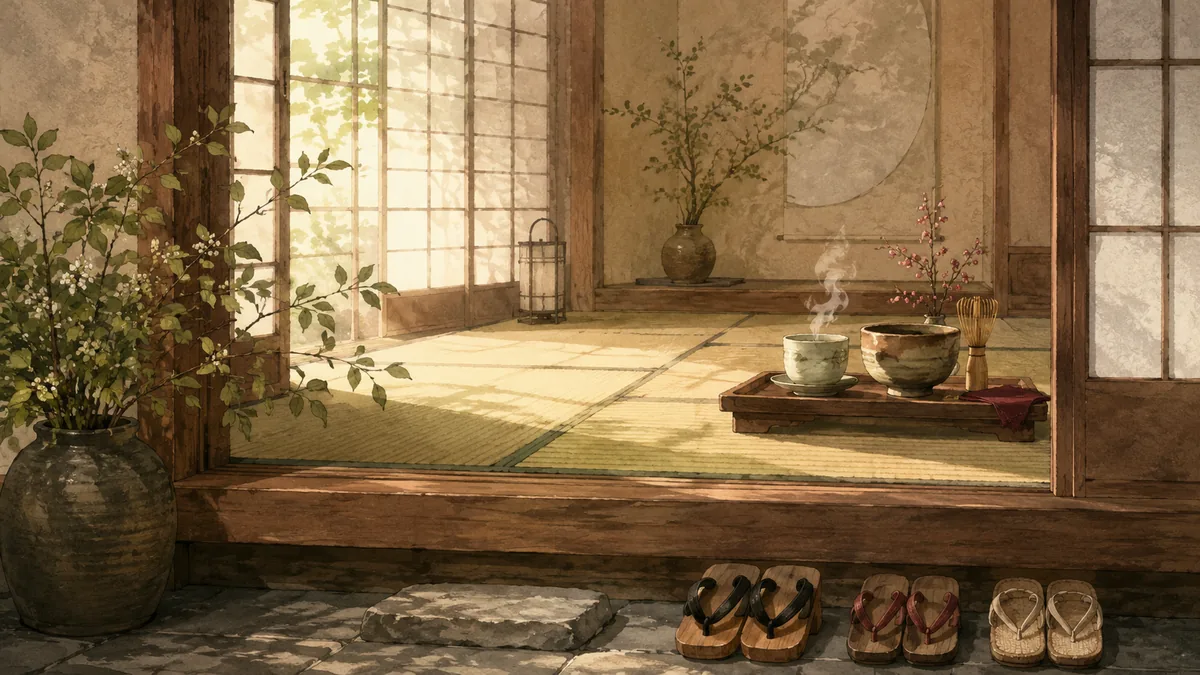
There's a recurring emphasis on distinguishing "inside" from "outside" through ritual rather than physical barriers. You take your shoes off at the entrance to a home, crossing from the genkan (entryway) to the interior — not because the floor material would actually be damaged by shoes in most cases, but because that crossing carries meaning. Noren fabric dividers in the doorways of restaurants and shops don't block entry, but their presence signals that the business is open and that you're stepping into a different social space. Purification salt (mori-shio) placed at a doorstep marks a conceptual threshold. Temporary rope barriers (shimenawa) define sacred spaces at shrines and during festivals.
The torii fits into this pattern. You don't need a wall if everyone agrees — or even half-consciously registers — that the frame means something. The gate says: from here, things are different. And the body seems to respond to that cue, even when the conscious mind hasn't thought it through.
The small stone basin near the torii, called a temizuya or chōzuya, is part of the same logic. You ladle water over your hands before proceeding — a ritual cleansing (misogi) that functions as preparation for entering a different kind of space. Whether or not someone approaching it feels any particular religious meaning, the action creates a pause, a small ceremony of transition.
I want to be clear that I'm offering one reading here, not doctrine. Shinto is less a unified theology than an accumulation of folk practices, local traditions, and imperial-era codifications. What a torii "means" has different answers depending on which scholar, priest, or worshipper you ask.
The Bow Before Entering — Is It Required?
Some visitors notice that many Japanese people bow slightly before passing through a torii, then bow again on the way out. The short answer: it's considered a polite gesture, but it's not a formal rule, and skipping it won't get you in trouble with anyone.
The etiquette guides you'll find at many shrines suggest walking to one side of the central path (sandō) rather than the middle, because the middle is traditionally considered the path of the enshrined deity. Again, this is widely known, not widely enforced, and not everyone follows it — or even knows about it.
As a visitor from outside Japan, the question I hear most often is: "Is it disrespectful for me to walk through a torii?" The straightforward answer is no. Torii are open to anyone. If you want to try the slight bow as a way of engaging with the space on its own terms, that's genuinely appreciated by people who care about such things. But not knowing, and simply walking through curiously, is not an offense.
Where You Encounter Them in Everyday Life
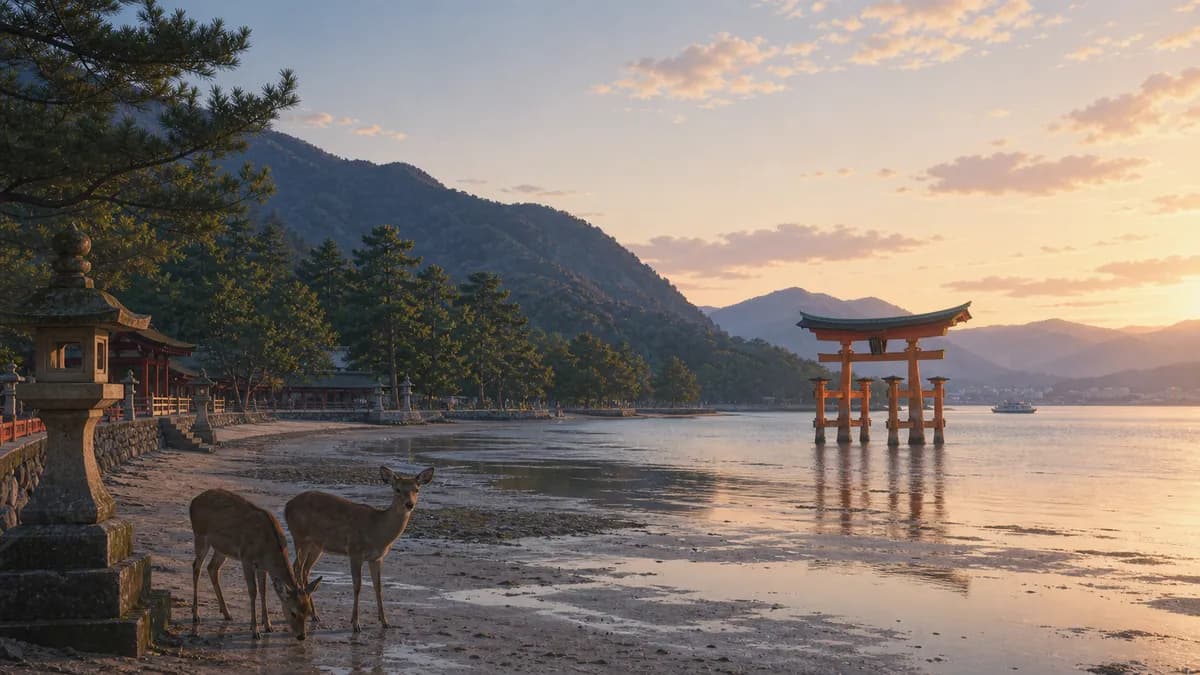
One thing that surprised me early on was how un-monumental most torii are in practice. Yes, there's the famous ō-torii at Itsukushima Shrine in Hiroshima — the large vermilion gate standing in the sea, which appears to float at high tide and has been a UNESCO World Heritage site since 1996. There's the 12-meter structure at Meiji Jingu in Tokyo. There's the photogenic tunnel of gates at Fushimi Inari.
But there are also torii in places you wouldn't look twice at: a tiny sidewalk shrine between two apartment buildings in Osaka, a rooftop Inari altar on a department store in Ginza, a crumbling wooden gate at the edge of a rice field in rural Akita. In those contexts, the torii isn't a landmark — it's more like punctuation in the built environment. A quiet note that says: this corner of the world is held by something other than commerce or transit.
Many people in Japan pass through a torii multiple times a year without thinking of it as a particularly spiritual act. Hatsumōde (first shrine visit of the New Year) draws enormous crowds, many of whom are there more for tradition and the feeling of seasonal transition than for any doctrinal reason. The same goes for Shichi-Go-San (a rite of passage for children aged three, five, and seven), Ema wish-plaques at entrance-exam season, and the quiet visit someone makes before a job interview or a medical procedure. The torii frames all of it — the devout and the habitual and the hedging-your-bets.
What First-Time Visitors Often Notice
Something I hear fairly consistently from people visiting Japan for the first time, especially those who spend time at shrine complexes: the air feels different inside. Not in a mystical sense, necessarily — though some people describe it that way — but in a sensory one. The gravel underfoot makes a different sound. The trees are older and taller. Street noise drops. The pace slows.
This isn't accidental. Many shrine grounds are deliberately designed to shift perception through accumulated small signals: the crunch of jari gravel that you can't walk quietly on, the shift from pavement to packed earth, the high canopy of old-growth trees, the way the path often curves so you can't see the main hall from the torii. The transition is engineered. The torii is the first cue in a sequence.
For my part, I always give a small bow at a torii. When I think about it, it's nothing special. Walking straight into someone's house without so much as an ojama shimasu — "sorry to intrude" — is close to unthinkable for me. And this is a god's house. So you dip your head once at the entrance before you step in; that's all it is. That single beat in front of the torii is, to me, less an act of faith than an extension of ordinary manners.
I'll also confess the child's version of this feeling. I was taught that the shrine was a sacred, clean place — and still, as a kid, the grounds at dusk were a little scary. The stone guardian dogs looked like they might start moving. Looking back, I think my body was reading the same signal correctly: the air inside the torii is not ordinary air. In a child, fear and reverence are siblings.
At Fushimi Inari specifically, the tunnel of consecutive gates does something interesting to time perception — especially early in the morning before tour groups arrive. Walking through hundreds of identical forms in sequence, each one casting the same shadow, has an effect that's hard to describe without sounding more mystical than I intend. It's closer to the feeling of walking through a long corridor with repeated patterns: the repetition itself becomes the experience.
Eight Million Gods, and the Torii as a Front Door
A moment ago I called this a god's house. So which room of the house does the owner actually keep to?
The old phrase yaoyorozu no kami — the eight million gods — reads like its own answer: no room in particular. The sacred isn't concentrated in one rare spot; it's spread thin and everywhere. I can't state this as fact. But read the torii that way, and its strange, doorless posture starts to make sense —
If gods are everywhere, what you need isn't a wall to contain one. It's a marker that says: from here, that presence gets denser. That may be exactly why a torii has no door. With nothing to shut out, there's nothing to close. It simply stands at the seam where the thickness of the air quietly changes from outside to inside.
The "walking into a god's house" feeling from a moment ago connects here too. The owner of the house is faintly present in every room — so you dip your head once at the entrance before stepping in. A torii may be the shape a front door takes in a world of eight million gods: not so much a gate that won't close as a doorway left permanently open, and no less real for it.
Not Everyone Pauses — And That's Worth Saying
I'd be doing a disservice to leave you with an image of Japan as a place where every person approaching a torii stops in reverent contemplation. That's not how it looks on the ground.
Plenty of people walk through without any particular ceremony — a shortcut on the commute, a quick spin through the grounds during a lunch break, or the slightly glazed-over pace of someone who's visited the same shrine a hundred times. Children run through. Tourists stop in the middle of the path for photos. On busy festival days, the crowd moves like a slow river and individual gestures get swallowed by the flow.
The bow, the walk-to-the-side, the handwashing — these are part of a system of manners that many people know in outline but practice inconsistently, like knowing which fork is the salad fork. The existence of the etiquette doesn't mean everyone performs it, and the absence of performance doesn't mean people don't feel something when they cross the threshold.
That gap between the formal description and the lived experience is, honestly, part of what makes shrine culture interesting to observe. The torii doesn't demand anything of you. It just marks the line and leaves the rest up to you.
The last time you felt like you were stepping into a different space — where was that line, and what was it made of?
Sources & References
- Fushimi Inari Taisha official visitor information and shrine history materials (Kyoto)
- Meiji Jingu official visitor guide (Tokyo)
- Jinja Honcho (Association of Shinto Shrines) public documentation on shrine etiquette and architecture
- Itsukushima Shrine (Hiroshima) UNESCO World Heritage designation materials
- Personal observation and conversation; all interpretations of Shinto practice are my own reading and carry the usual caveats about a tradition with many regional and denominational variations
The Japanese Mind: Understanding Contemporary Japanese Culture
Chapters on aimai (ambiguity), amae, giri, wa and more — the values beneath the gestures and words. For readers who want to go deeper into the 'why.'
A Geek in Japan (Revised & Expanded)
A wide-angle introduction to the 'why' of Japanese culture — manga, anime, Zen, the tea ceremony and more. A natural companion to the topics Naze explores.
Share this article
Read Next
- Gestures & MannersPILLARWhat Is Omotenashi — And Why Does Japanese Hospitality Feel Different?Omotenashi is Japanese hospitality that anticipates what you need before you think to ask — and make…
- Gestures & MannersWhy Don't Japanese People Linger After Eating?Japanese diners tend to leave fairly soon after finishing, especially when it's busy. Here's the qui…
- Gestures & MannersWhy Do Japanese Restaurants Give Free Water and Oshibori?Sit down at almost any Japanese restaurant and cold water, tea, and an oshibori appear before you've…
- Gestures & MannersWhy Does Japan's School Year Start in April?Japan's school year opens in April because its fiscal year does — a calendar fixed in the Meiji era,…
- Gestures & MannersWhy Do Japanese Train Workers Point and Call? — The Science Behind Shisa KankoStation workers who point firmly at signals and call out their status aren't performing a ritual — t…
Related Articles
Articles in the same category: