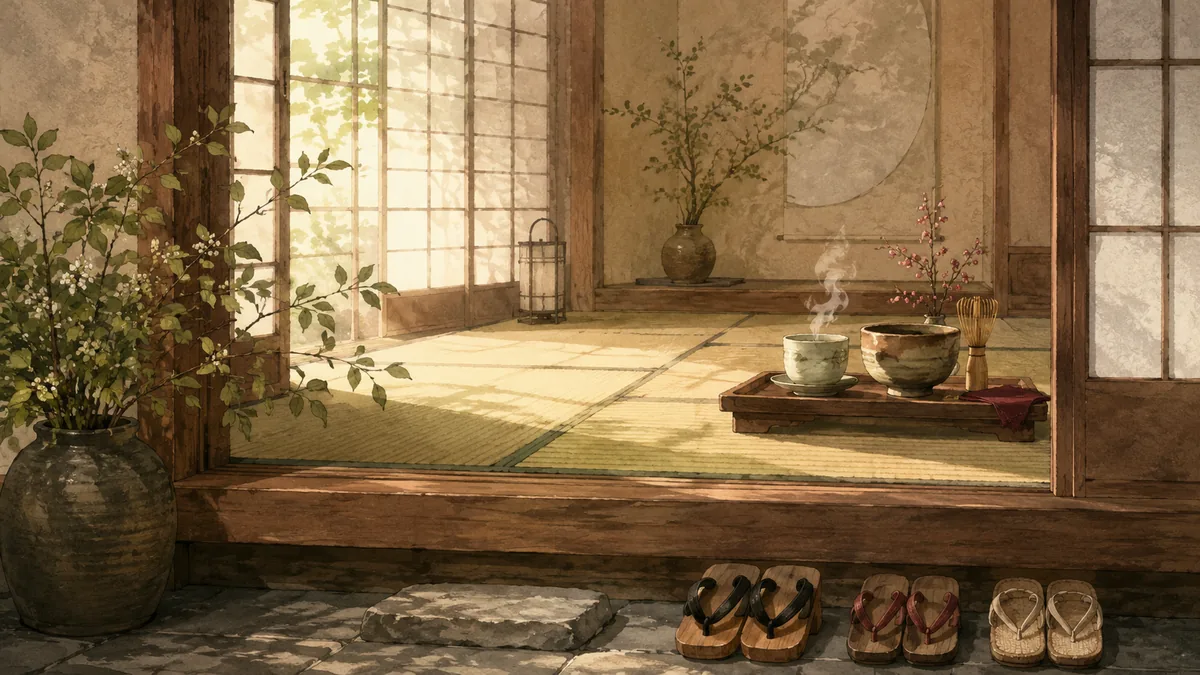
Why Japan Has a Word for Meaningful Emptiness — The Concept of Ma
Gestures & Manners · 2026-06-08 · ~1,900 words
There's a Japanese word I keep coming back to whenever I try to explain something that feels distinctly hard to pin down about everyday life here: 間 (ma).
It gets used for a gap between two pillars. For the pause between sentences. For the silence that falls over a dinner table and nobody rushes to fill. For the white space around a brushstroke in calligraphy. For the moment a comedian holds before delivering a punchline. One word. All of those things.
What they share — and this is the part that I find genuinely interesting — is that they're all describing nothing. An absence. A gap. And yet in Japanese that absence gets its own word, and that word carries real weight.
What Ma Actually Means
Etymologically, ma is thought to have started as an architectural term: the space between two structural columns, or the interval between objects. From there it spread outward to cover almost anything that exists between two things.
Time between events (like a rest in music). Space between objects (like the negative space in a painting). The relational distance between people (notably, the word for "human being" in Japanese — 人間, ningen — literally contains ma). The beat of silence between lines of dialogue. The held stillness before a movement in martial arts.
In practical conversation you'll hear it constantly:
- 間を取る (ma wo toru) — to pause deliberately, to give something space
- 間が悪い (ma ga warui) — bad timing, being caught at an awkward moment
- 間が持たない (ma ga motanai) — can't hold the silence, feeling the need to fill it
- 間抜け (manuke) — literally "someone with the ma knocked out of them," meaning a person who can't read timing or rhythm; a dolt
That last one is telling. If losing your ma is an insult, then having good ma is implicitly a skill — something that can be cultivated or squandered.
Where You Actually See It
The clearest place to observe ma in action is traditional performance.
In rakugo — the Japanese solo storytelling art where a single performer voices every character — comedians talk openly about the ma between words being where the laugh actually lives. It's not the punchline itself; it's the silence before it. The same line delivered with a half-second longer pause becomes a different joke. Often a better one.
In Noh theater, the moments of complete stillness are considered just as significant as the moments of movement. A performer who rushes through those pauses is considered to be missing the point. The audience is supposed to sit with that stillness, not wait it out.
In ikebana (flower arranging), the space between branches is discussed with the same seriousness as the branches themselves. You're not filling a vase — you're composing relationships between objects, and the gaps define those relationships.
In calligraphy and ink painting, the unpainted white area is called ma as well. Two brushstrokes can bracket a negative space that carries more visual energy than either stroke on its own.
In the dry rock gardens (karesansui) that often surprise visitors who expect lush greenery — the raked gravel, the empty stretches between stones — the unfilled space is the design, not the absence of one.
This pattern appears often enough across different art forms that it seems less like coincidence and more like a shared aesthetic instinct: emptiness as content rather than absence of content.
The Thinking Behind It — "Nothing" as Something
I want to be careful here not to overstate a tidy cultural theory, but there does seem to be a recurring logic across these different domains.
Many Japanese art forms appear to operate on the principle that what you don't include shapes what remains. A haiku's power comes partly from what it refuses to say — the kireji (cutting word) creates a gap for the reader to fall into. A tea room's value comes partly from its deliberate smallness, its lack of ornamentation. The silence in a conversation can be an invitation rather than a failure.
Where this logic comes from is genuinely contested. Scholars point to Zen Buddhist influence, to the architectural traditions of shrine and temple design, to the aesthetics of the Heian court, to the practical minimalism of small living spaces. Most likely it's a convergence of several streams rather than one clean origin.
I'll admit I'm working from general reading here rather than academic expertise, and the cultural interpretation of ma is something that Japanese scholars themselves debate. So take this as one framing rather than settled fact.
How It Shows Up in Ordinary Life
You don't need to attend a Noh performance to encounter ma as a lived concept. It shows up in more mundane places.
In conversation, many people in Japan are comfortable with silences that would feel genuinely uncomfortable to someone raised in, say, a North American or Western European context. A pause of five or ten seconds while someone thinks through their answer isn't unusual and often isn't experienced as awkward. It's considered appropriate to let someone finish forming a thought before responding — or to simply sit together without the silence needing to be filled.
In professional settings, the person who speaks least in a meeting is not always the one with least authority. Timing matters: when you speak can carry as much signal as what you say.
In comedy and entertainment, ma is discussed as a measurable craft skill. Variety shows and stand-up specials will literally analyze performers' timing as technique. You'll hear commentators say a comedian's ma is good the same way you'd say a musician has good rhythm.
In everyday language, people will compliment someone's ma in conversation: they know when to speak, when to hold back, when to let silence do the work.
Personally, I feel ma in all sorts of places. Take a stage show: the taut stretch of time before the curtain rises, and the suspended in-between of an intermission, are already part of the show — and it's all designed right through to the yoin, the lingering resonance after the curtain falls. Conversational ma is interesting too. It's partly a matter of tempo, but more than that, some people's pauses feel comfortable to me and others' don't — it really comes down to whether your ma and theirs fit. The spatial ma that stays with me is a shop that doesn't line up rows of goods but sets a single main item, alone, in the middle of the room. There's something clean-cut about it — I'm impressed anyone dared subtract that much. That, too, is one form of beauty.
How Visitors Often Experience It
One thing I hear fairly often from people visiting Japan, or newly arrived expats, is some version of: "Conversations here make me anxious — there's so much silence and I can never tell if I've said something wrong."
That reaction makes complete sense if you're coming from a culture where silence in conversation tends to signal discomfort, disagreement, or social failure. In many English-speaking contexts, keeping a conversation flowing is a form of courtesy — you fill gaps to show engagement and warmth. A silence implies something has gone wrong.
In Japan, silence more often reads as neutral or even respectful — someone is processing, considering, being careful. It doesn't carry the same alarm signal. So the gap that a visitor reads as "this is going badly" might read to the other person as simply "we are thinking together."
This gap in interpretation can cut both ways, of course. I've also met people who moved to Japan and initially found the conversational pace slower or more effortful than they expected — until they stopped trying to fill every pause and found that the conversations became easier, not harder.
That said, I want to resist the version of this story that romanticizes Japanese silence as some kind of universal cultural gift. The relationship between silence and ma in ordinary social life is more complicated than that.
Not Everyone Is Comfortable with Silence — Including Many Japanese People
This is worth saying plainly: plenty of people in Japan find silence uncomfortable. Some feel social pressure to keep talking, to smooth over pauses, to perform engagement. "Filling the silence" anxiety is not uniquely a Western experience.
The concept of ma as a refined, intentional practice — the kind a rakugo performer cultivates or that a tea ceremony master embodies — is quite different from how most people actually move through their days. Knowing intellectually that silence can be ma does not mean you feel comfortable sitting in it.
There's also a generational component. Younger people navigating always-on digital communication often describe the same noise-filling instincts you'd recognize from any other context. The language contains ma; that doesn't mean everyone lives it fluently.
I think the honest version of the observation is narrower than the cultural-essentialist one: Japanese has a word that treats absence as a value-carrying thing, and that word shows up across enough different domains — architecture, performance, conversation, visual art — that it's clearly pointing at something real. Whether any given person embodies that concept is a separate question.
Why the Word Itself Matters
There's a version of this piece that would argue the concept of ma proves something sweeping about Japanese culture. I don't think that's quite right, and I'd be skeptical of anyone who claimed it was.
What I do think is worth noticing: having a word for something changes how you can talk about it, and possibly how you experience it. English doesn't have a single word that covers the meaningful pause before a reply, the negative space in a painting, the gap between buildings, and the timing of a joke. We have pause, space, interval, timing, negative space, silence — a cluster of words that each catch part of it, but none that names the whole.
When you have a word for something, you can point at it. You can say "that's good ma" or "the ma is off" and the person you're talking to knows what quality you're assessing. The evaluation becomes possible.
Maybe that's what this article is actually about: not a grand claim about culture, but a small observation about vocabulary. Sometimes a language gives you a concept, and the concept quietly opens up a way of noticing things you might otherwise have let blur past.
When did you last notice a silence that felt exactly right? Not awkward, not empty — just the right amount of nothing in exactly the right place?
In Japanese, that has a name.
Sources & References
- National Institute for Japanese Language and Linguistics (NINJAL) — lexical notes on 間 and compound usage
- Arata Isozaki, Ma: Space/Time in Japan (essay and exhibition catalogue, 1978) — foundational framing of ma in architecture and visual art
- Donald Richie, A Tractate on Japanese Aesthetics (Stone Bridge Press, 2007) — accessible overview of aesthetic concepts including ma, wabi, and mono no aware
- General reference literature on rakugo performance craft and Noh theory; interpretations of cultural context are the author's own reading and should not be taken as academic consensus
The Japanese Mind: Understanding Contemporary Japanese Culture
Chapters on aimai (ambiguity), amae, giri, wa and more — the values beneath the gestures and words. For readers who want to go deeper into the 'why.'
A Geek in Japan (Revised & Expanded)
A wide-angle introduction to the 'why' of Japanese culture — manga, anime, Zen, the tea ceremony and more. A natural companion to the topics Naze explores.
Share this article
Read Next
- Gestures & MannersPILLARWhat Is Omotenashi — And Why Does Japanese Hospitality Feel Different?Omotenashi is Japanese hospitality that anticipates what you need before you think to ask — and make…
- Gestures & MannersWhy Don't Japanese People Linger After Eating?Japanese diners tend to leave fairly soon after finishing, especially when it's busy. Here's the qui…
- Gestures & MannersWhy Do Japanese Restaurants Give Free Water and Oshibori?Sit down at almost any Japanese restaurant and cold water, tea, and an oshibori appear before you've…
- Gestures & MannersWhy Does Japan's School Year Start in April?Japan's school year opens in April because its fiscal year does — a calendar fixed in the Meiji era,…
- Gestures & MannersWhy Do Japanese Train Workers Point and Call? — The Science Behind Shisa KankoStation workers who point firmly at signals and call out their status aren't performing a ritual — t…
Related Articles
Articles in the same category:
- Why Do You Have to Wash Before Getting in a Japanese Onsen?
- Why Wrapping Things So Carefully Matters in Japan — Furoshiki, Gifts & the Art of Consideration
- Why Do Japanese People Exchange Business Cards with Both Hands? — The Logic of Meishi Etiquette
- Why Do Japanese Train Workers Point and Call? — The Science Behind Shisa Kanko