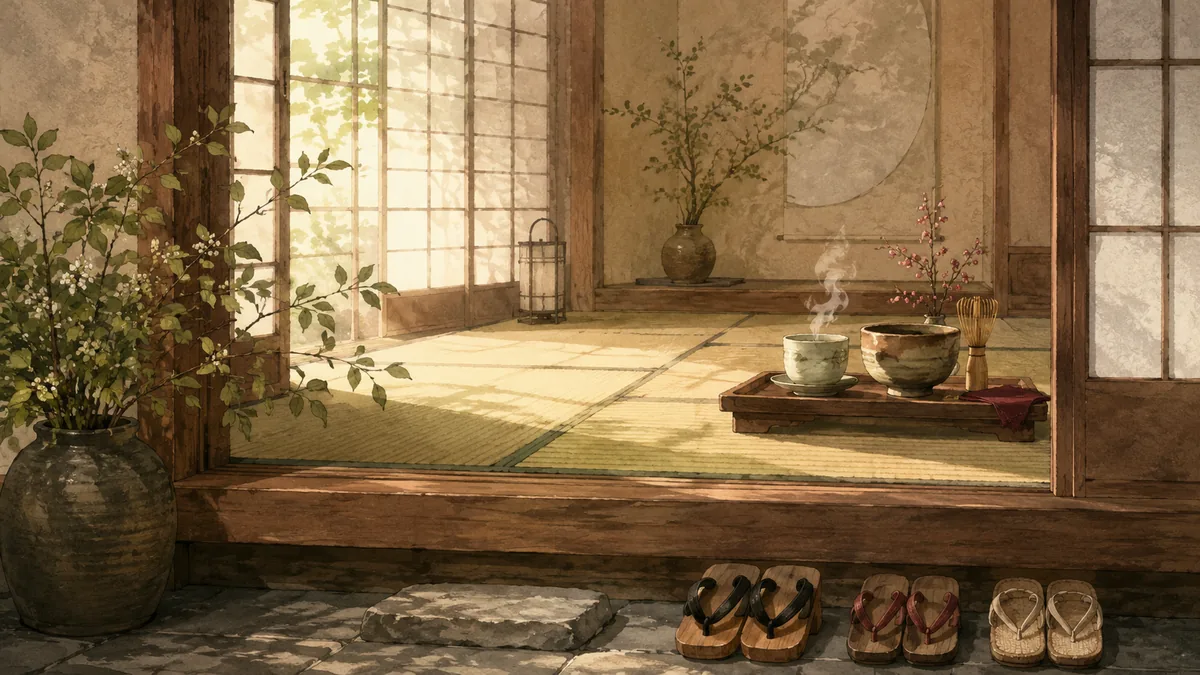
Why Ikebana Removes Instead of Adds — The Aesthetics of Subtraction
Gestures & Manners · 2026-06-08 · ~1,800 words
The first time most people encounter ikebana in person, they notice the same thing.
There's so little there.
Compared to a European bouquet overflowing with roses, or the lush altar arrangements common at Western weddings, ikebana can feel almost spare. A single camellia. Two bare branches. That's it — a complete work. You keep waiting for someone to add more, and no one ever does.
So why does it stay so minimal? And what does that restraint actually mean?
What Ikebana Actually Is
Ikebana — also called kadō, roughly "the way of flowers" — is a traditional Japanese practice of arranging flowers, branches, and leaves in a vessel, treating the surrounding space as part of the composition itself.
The word ikeru (to arrange, to insert) shares its root with the word for "to give life." That nuance matters: the goal isn't just to decorate a room with flowers. It's closer to finding the position where a single stem looks most alive — and then getting everything else out of the way.
In practice, that means cutting branches that compete for visual attention. Stripping leaves that crowd the line. What remains isn't a simplified version of a full arrangement — it's the arrangement. The empty air between stems is treated as a structural element, not as negative space waiting to be filled.
Where It Looks Distinctly Japanese
Place an ikebana piece next to a Western floral arrangement and a few differences become immediately apparent.
First, sheer volume. Ikebana pieces often work with three to five elements, sometimes fewer. The sparseness isn't accidental or budget-related — it's the point.
Second, line over mass. Western arrangements often build a dense, rounded form — you're meant to see the surface of flowers. Ikebana tends to foreground individual lines: the curve of a branch, the angle of a stem. The composition is built around those lines rather than around fullness.
Third, intentional void. Many schools of ikebana formally account for empty space as part of the structure. Some traditions use a triadic framework — ten, chi, jin (heaven, earth, human) — where three primary lines create a triangular composition with deliberate gaps between them. What sits in those gaps isn't nothing; it's part of the work.
The Thinking Behind It — Subtraction as Technique
I want to be careful here, because cultural explanations can slip into oversimplification fast. But there's a pattern worth noting.
Across several Japanese art forms, the act of removing tends to be treated as the more skilled move. Haiku compresses an entire moment into seventeen syllables and trusts the reader to feel the rest. Noh theater strips gesture to its minimum — a performer might stand nearly still for minutes, and that stillness carries more weight than motion. Ink wash painting (suiboku-ga) leaves vast sections of paper untouched, and that blankness isn't laziness; it's where the sky lives. The raked gravel of a dry garden, Japanese plating in a kaiseki meal, the calligraphic balance of brushwork against white paper — in each case, what's been held back does as much work as what's been put in.
Ikebana fits into that continuum. Reduce the number of stems and each remaining one becomes more visible. Widen the space around a branch and the relationship between elements sharpens. You're not simplifying — you're concentrating.
Some scholars trace this instinct to Zen Buddhism and the influence of tea ceremony aesthetics (wabi-sabi, the appreciation of impermanence and incompleteness). Those connections are plausible, but worth treating as one interpretation among several rather than a settled explanation. Ikebana's history spans centuries and many different schools, and not everyone in those traditions would frame what they do in those terms.
How It Persists in Everyday Life
You don't have to be a practitioner to see this sensibility operating in contemporary Japan. Once you're looking for it, it turns up in unexpected places.
The tokonoma — the decorative alcove in a traditional room — typically holds a single seasonal arrangement, not a vase crammed with flowers. Ryokan inns often greet guests with one careful stem in a small ceramic vessel on the check-in desk. Upscale restaurants frequently use restrained, almost architectural flower arrangements. There's an unspoken shared understanding that fewer, done well reads as more refined than more, done enthusiastically.
In home contexts, the single-stem vase (ichirin-zashi) has a quiet but persistent following, including among younger Japanese people. Search #一輪挿し or #ikebana on Instagram and you'll find thousands of people who've internalized this logic — one good branch, correct placement, done.
How It Reads From Outside
I've heard a version of the same reaction from people encountering ikebana for the first time, particularly those visiting Japan from places where flower abundance signals celebration and care.
The initial impression is often something like: it feels unfinished. There's an impulse to add more — another stem, a second color, something to balance what looks like emptiness.
Then, after sitting with it for a while, the logic shifts. You start to trace each line individually. You notice how a single bent branch creates tension with the vessel below it. You realize that adding one more element would, in fact, destroy exactly what makes it work. The arrangement has used restraint to train your eye.
That's probably the most honest way to describe what ikebana's subtraction achieves: it doesn't just create a sparse aesthetic. It engineers a specific quality of attention. You can't skim it the way you skim a dense arrangement. You have to actually look.
For people interested in experiencing this firsthand, many cultural centers in Kyoto and Tokyo offer single-session ikebana workshops in English. The major schools — Ikenobo, Sogetsu, Ohara — all have international branches, and Western floral designers have increasingly drawn on ikebana principles over the past few decades. It's genuinely cross-pollinating, not a one-way influence.
One Important Caveat: Schools Vary Enormously
I want to push back on any impression that "ikebana = minimal" is the whole picture, because it really isn't.
The traditions lumped under the ikebana label range from Ikenobo's classical, highly formalized arrangements to Sogetsu's avant-garde installations that sometimes incorporate industrial materials and fill an entire room. The philosophical approaches, the visual vocabularies, the scales — they're quite different from each other. Calling ikebana a single aesthetic would be like describing all of Western painting as "uses lots of color."
Moreover, not every Japanese occasion calls for the minimal approach. Wedding ceremonies, Buddhist funeral altars, Shinto offerings — many of these contexts traditionally call for full, voluminous, celebratory arrangements. The subtraction aesthetic is one mode, not the universal Japanese answer to flowers.
And a practical note: most Japanese people today don't practice ikebana. It's an elective school subject and an optional hobby, not a daily practice. The number of people who regularly arrange flowers at home in any tradition is, in my experience, a fairly small slice of the population — though plenty of people own a nice vase and occasionally put something in it.
What does seem broadly shared is the preference — a gut-level sense that one good stem is more elegant than a dozen mediocre ones. You don't need to study kadō for years to have absorbed that instinct. It shows up in how people arrange the objects on a shelf, how they plate food, how they think about what to leave out.
For me, this "subtract rather than add" instinct clearly isn't limited to flowers. It comes up constantly with food. Let the ingredient's own flavor speak: with something good, salt alone often beats a heavy sauce piled on top. Drawing out an ingredient's full potential is, sometimes, a matter of taking away. And finding beauty in empty space itself may be its own Japanese trait — in painting, in ikebana, in literature. You don't render everything; you deliberately leave room for interpretation. By not filling it, the viewer's imagination can move in. The blank isn't a lack. It's a place that invites you in.
Have you ever deliberately put just one thing in a vase when you could have put five? That's the same impulse, even if you didn't have a name for it.
Sources & References
- Ikenobo official resources and introductory publications on the history and philosophy of classical ikebana (池坊 公式資料)
- Sogetsu School public materials on contemporary ikebana practice and international programs (草月流 公式資料)
- Ohara School introductory documentation on moribana and natural landscape arrangements (小原流 公式資料)
- Personal reading of general introductions to kadō; interpretations of school philosophy and historical influence vary by source and tradition
The beauty of subtraction, by your own hand. With a vase and a kenzan, you can start ikebana today.
The Japanese Mind: Understanding Contemporary Japanese Culture
Chapters on aimai (ambiguity), amae, giri, wa and more — the values beneath the gestures and words. For readers who want to go deeper into the 'why.'
A Geek in Japan (Revised & Expanded)
A wide-angle introduction to the 'why' of Japanese culture — manga, anime, Zen, the tea ceremony and more. A natural companion to the topics Naze explores.
Share this article
Read Next
- Gestures & MannersPILLARWhat Is Omotenashi — And Why Does Japanese Hospitality Feel Different?Omotenashi is Japanese hospitality that anticipates what you need before you think to ask — and make…
- Gestures & MannersWhy Don't Japanese People Linger After Eating?Japanese diners tend to leave fairly soon after finishing, especially when it's busy. Here's the qui…
- Gestures & MannersWhy Do Japanese Restaurants Give Free Water and Oshibori?Sit down at almost any Japanese restaurant and cold water, tea, and an oshibori appear before you've…
- Gestures & MannersWhy Does Japan's School Year Start in April?Japan's school year opens in April because its fiscal year does — a calendar fixed in the Meiji era,…
- Gestures & MannersWhy Do Japanese Train Workers Point and Call? — The Science Behind Shisa KankoStation workers who point firmly at signals and call out their status aren't performing a ritual — t…
Related Articles
Articles in the same category: