Why Don't People Talk on the Phone on Japanese Trains?
Gestures & Manners · 2026-06-08 · ~1,400 words · ~4 min read
Contents (5)
- The Asymmetry: Screens Yes, Voices No
- How the Rule Developed
- Why Voice Is Different
- The Quiet as Pressure
- A Question for Visitors
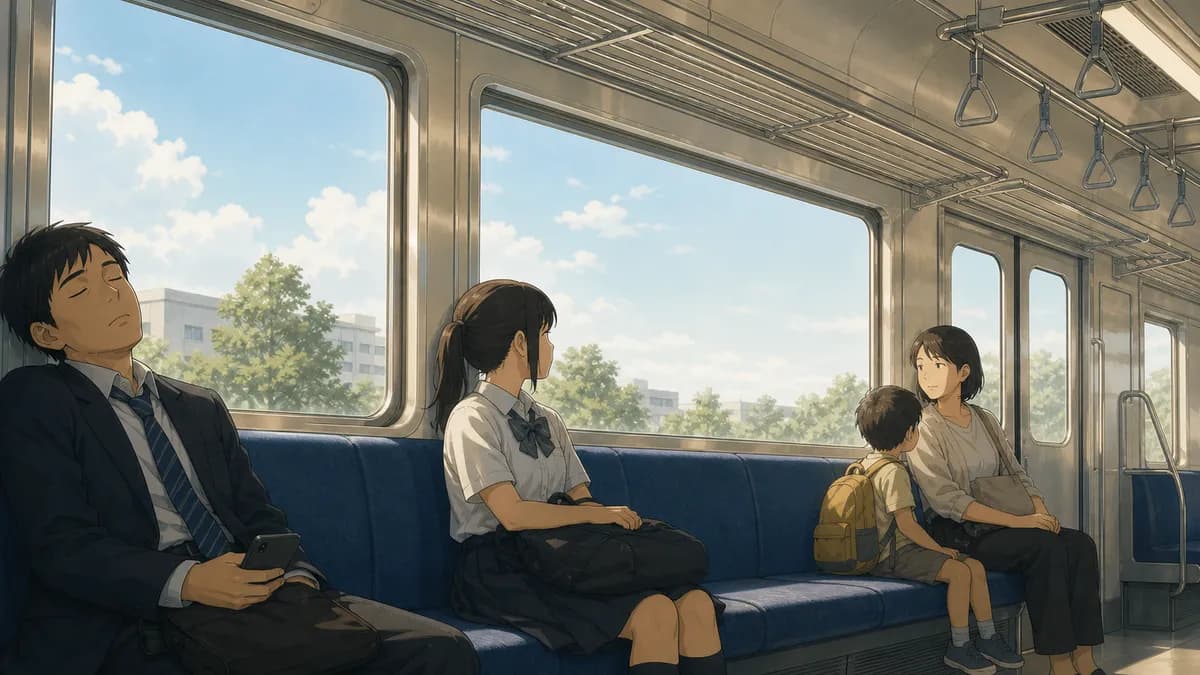
Board a Tokyo commuter train. The carriage is full. People are on their phones — reading, scrolling, playing games, watching shows. Headphones everywhere.
But if someone starts a phone call, something shifts. Stares. A subtle stiffening. Sometimes a gentle comment from a conductor if it continues. The call gets hushed or taken to the vestibule.
Voice is handled differently here.
The Asymmetry: Screens Yes, Voices No
This is the striking part for many visitors: it's not that phones are discouraged in general. It's specifically voice calls that are treated as a problem.
Texting your friend in real time: fine. Playing a game: fine. Watching a video (with headphones): fine. Calling your friend to say the same things: not fine.
The difference isn't about distraction or technology. It's about what a voice does in a shared, enclosed space that a screen doesn't do.
How the Rule Developed
The norm around phone calls on trains developed in the 1990s as mobile phones became common in Japan, according to japanetic.com. In 1997, NTT Docomo introduced "manner mode" — a vibrate-only setting — specifically for public spaces. Within a few years it became a standard feature on all Japanese phones.
The original official concerns were partly about pacemaker interference — rail operators posted notices asking passengers to turn off phones near priority seating. This led to widespread associations between mobile phones and train rules. Over time, Osaka Metro and many Kansai rail operators updated the guidance around 2012: the "power off" requirement was replaced with "use manner mode, don't make calls," reflecting improved technology and reduced interference risk.
What remained, and hardened, was the social norm against voice calls. That norm had developed alongside the official guidance and outlasted its original justification.
If anything, I suspect the order runs the other way around: the announcements didn't create the instinct. The instinct — this space belongs to everyone, so don't intrude on the people sharing it — was already soaked in, and the official guidance simply wrote down what most passengers were doing anyway.
Why Voice Is Different
Here's how I'd describe the logic behind the asymmetry:
A screen is private. What you see on your phone belongs to your visual field. Other passengers may glance at it, but they're intruding — it doesn't reach out toward them uninvited.
A voice is different. It moves through shared air. It enters other people's ears without their consent. And a phone call is particularly hard to tune out because it's one-sided: you hear half a conversation, which is harder to ignore than silence or music precisely because it implies meaning that you can't quite resolve.
This is related to the broader Japanese social value of not causing meiwaku — not imposing your private life on others in a shared space. Screens stay private; voices don't. The train carriage is a space where many people are temporarily sharing close quarters, and voices are the one thing that crosses those invisible boundaries without asking.
You understand all of this fastest when it happens to you. Your own phone — the one you forgot to switch to manner mode — rings in a quiet carriage. Cold sweat. You fumble for your pocket in a hurry. Nobody scolds you; simply being there is awkward enough. And those few seconds feel exactly like a phone going off in a theater or a cinema. That's the closest description I have: a Japanese train carriage works like a moving auditorium — a space where everyone is sharing one quiet — and even when it's your machine that broke it, your body apologizes first.
There's one scene that, to me, captures how deep this runs. When you miss a call because you were on a train and then ring back — or the other person rings back — it's surprisingly common for both of you to open with "sumimasen." Which, if you think about it, is strange. The caller had no way of knowing you were on a train. And yet, for the fact that a call landed somewhere you weren't supposed to answer, even the caller apologizes. Nobody did anything wrong, and both sides pre-emptively offer a small apology anyway. The etiquette of the voiceless carriage quietly reaches all the way to the other end of the line.
The Quiet as Pressure
It's worth being honest about the other side.
For some visitors — and for some Japanese people — the silence on trains can feel oppressive. There are situations where a normal speaking voice draws looks. The social enforcement isn't neutral: it creates an environment where people self-censor in ways that go beyond phone calls.
And the mechanism by which the norm is enforced — collective staring, ambient disapproval — is itself a form of pressure. The quiet is maintained not just by internal conviction but by the possibility of social sanction. That's a legitimate thing to note alongside the genuine comfort the quiet creates for many.
Sleeping on Japanese trains is possible partly because of this quiet — the absence of unpredictable noise makes the carriage feel safe enough for unconsciousness. The quiet isn't neutral; it's maintained, at cost.
One honest addition from the inside, though: I don't think many passengers experience this quiet as unpleasant. For most people it's closer to the opposite — the silent carriage is one of the more restful rooms of the day. The pressure is real and worth naming. So is the fact that, for the majority, the quiet is a shared comfort before it is an endurance.
A Question for Visitors
If you're traveling in Japan and need to take a call, the standard approach is to step off the train or move to a vestibule between cars. Brief calls to confirm meeting points happen and aren't always treated harshly — the intensity of the norm varies by context, train type, and time of day.
But if you want to understand why the norm exists in its current form: voice is the one thing on a train that can't be made private. And in a culture that has developed detailed practices around not crossing into other people's space uninvited, that's enough.
Sources & References
- japanetic.com, "Japanese Train Etiquette: Why Phone Calls Are Strictly Taboo" — norm development and enforcement
- Osaka Metro, "Mobile phone manners will be changed" — official policy update (primary source)
- JRailPass, "Japan Train Etiquette" — practical visitor guidance
The Japanese Mind: Understanding Contemporary Japanese Culture
Chapters on aimai (ambiguity), amae, giri, wa and more — the values beneath the gestures and words. For readers who want to go deeper into the 'why.'
A Geek in Japan (Revised & Expanded)
A wide-angle introduction to the 'why' of Japanese culture — manga, anime, Zen, the tea ceremony and more. A natural companion to the topics Naze explores.
Share this article
Read Next
- Gestures & MannersPILLARWhat Is Omotenashi — And Why Does Japanese Hospitality Feel Different?Omotenashi is Japanese hospitality that anticipates what you need before you think to ask — and make…
- Gestures & MannersWhy Don't Japanese People Linger After Eating?Japanese diners tend to leave fairly soon after finishing, especially when it's busy. Here's the qui…
- Gestures & MannersWhy Do Japanese Restaurants Give Free Water and Oshibori?Sit down at almost any Japanese restaurant and cold water, tea, and an oshibori appear before you've…
- Gestures & MannersWhy Does Japan's School Year Start in April?Japan's school year opens in April because its fiscal year does — a calendar fixed in the Meiji era,…
- Gestures & MannersWhy Do Japanese Train Workers Point and Call? — The Science Behind Shisa KankoStation workers who point firmly at signals and call out their status aren't performing a ritual — t…
Related Articles
Articles in the same category:
- Why Do Japanese People Watch Until You're Out of Sight? — The Farewell That Doesn't End
- Why Japanese Gardens Leave So Much Empty — The Aesthetics of Ma and Mitate
- Why Is Japanese Gift Wrapping So Elaborate? — The Greeting Before the Gift
- Why Bonsai Takes a Lifetime — Japan's Culture of Tending What Never Quite Finishes