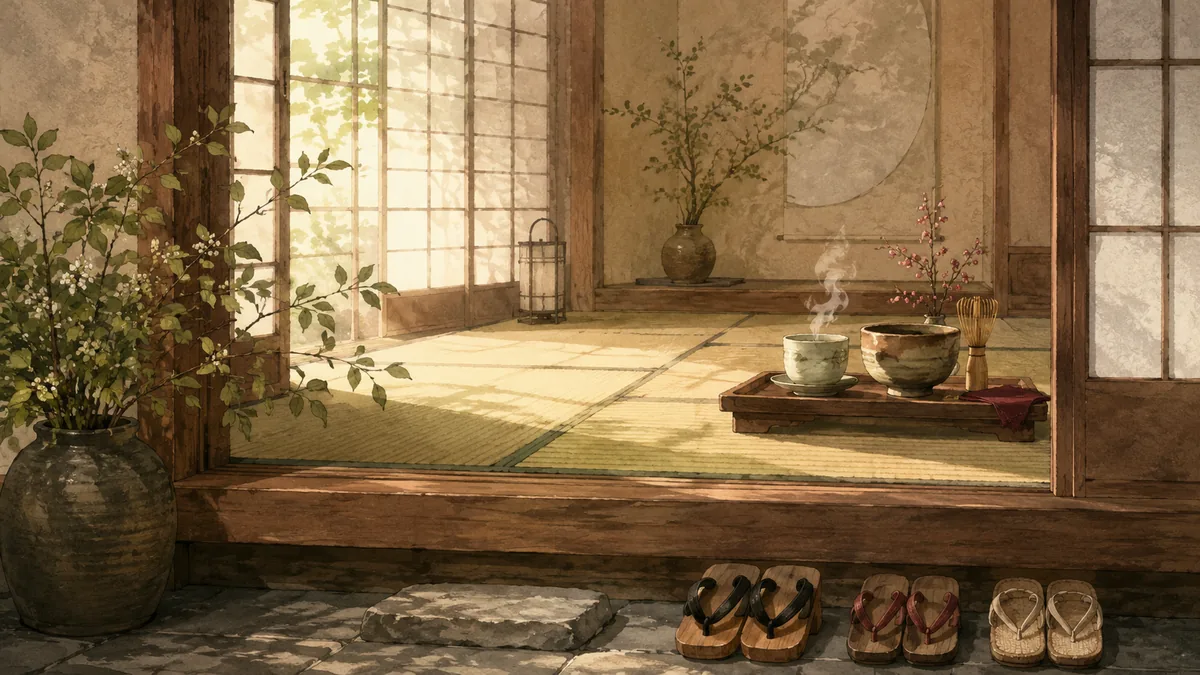
Why Japanese Culture Values Ongoing Care Over Finished Products — A Different Idea of 'Done'
Gestures & Manners · 2026-06-08 · ~1,900 words
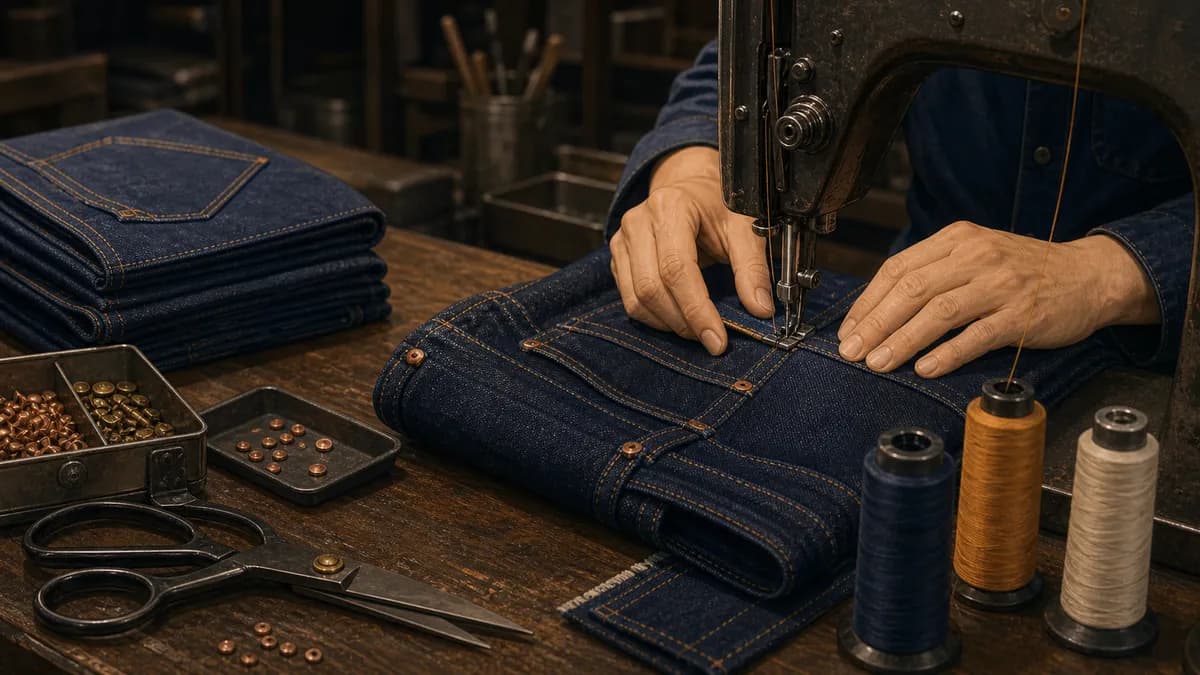
In a small lacquerware shop in Kyoto, the owner said something I haven't been able to shake.
"This bowl is designed to be finished in fifty years."
I had to ask him to say it again. He meant it literally: the bowl leaves the workshop looking beautiful, but it isn't done. Each use deepens the lacquer. A small chip gets repaired, another coat applied. The sheen develops slowly, over decades, shaped by the hands that hold it. The finished object and the person living with it grow into each other. That process — all of it — is the bowl.
I've been turning that idea over ever since, because it cuts against how most of us think about making something. You build it, you finish it, you move on. In many corners of Japanese craft and design culture, that sequence doesn't quite apply.
What 'Maintenance Over Completion' Actually Looks Like
This isn't a single philosophy with a name and a founding text. It's more of a pattern that shows up in scattered, unrelated places — and once you start noticing it, it's hard to stop.
Bonsai trees are tended for decades, sometimes across multiple generations. A specimen that's a hundred years old isn't finished; it's mid-conversation. Tea ceremony utensils — bowls, whisks, caddies — are used, repaired, re-used, and often sent back to their makers for restoration. Temple gardens are raked and trimmed every morning, not because they fell into disrepair overnight, but because the tending itself is the point. Traditional wooden architecture is repaired beam by beam, roof tile by roof tile, sometimes across centuries.
For me, the place this idea shows up most beautifully is kintsugi — repairing broken pottery with lacquer and gold. You don't simply restore the piece to how it was. By rejoining it, you bring it back as something with more character, more beauty, than it had before it broke. Rather than hiding the damage, you take the whole history of having been broken and turn it into a new landscape on the object. Giving something everyone had written off as finished a value greater than it ever had — that idea itself might be the most Japanese thing in all of this.
And then there's the Ise Grand Shrine.
Every twenty years, the shrine's main buildings are completely reconstructed — same layout, same ancient materials, same carpentry methods — on an adjacent plot. The old structure is then carefully dismantled. This cycle has continued for over a thousand years. The buildings are always new. The tradition never stops. It's a strange, deliberate paradox: the shrine is perpetually fresh and perpetually ancient at the same time.
These examples don't all come from the same root. Scholars trace threads back to Buddhist ideas of impermanence, Shinto emphases on ritual renewal and purity, the cyclical rhythms of agricultural society, and the apprenticeship structures of craft guilds. There's no single origin story. But the pattern keeps appearing.
The Relationship Between Maker and Owner
One thing that strikes many people encountering traditional Japanese crafts for the first time is that the transaction doesn't end at the point of sale.
In many craft traditions — lacquerware, swords, ceramics, textiles — the expectation is that an owner will return to the maker, or to a specialist, for ongoing care. Lacquer bowls get re-coated. Sword blades get re-polished. Kimono get re-tailored as they age or as fashions shift. High-quality knives go back to a sharpener who knows that specific steel.
This creates a long relationship between objects, owners, and craftspeople that's fairly different from the standard model of retail: object leaves shop, relationship ends. In these contexts, buying something is more like entering an ongoing arrangement.
For people used to treating most purchases as disposable, this can feel almost alien — or, depending on your temperament, deeply appealing. I've spoken with woodworkers, potters, and textile artists outside Japan who've looked at this model with frank envy. "We make things that are designed to last," one told me, "but we have no infrastructure for what happens after someone takes it home."
The Aesthetic of the Unfinished
There's also something happening at the level of aesthetics that's worth slowing down for.
In Japanese craft and design, incompleteness is often treated not as a flaw but as an invitation. The deliberate asymmetry of a tea bowl. The empty space in a hanging scroll painting. The way a bonsai's current shape is understood as one frame in a longer film. These aren't accidents or affectations — they're related to the idea that a thing which is still changing, still being tended, is more alive than something frozen in its final form.
Kintsugi — the practice of repairing broken ceramics with gold-dusted lacquer — has become well-known outside Japan in recent years, sometimes to the point of oversimplification. But the underlying idea is real: a break in an object's history doesn't diminish it. The repair becomes part of the object's story, sometimes the most interesting part.
There's a quiet critique of the "museum piece" logic embedded in all of this. Something behind glass, perfectly preserved, unchanging — is that really the fullest way for an object to exist? Many traditional craft practitioners in Japan would, I think, say no.
Where This Still Shows Up in Daily Life
If you spend time in Japanese cities — not just in heritage districts or craft markets, but in ordinary neighborhoods — you'll notice things that don't exist in quite the same density elsewhere.
Knife-sharpening services, sometimes mobile, sometimes tucked into a corner of a covered shopping arcade. Umbrella repair. Futon re-stuffing. Shoe repair. Furniture re-upholstering. Leather conditioning. These aren't rare boutiques catering to the wealthy; they're ordinary small businesses embedded in the fabric of everyday commerce.
They're declining — let's be honest about that. The economics are hard, younger generations aren't always taking over, and the culture of repair faces the same global headwinds everywhere. But compared to many Western cities where this kind of infrastructure has largely disappeared, the density of repair culture in Japan is still striking.
Among craft enthusiasts internationally, there's been growing interest in what sometimes gets called Japanese "repair culture" or "slow craft" — not just kintsugi, but the broader ecosystem of people who make their living maintaining things rather than replacing them. Whether that international interest translates into anything that sustains these trades domestically is a genuinely open question.
What Visitors Often Notice
People who travel to Japan for the first time, and who come back trying to articulate what felt different, often land on something like: "It's the most modern place I've ever been, and also the most ancient, at the same time."
That's not just a tourism-brochure contrast for effect. The Ise Shrine rebuilding cycle sits alongside a consumer electronics industry that releases annual hardware updates. A centuries-old wooden temple gets its roof replaced by craftspeople using techniques passed down across generations, while a few kilometers away a shopping mall sells fast fashion with a six-week runway from design to shelf.
These aren't contradictions that Japan has resolved — they coexist, sometimes uneasily. But the fact that both are present in the same culture is worth sitting with.
A Necessary Complication: The New-Build Preference
I want to be careful not to leave you with an incomplete picture, because it would be easy — and wrong — to read everything above and conclude that Japan has some unified, coherent relationship with longevity and care.
It doesn't.
Japan's residential housing market is, by international standards, strongly oriented toward new construction. The rate of existing home sales as a proportion of total housing transactions is significantly lower than in the United States or most of Western Europe. A house that's twenty or thirty years old is often considered functionally depreciated in ways that would seem dramatic to someone from, say, Germany or the UK, where older homes frequently command premiums.
Consumer electronics follow a similar logic. When a device breaks, replacing it is often the default choice — not repairing it. The volume of single-use packaging, disposable goods, and discarded appliances tells a story that sits in real tension with the craft-care ethos described above.
So what's actually going on? My honest read is that Japan contains two distinct cultures of objects that don't map neatly onto each other. In the domain of traditional crafts, tools, textiles, and certain sacred architecture, the maintenance-first logic runs deep and is taken seriously. In the domain of housing, mass-market goods, and everyday electronics, the new-is-better logic operates at full strength.
To say "Japan values maintenance over completion" captures something real about one part of the culture. To imply that this applies universally would be to miss something equally real.
What Stays With Me
The lacquerware shop owner in Kyoto probably didn't intend to reframe how I think about making things. He was just answering a question about why his bowls are priced the way they are.
But the image has stayed with me: an object that takes a human lifetime to reach its fullest form, that requires ongoing attention from both maker and user, that doesn't have a moment of completion so much as a continuous unfolding.
That's a different relationship with time than most of us maintain with the things we own. Whether it's something to admire from a distance, or something to actually build into how you live — that's a question I'm still working out.
What's something you've owned for years, kept repairing, and would genuinely not want to replace?
Sources & References
- Agency for Cultural Affairs (文化庁), public materials on intangible cultural heritage and traditional craft preservation in Japan
- Jingu Shicho (伊勢神宮), publicly available documentation on the Shikinen Sengu cycle and its architectural traditions
- General reference works on Japanese aesthetics including writings on wabi-sabi, mono no aware, and craft philosophy; interpretations here are the author's own and remain open to scholarly debate
- Housing market comparison data from Japan's Ministry of Land, Infrastructure, Transport and Tourism (国土交通省) and international housing research, as cited in general economic reporting
The Japanese Mind: Understanding Contemporary Japanese Culture
Chapters on aimai (ambiguity), amae, giri, wa and more — the values beneath the gestures and words. For readers who want to go deeper into the 'why.'
A Geek in Japan (Revised & Expanded)
A wide-angle introduction to the 'why' of Japanese culture — manga, anime, Zen, the tea ceremony and more. A natural companion to the topics Naze explores.
Share this article
Read Next
- Gestures & MannersPILLARWhat Is Omotenashi — And Why Does Japanese Hospitality Feel Different?Omotenashi is Japanese hospitality that anticipates what you need before you think to ask — and make…
- Gestures & MannersWhy Don't Japanese People Linger After Eating?Japanese diners tend to leave fairly soon after finishing, especially when it's busy. Here's the qui…
- Gestures & MannersWhy Do Japanese Restaurants Give Free Water and Oshibori?Sit down at almost any Japanese restaurant and cold water, tea, and an oshibori appear before you've…
- Gestures & MannersWhy Does Japan's School Year Start in April?Japan's school year opens in April because its fiscal year does — a calendar fixed in the Meiji era,…
- Gestures & MannersWhy Do Japanese Train Workers Point and Call? — The Science Behind Shisa KankoStation workers who point firmly at signals and call out their status aren't performing a ritual — t…
Related Articles
Articles in the same category: