Why Japan Doesn't Try to Conquer Nature — Coexistence as a Cultural Default
Gestures & Manners · 2026-06-08 · ~1,900 words
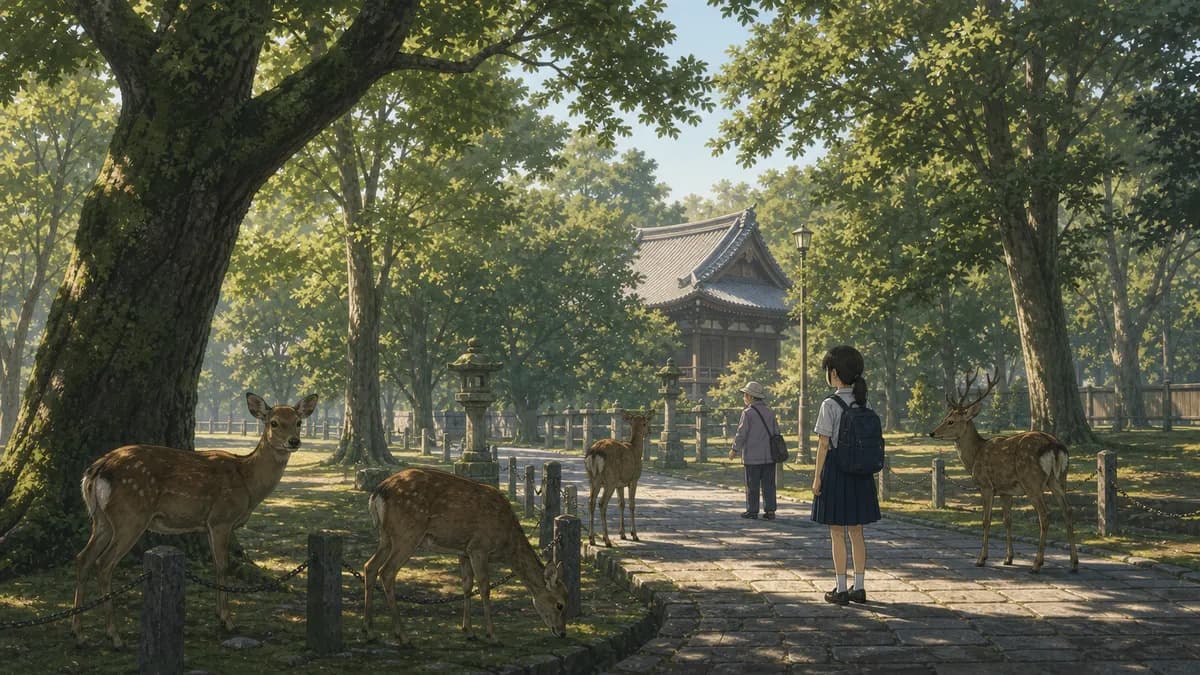
In English, we talk about "conquering" nature fairly casually — conquering a mountain, beating the elements, taming the wild. In Japanese, that framing is noticeably rarer. The phrases you hear more often translate closer to "living alongside nature," "leaning into nature," or "weaving nature in." Nature isn't typically cast as the adversary. It's more like the setting you've always been part of.
I've been thinking about why that difference exists, and whether it's as deep as it looks — or partly a flattering story Japan tells about itself.
Nature as Presence, Not Problem
One of the first things many people notice when they start engaging with Japanese aesthetics is how often nature isn't just background. It's the point.
Traditional garden design doesn't impose a geometric grid over the land — it works with existing stone, water, and slope to create something that reads as natural even when it's entirely deliberate. Ikebana, the art of flower arrangement, isn't about filling a vase prettily; it's about capturing a moment of growth or season in three dimensions. Bonsai keeps a tree alive in miniature for decades, sometimes centuries, through constant attentive care — not domination, exactly, but an intimate, ongoing negotiation.
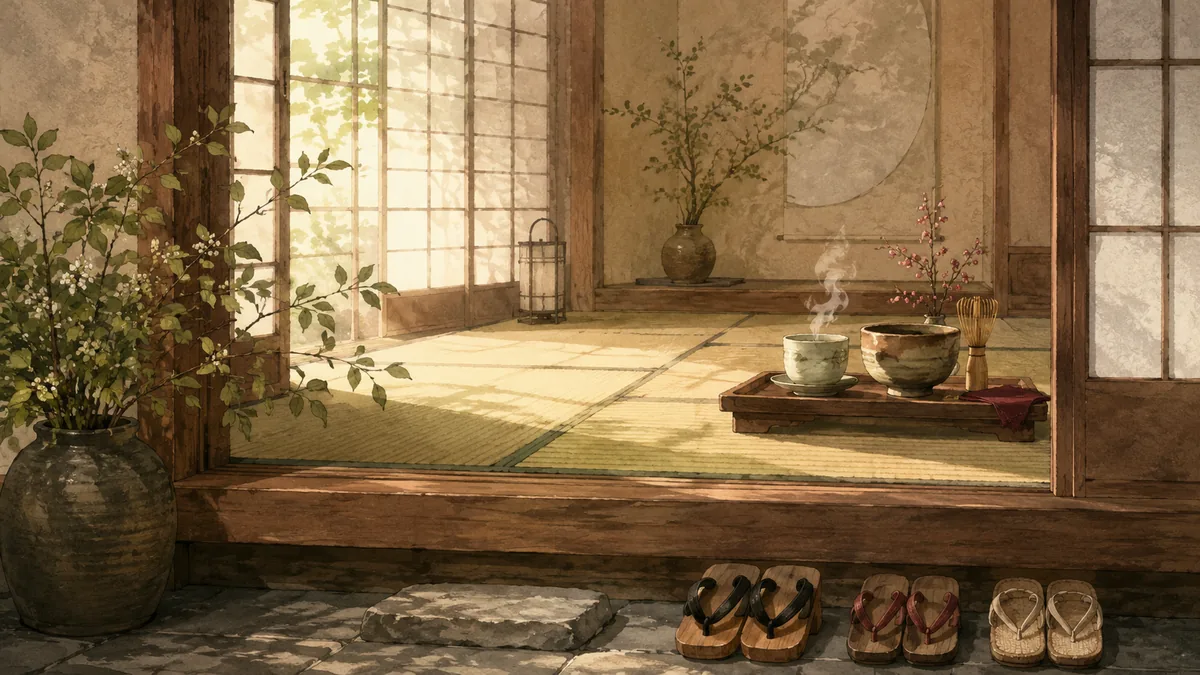
These aren't fringe traditions. They show up in ordinary life: the small potted plant outside an apartment door, the single seasonal branch in a restaurant alcove, the way a bowl of food is arranged to suggest the season it came from. Nature gets woven into daily life at a granularity that can seem almost fussy to outside eyes, but feels, from the inside, more like keeping something important in view.
The Shinto Background: Eight Million Gods
A useful starting point for understanding the cultural logic here is Shinto — not as a religion most people actively practice in a formal sense, but as a set of background assumptions about what the world is made of.
The concept of yaoyorozu no kami — often translated as "eight million gods" though the number really means something closer to "uncountably many" — holds that gods or spiritual presences (kami) inhabit natural features and objects: mountains, rivers, particular trees, rocks, even tools that have been used long enough. The number isn't literal. It's a way of saying the divine isn't concentrated in one place or one figure but dispersed through the world, including the non-human world.
This is quite different from a worldview in which nature is something a single creator god made for human use and stewardship. When divinity is understood to reside in a river or a forest rather than above it, treating that river as merely a resource to be managed becomes harder to fully justify — at least philosophically. Whether it actually stops people from damming rivers is another matter (more on that later).
I want to be careful here not to reduce this to "Japan is Shinto, therefore Japanese people love nature." The picture is far more layered — Buddhism, Confucianism, Taoism, and the enormous disruptions of Meiji modernization and postwar industrialization all reshaped how people actually relate to the natural world. But Shinto does seem to provide a persistent cultural grammar, a way of framing natural things as worthy of acknowledgment, even reverence.
Satoyama: The Middle Landscape
If Shinto represents a philosophical orientation, satoyama represents something more practical — and in some ways more interesting.
The word literally means something like "village mountain" and refers to the managed woodland and farmland on the edges of traditional settlements. Not wilderness, not developed land, but a middle zone maintained over generations through regular human intervention: harvesting timber and firewood, gathering wild vegetables and mushrooms, managing undergrowth, maintaining terraced rice paddies on sloped land.
Satoyama isn't a pristine natural space. It's deeply shaped by human activity. But that activity is paced and scaled so the landscape can keep producing — not mined for short-term gain, but tended like a long-term relationship. Some of these landscapes have been continuously maintained for several hundred years.
The ecological value of satoyama has been increasingly recognized internationally, partly because this kind of human-managed transitional habitat often supports biodiversity that both full wilderness and agricultural monoculture tend to lack. The UN Environment Programme has highlighted satoyama as a model for sustainable landscape management, under the banner of "Socio-ecological Production Landscapes and Seascapes" (SEPLS).
For me, satoyama is the most honest version of what "coexistence with nature" might actually look like in practice: not an absence of human touch, but a particular quality of human touch — attentive, consistent, calibrated to what the land can sustain.
Seasons as Infrastructure
Another place this shows up is in the Japanese relationship with seasons — which goes well beyond weather.
The traditional calendar was divided into 72 micro-seasons (shichijūni kō), each about five days long, tracking specific natural events: when the first frogs begin calling, when cherry blossoms peak, when the bush warbler starts to sing. This is a level of attentiveness to natural rhythm that modern life has mostly abandoned, but traces of it persist in how culture is organized.
Wagashi (traditional sweets) change shape and flavor by season. Kaiseki cuisine builds menus around what's at peak. Kigo — seasonal reference words — are required in haiku. Festivals follow agricultural and celestial rhythms rather than purely administrative calendars. Even the aesthetic concept of mono no aware — often translated as a gentle sadness at impermanence — is inseparable from the experience of watching cherry blossoms fall, or autumn leaves turn, or summer end.
The effect is that seasons aren't something to get through or protect yourself from. They're a rhythm you're expected to notice, to mark, to find meaning in. Nature isn't backdrop; it's the organizing structure of the year.
How It Looks From Outside
Many visitors to Japan — especially those coming from heavily developed urban environments — comment on how much green exists inside Japanese cities. Tokyo is a global megacity of nearly fourteen million people, yet it contains Meiji Jingu's forested shrine grounds, the green belt around the Imperial Palace, countless neighborhood shrines tucked between buildings, and old trees that have survived decades of redevelopment because no one wanted to cut them down.
This isn't purely aesthetic. Shrine forests (chinju no mori) have historically served as protected green corridors within urban areas — not by urban planning mandate but because removing them felt, to many residents, like removing something that had a right to be there.
Words like satoyama, wabi-sabi, and Shinto increasingly appear in international ecological and sustainability writing without translation, treated as concepts that don't have clean equivalents elsewhere. I find this interesting partly because it signals a genuine gap — and partly because it risks turning a complex, internally contradictory cultural history into a tidy export.
The Part That Gets Left Out
This is the section I think matters most, and the one that's easiest to skip if you're writing a piece about Japanese aesthetics for an admiring foreign audience.
Japan's postwar economic miracle was built, in significant part, on the kind of industrial development that is not gentle with nature. The Minamata disaster — in which a chemical company's mercury discharge poisoned an entire coastal community through contaminated fish, causing severe neurological damage across generations — is one of the most documented industrial pollution catastrophes of the twentieth century. Yokkaichi asthma, Itai-itai disease, the systematic concrete-lining of rivers and coastlines, large-scale deforestation: these happened in the same country, often within the same decades, that was also exporting the image of a culture deeply in tune with nature.
Today, Japan's per-capita plastic consumption is among the highest in the developed world. Its energy mix remains heavily dependent on fossil fuels. Biodiversity loss is an ongoing concern in both marine and terrestrial environments. The gap between the cultural ideal and the material reality is substantial.
I don't think this invalidates the cultural tendency — the aesthetic orientations, the philosophical frameworks, the Shinto grammar of attention toward natural things. But it does mean that "Japan is a culture that lives in harmony with nature" is, at best, half the story. The more honest version is that Japan contains both a deep cultural vocabulary for coexistence and a modern industrial history that has often ignored it. Both are real. They exist in the same country, sometimes in the same person.
The interesting question isn't which one is the "real" Japan. It's how a society holds that contradiction — and whether the cultural vocabulary for coexistence can be part of how it finds its way through what comes next.
What Stays
Despite everything, some of the older relational habits with nature seem genuinely persistent in everyday Japanese life, not just as museum pieces.
The national attention to cherry blossom forecasts (sakura zensen) — tracked on the news like a weather front moving northward across the archipelago each spring — draws millions of people outside not to photograph something exotic but to mark something they feel is part of their year. The autumn leaf-viewing season (koyo) operates similarly. First sunrise of the new year (hatsuhinode) is still widely observed. The summer festival calendar is still organized around water, ancestors, and the turning of seasons.
These aren't tourist events, primarily. They're things many ordinary people actually do, in a context where pausing to notice the natural world still has social legibility — where saying "the plum blossoms came early this year" is a normal thing to say to a stranger.
That quality of attention — of treating the non-human world as worth noticing, worth marking, worth being present for — may be the most durable inheritance of the cultural frameworks I've been describing. Not conquest, not romanticism, but a sustained practice of paying attention.
For me, the real weight of this stance hit home with the 2011 earthquake and tsunami. In the face of nature at that scale, you're confronted with how genuinely powerless people are — seawalls, preparations, worst-case projections, all overrun in an instant. And yet. Across Japan, the disasters that struck a given place long ago are often preserved — in oral lore, in place names, in stone markers. There are old stones carved by earlier generations reading do not build your house below this point, and evacuation routes handed down by word of mouth. I think all we can really do is coexist with nature by inheriting, rather than ignoring, the hard-won wisdom those people left with their own bodies. To deflect isn't to win and isn't to give up. It's probably this: passing each generation's way of riding it out, unforgotten, to the next.
Where did you last feel like you were alongside nature, rather than just passing through it?
Sources & References
- Ministry of the Environment (Japan), satoyama initiative documentation and biodiversity policy materials
- United Nations University Institute for the Advanced Study of Sustainability, "Socio-ecological Production Landscapes and Seascapes (SEPLS)" framework materials
- Ainu and Shinto natural theology overviews via the Association of Shinto Shrines (Jinja Honcho) public materials
- General reference: Azby Brown, Just Enough: Lessons in Living Green from Traditional Japan (Kodansha, 2009)
- General reference: David Suzuki & Keibo Oiwa, The Japan We Never Knew (1996) for counterpoint on Japan's environmental record
- Personal synthesis; historical and philosophical interpretations vary among scholars
The Japanese Mind: Understanding Contemporary Japanese Culture
Chapters on aimai (ambiguity), amae, giri, wa and more — the values beneath the gestures and words. For readers who want to go deeper into the 'why.'
A Geek in Japan (Revised & Expanded)
A wide-angle introduction to the 'why' of Japanese culture — manga, anime, Zen, the tea ceremony and more. A natural companion to the topics Naze explores.
Share this article
Read Next
- Gestures & MannersPILLARWhat Is Omotenashi — And Why Does Japanese Hospitality Feel Different?Omotenashi is Japanese hospitality that anticipates what you need before you think to ask — and make…
- Gestures & MannersWhy Don't Japanese People Linger After Eating?Japanese diners tend to leave fairly soon after finishing, especially when it's busy. Here's the qui…
- Gestures & MannersWhy Do Japanese Restaurants Give Free Water and Oshibori?Sit down at almost any Japanese restaurant and cold water, tea, and an oshibori appear before you've…
- Gestures & MannersWhy Does Japan's School Year Start in April?Japan's school year opens in April because its fiscal year does — a calendar fixed in the Meiji era,…
- Gestures & MannersWhy Do Japanese Train Workers Point and Call? — The Science Behind Shisa KankoStation workers who point firmly at signals and call out their status aren't performing a ritual — t…
Related Articles
Articles in the same category: