Why Do Falling Cherry Blossoms Feel More Beautiful Than Full Bloom?
Seasons & Nature · 2026-06-16 · ~1,900 words · ~6 min read
Contents (7)
- Full Bloom vs. the Fall
- The One-Week Window
- One Way to See It
- Falling Isn't Vanishing
- The Other Side
- Where to Feel It
- A Question I Can't Answer
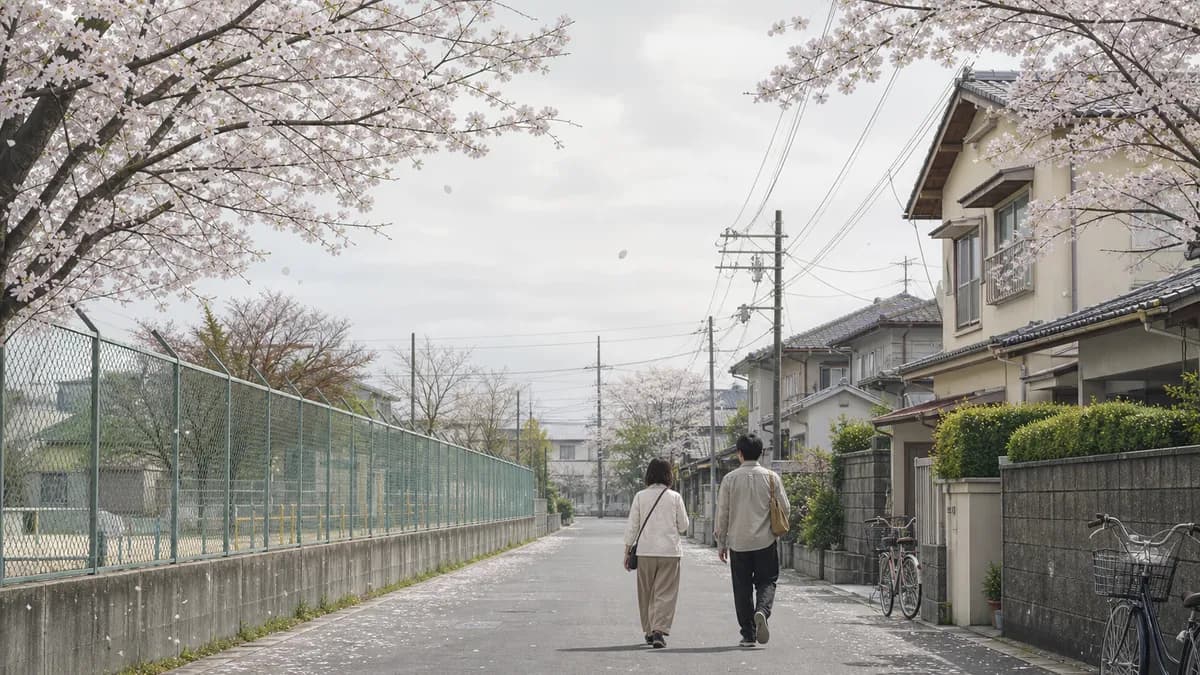
On the morning the peak-bloom forecast finally arrives, everyone looks up at the trees. A few days later, when the wind picks up and the petals begin to lift — the sidewalks go pink, a petal lands on a stranger's shoulder, your coffee cup catches one — something shifts. Most people stop again. And somehow this moment feels more beautiful than the first.
That's a strange thing to notice. Full bloom is the goal everyone was chasing. Why would the ending outshine it?
Full Bloom vs. the Fall
Here's the most direct answer I can offer: full bloom shows you the sakura. Falling petals remind you it won't last.
The tree at peak — mankai (満開) — is objectively spectacular. Every branch loaded, the color uniform and complete. You'd think that's the height of it.
But the petals falling are doing something full bloom can't: they're carrying the end inside themselves. Each one has already made its decision. That's the detail that catches — not the beauty of the tree alone, but the beauty of the tree releasing.
I'd put it this way: full bloom is the fact; the fall is the feeling.
The One-Week Window
If you've been in Japan in late March or early April — or if you've watched any anime set in spring — you know this rhythm. The cherry-blossom front (sakura zensen, 桜前線) moves north across the country tracked by the Japan Meteorological Corporation's bloom forecasts the way a sports broadcast tracks a score. Hanami parties get booked weeks in advance. There's real planning, real anticipation.
Then it opens. And within roughly a week — often less if rain or wind comes early — it's over.
That window is part of the feeling. You can't stagger your appreciation across a month. You're in it, briefly, and then it's gone. Japanese people tend to describe this quality as hakanai (はかない) — fleeting, transient — but the word carries something English equivalents don't quite hold. It's not pure sadness. It's closer to a fondness because you know it won't stay. The grief and the warmth arrive together, without resolving into either one.
If you're learning Japanese, you've probably already met this word — maybe in a lyric, a novel, or a line of dialogue. If you first encountered sakura through anime, you've almost certainly seen the scene: petals falling in slow motion past a character's face, marking a transition — a graduation, a departure, something ending quietly. That's not just dramatic license. It reaches back to a real, lived feeling that most people in Japan recognize without needing to name it.
What strikes me personally is that the event of hanami is itself continuous with this hakanai feeling. Thinking back, a hanami gathering held every kind of person at once: families and relatives, groups of students, coworkers stopping by after work, couples — people who normally never cross paths, all mixed together under the same tree, each spending their own spring. And every year, it repeats. For many Japanese people, sakura may be one of the big markers by which you feel, in your body, that another year has passed. Maybe the falling petals stand out so sharply precisely because they hand you that annual turning point in a form you can see.
One Way to See It
There's a concept in Japanese aesthetics — mono no aware (物の哀れ) — that scholars often translate as "the pathos of things" or "the bittersweet awareness of impermanence." It's associated with the literary scholar Motoori Norinaga, who developed the idea in the 18th century while writing about classical literature. The concept doesn't originate with sakura, but sakura became one of its clearest illustrations: beauty made sharper by the knowledge that it's already ending.
Here's how I see it — and I want to be upfront that this is one reading, not a verdict:
The falling petals might feel more beautiful than full bloom because they force a kind of present-tense attention that perfection doesn't. When something is at its absolute peak, you can tell yourself you'll look properly later. When it's falling, you can't. The impermanence isn't a flaw in the experience — it may be what generates the experience in the first place.
I won't claim that's the reason. I doubt there's a single one. But personally, I think the falling petal is beautiful in the way a last conversation is sometimes more vivid than a whole ordinary year together. Not because endings are better — but because they arrive with a particular quality of attention you can't manufacture any other way.
There are many views on this, of course. Some thinkers frame it through Buddhist ideas about impermanence and non-attachment; others locate it in the agrarian calendar, where sakura bloom historically aligned with rice-planting season, marking renewal as much as ending. Both angles carry real weight. I find myself drawn to the simpler, more observational explanation — but I hold that loosely.
Falling Isn't Vanishing
There's a current that runs quietly through a lot of Japanese life: the sense that when something ends, it hasn't simply been erased. The cherry tree will bloom again next year, on the same branch. That old way of receiving the world — that a kind of presence dwells in things, in paddy water, in an aged tree, in a roadside stone, the sensibility long called yaoyorozu no kami (八百万の神), the "eight million gods" — rests on a quiet premise: that a life doesn't stop so much as change form and come around again.
When the falling petals catch at something in you, it's probably because you're watching an ending. But maybe the reason that gaze doesn't freeze into pure grief is that some part of your body already knows this same tree will flower again, right here, next spring. I can't state it as fact. But seen this way, the feeling the falling sakura stirs looks less like the sorrow of loss alone, and more like a kind of double bow — lowering your head to a life passing while trusting, at the same moment, that it will return. Sad, yet able to let go. Reluctant, yet willing to wait for next year.
Follow that thread and "loving impermanence" starts to feel like too small a description. Under the same single tree, you're holding two things at once — what is disappearing, and what will come around again. And every year, without ever putting it into words, we do it once more.
The Other Side
Of course, not everyone feels this. Some people genuinely prefer full bloom — the abundance, the spectacle, the unambiguous maximum of it. Some find the falling petals simply a little sad, without the layered sweetness that hakanai implies. Both reactions are real.
And there's something worth naming honestly: in Japan, there can be a quiet pressure to feel moved by sakura on schedule, every spring. To produce the correct emotion when the forecast says peak. That expectation is real for some people — and it can make the whole experience feel more like a performance than a feeling.
It isn't only romantic. For some it can be exhausting — the hanami party logistics, the crowds, the obligation to appreciate something beautifully and punctually. Both the beauty and the pressure live under the same tree. I think acknowledging that is more honest than pretending everyone stands under the petals and feels the same thing.
Where to Feel It
If you want the falling-petal experience rather than the full-bloom spectacle, timing matters more than location.
Go two to four days after peak bloom. This is when petals fall in earnest — hanafubuki (花吹雪), "flower blizzard," is the word for gusts that send hundreds of petals horizontal at once. Crowds thin compared to peak, and the light through half-bare branches has a different quality: spare, a little cold, somehow more spring-like than the full opulence.
Find water. Petals falling onto a river or castle moat collect into slow, drifting pink rafts. The movement on the water makes time feel visible in a way that's hard to describe and easy to feel.
Go early, or alone. The feeling the falling petals carry is a quiet one. It doesn't survive a packed picnic particularly well.
A few spots often mentioned for this specific late-bloom experience: Hirosaki Castle in Aomori for the moat's petal carpets; Philosopher's Path in Kyoto for the canal; Shinjuku Gyoen in Tokyo for the range of late-blooming varieties that stagger the fall across nearly two weeks.
A Question I Can't Answer
I've been describing the feeling, but I'm genuinely uncertain I've located its cause. Maybe the fall is beautiful because it's rare. Maybe because it carries weight. Maybe because in late March, after a long winter, everyone is ready to feel something and the petals happen to arrive at the right moment.
Or maybe — and this is the thought I keep returning to — the fall is beautiful because it's doing something. Full bloom just is. The petal falling is an act. A small, singular, irreversible act. And we tend to recognize something in that.
I'd never say that's the reason. But if you come to Japan in cherry-blossom season, once you've taken your full-bloom photos, wait just a few more days. On a windy afternoon, when the petals let go all at once — those few minutes will likely stay with you longer than any famous view on the itinerary.
Sources & References
- Japan Meteorological Corporation — Cherry Blossom Forecast (桜開花予想, published annually)
- Motoori Norinaga, Isonokami no Sasamegoto (石上私淑言, 1763) — foundational text on mono no aware; widely discussed in Japanese literary surveys
- A personal reading from everyday observation; no single external source underpins the aesthetic argument
A Geek in Japan (Revised & Expanded)
A wide-angle introduction to the 'why' of Japanese culture — manga, anime, Zen, the tea ceremony and more. A natural companion to the topics Naze explores.
The Japanese Mind: Understanding Contemporary Japanese Culture
Chapters on aimai (ambiguity), amae, giri, wa and more — the values beneath the gestures and words. For readers who want to go deeper into the 'why.'
Share this article
Read Next
- Seasons & NatureWhy Is a Kotatsu So Hard to Leave? — Japan's Philosophy of Local HeatThe kotatsu doesn't heat the room — it heats only you. That single design choice explains almost eve…
- Seasons & NatureWhy Fireworks Are the Heart of Japanese SummerHanabi taikai began in 1733 as a memorial for famine and plague victims. That origin explains why Ja…
- Seasons & NatureWhy Are Japan's Autumn Leaves Called 'Hunting'? — The Meaning of MomijigariMomijigari literally means 'leaf hunting' — but nothing is ever caught. This piece traces why the ol…
- Seasons & NatureWhy Japan Divides the Year Into 72 Seasons — Calendars, Rituals & the Rhythm of FoodJapan doesn't just have four seasons — it has 72. From ancient lunar calendars to wagashi that chang…
- Seasons & NatureWhy Does Japan Have a Rainy Season — and Is June Worth Visiting?Tsuyu, Japan's rainy season, runs roughly from early June to mid-July. Rain probability in Tokyo pea…
Related Articles
Articles in the same category: