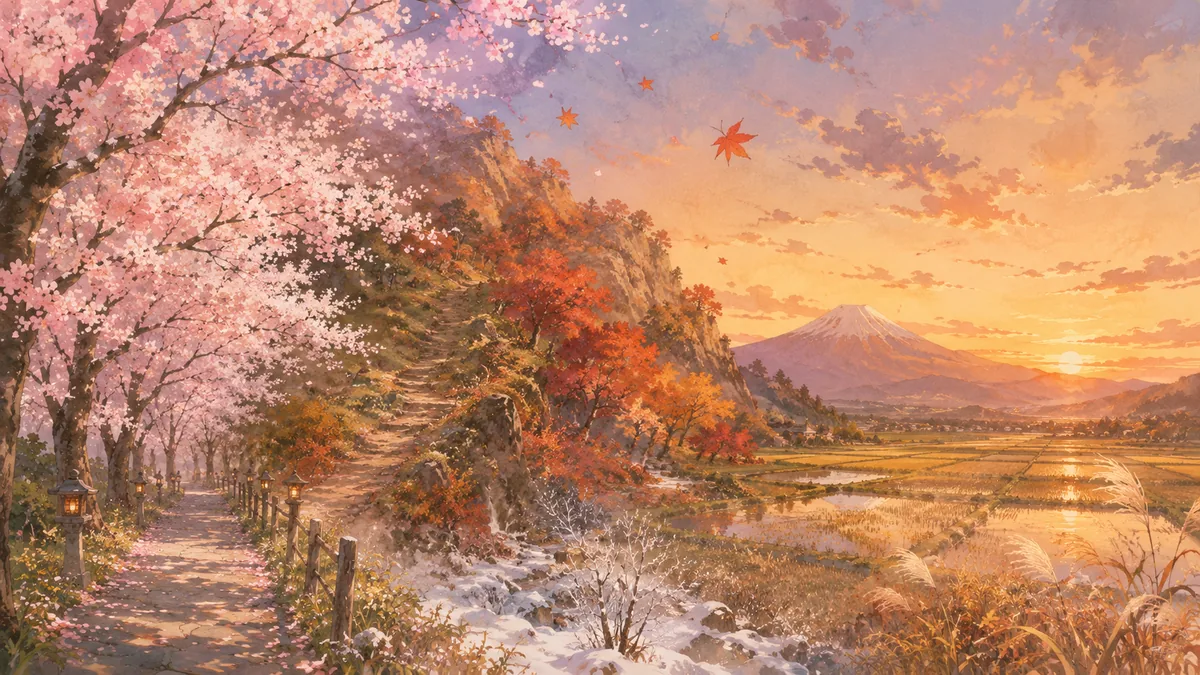
Why Japan Divides the Year Into 72 Seasons — Calendars, Rituals & the Rhythm of Food
Seasons & Nature · 2026-06-08 · ~1,900 words
Step up to the glass display case of a traditional wagashi shop in Kyoto and you'll notice something disorienting: the sweets keep changing — not monthly, but almost weekly.
One visit you'll find delicate confections shaped like hydrangea blossoms. Swing by two weeks later and those are gone, replaced by minazuki — a triangular rice cake said to ward off summer heat. Another two weeks and suddenly there are jellied sweets the color of a river, shaped like sweetfish. If you're keeping track, that's three entirely different seasonal "moments" in the span of a month.
I found myself wondering: why does this culture slice time so finely? Four seasons aren't enough for a wagashi chef, apparently. So what's actually going on?
A Calendar That Updates Every Five Days
The short answer is that Japan inherited — and then quietly kept — a timekeeping system that makes Western four-season thinking look coarse.
From ancient China came the nijūshi sekki (二十四節気), a solar calendar that divides the year into 24 segments. You've probably encountered some of these terms even without knowing it: risshun (立春, the start of spring), shunbun (春分, the spring equinox), geshi (夏至, the summer solstice), tōji (冬至, the winter solstice). These still show up in Japanese weather forecasts, on packaging, in seasonal menus.
But 24 wasn't fine enough. Each of those 24 segments is further divided into three, producing shichijūni kō (七十二候) — 72 micro-seasons, each roughly five days long. These 72 periods have evocative names drawn directly from nature: one early-spring interval is called suzume hajimete sukuu (雀始巣) — "sparrows begin to nest." Another in late summer: "hawks learn to hunt." Another in winter: "salmon gather and swim upstream."
The logic isn't astronomical precision. It's more like a prompt: pay attention right now, because this particular moment won't last long.
What Makes This Feel Distinctly Japanese
I want to be careful here — other temperate cultures have their own seasonal granularity, and I don't think it's useful to claim Japan invented sensitivity to nature. But there are a few places where this calendar logic seems to have seeped unusually deep into daily life.
Food vocabulary. In the world of Japanese cuisine, the same ingredient gets different names depending on exactly where it falls in the seasonal arc. Hashiri (走り) means the ingredient has just appeared, before peak season — early, a little scarce, expensive, almost theatrical in its novelty. Shun (旬) is the peak, when flavor is best and price drops. Nagori (名残) is the tail end — the ingredient is almost gone, and eating it carries a faint melancholy, an awareness that this is nearly the last chance until next year. Hatsumono (初物) refers specifically to the very first appearance of a seasonal food, which has traditionally been treated as something almost ceremonial.
Take sweetfish (ayu): early summer's hashiri ayu are eaten one way, peak-summer shun ayu another way, and the autumn ochiayu — females heavy with roe before they swim downstream to spawn — are treated as an entirely different culinary experience. Same fish, three different relationships.
This isn't just chef's vocabulary. It's a framing device that asks: where in time are we right now?
Annual rituals scattered throughout the calendar. Japan has a dense schedule of seasonal observances: Setsubun (bean-throwing to mark the old lunar new year's eve), Hinamatsuri (Doll Festival in early March), Tango no Sekku (Boys' Day in May), Tanabata (Star Festival in July), Obon (midsummer ancestral rites), Jugoya (the harvest moon viewing in autumn), Tōji (winter solstice, traditionally the night for yuzu baths). These aren't just cultural decorations — they're distributed anchors across the year, moments that force a pause and a seasonal reckoning.
The arts. Haiku's kigo system — the requirement that every haiku contain a "season word" — is perhaps the most formalized expression of this. Entire dictionaries exist cataloguing which words belong to which season. Kamo (wild duck) signals winter. Hotaru (firefly) is early summer. Momiji (red maple leaves) is autumn. The discipline of haiku is partly a discipline of seasonal attention.
Similarly, ikebana flower arrangements, kimono textile patterns, kaiseki menus, and the themes of wagashi all operate on a calendar that moves in increments far smaller than a season.
Why Did This Develop?
Honestly, I'll offer this as a reading rather than a settled explanation.
One layer is agricultural history. Knowing exactly when to plant, when to thin, when to harvest — this required close attention to environmental signals, not just the rough category of "summer." A culture that farmed rice across highly varied microclimates (Japan's geography is dramatic: mountains, coastal plains, different rainfall patterns by region) would benefit from a fine-grained temporal vocabulary.
Another layer is aesthetic refinement in court and tea culture. The chanoyu (tea ceremony) tradition placed enormous emphasis on ma — the charged quality of a particular moment — and on ichigo ichie, the idea that each encounter is unique and unrepeatable. When you design a practice around the unrepeatable nature of moments, you're motivated to notice what's different about this moment versus last week's. Seasonal granularity becomes a vehicle for presence.
These two threads — practical agriculture and refined aesthetics — probably reinforced each other over centuries. The result is a culture where noticing that we've moved from "hydrangea season" to "sweetfish season" isn't precious or performative; it's just how time is talked about.
That said, I'd resist any strong claim that this is uniquely Japanese. The Korean jeolgi calendar, Chinese seasonal traditions, and various European folk calendars all show similar impulses. What seems distinctive is how persistently Japan's version has survived into commercial and everyday contexts.
How It Shows Up in Modern Life
You don't have to seek out traditional culture to encounter this — it's woven into ordinary consumer life in ways that can catch you off guard.
Convenience stores rotate seasonal limited-edition products with a cadence that feels almost aggressive: cherry blossom everything in March, matcha and new tea in May, cold noodles in July, chestnut and sweet potato in October. Starbucks Japan's seasonal frappuccinos have their own devoted following. Supermarket displays shift not just by month but sometimes by week. Fashion magazines use vocabulary like shoka (初夏, early summer), seika (盛夏, peak summer), and banshū (晩秋, late autumn) as distinct categories.
For my part, I don't look at these seasonal storefronts with a purely cynical eye. There's strategy behind them, sure — but a display someone is clearly enjoying making is fun to look at, and that fun rubs off. Christmas is the most obvious case: when a town's lights all change at once, that alone is enough to make it feel like the year is ending. And there's one that puzzles me every year — the "hiyashi chūka hajimemashita" ("cold ramen has started") strip that appears on eateries as summer comes on. Why is it cold ramen, of all things, that gets to announce a whole season so proudly? That single slip of paper is, I suspect, its own small piece of how Japan slices the year up so finely.
Weather forecasts routinely reference nijūshi sekki terms. When the meteorological agency announces nyūbai (梅雨入り, the rainy season's official start) or akisame (autumn rains), it's not poetic — it's practical information that carries real cultural weight.
For visitors, one of the most striking experiences is realizing how quickly things change. Cherry blossoms have maybe a week at full bloom before they scatter. Autumn foliage shifts color over a couple of weeks and is gone. The wagashi in that Kyoto shop case will be completely different if you return in three weeks. People who've visited Japan multiple times often say that's part of the draw — the country literally looks and tastes different depending on when you show up.
The Honest Caveat: City Life Blurs This
I want to be straightforward about something, because I think the "Japanese people are deeply attuned to nature" narrative can tip into soft romanticization.
For many people living in Tokyo or Osaka, the nijūshi sekki is background noise. Produce is available year-round at supermarkets. Air conditioning and heating flatten the sensory experience of seasonal change. If you asked a random salaryman whether we're currently in shōman (小満, the 8th solar term) or bōshu (芒種, the 9th), there's a reasonable chance they'd shrug.
The seasonal sensitivity is real, but it exists on a spectrum. There are people who actively cultivate it — who visit wagashi shops for the seasonal menu, who follow shun ingredients at izakayas, who post about the first hatsumono of the year. And there are people for whom the seasonal cues are ambient wallpaper: noticed occasionally, not deeply felt.
The gap between "Japan as a culture has 72-season infrastructure" and "individual Japanese people are constantly tuned into seasonal nuance" is worth keeping in mind. The system is there. Individual engagement with it varies enormously.
That said, even as ambient wallpaper, the infrastructure matters. When the convenience store swaps its entire drink section to cold mugicha barley tea overnight, something registers. When the weather forecast says tsuyu ake — the rainy season is officially over — people exhale. The calendar still shapes experience, even lightly.
A Question Worth Sitting With
One thing I keep returning to: there's something in the 72-season framework that works against the flattening of time. When your calendar says "right now is kōgane mushi ari ni irazu" (golden beetles disappear into the ground) — that specific, that granular — it becomes harder to treat this week as interchangeable with last week or next month.
Whether that translates into lived attentiveness probably depends on the person. But the cultural architecture is there, offering a different relationship with time than the blunt four-season model most of us grew up with.
When did you last notice a season shifting? Not the official calendar date — but actually feel it, in what was on the menu or what was blooming or what the light looked like at 5pm? Japan's answer to that question is: probably about five days ago.
Sources & References
- National Astronomical Observatory of Japan (国立天文台), explanatory materials on the traditional Japanese calendar and nijūshi sekki
- General reference works on washoku (Japanese cuisine) culture, including seasonal ingredient vocabulary (hashiri, shun, nagori)
- Introductory texts on shichijūni kō (72 micro-seasons) and their historical adaptation from Chinese originals to Japanese climate conditions
- Historical and anthropological writing on chanoyu and the development of seasonal aesthetics in Japanese court and merchant culture
A Geek in Japan (Revised & Expanded)
A wide-angle introduction to the 'why' of Japanese culture — manga, anime, Zen, the tea ceremony and more. A natural companion to the topics Naze explores.
The Japanese Mind: Understanding Contemporary Japanese Culture
Chapters on aimai (ambiguity), amae, giri, wa and more — the values beneath the gestures and words. For readers who want to go deeper into the 'why.'
Share this article
Read Next
- Seasons & NatureWhy Is a Kotatsu So Hard to Leave? — Japan's Philosophy of Local HeatThe kotatsu doesn't heat the room — it heats only you. That single design choice explains almost eve…
- Seasons & NatureWhy Fireworks Are the Heart of Japanese SummerHanabi taikai began in 1733 as a memorial for famine and plague victims. That origin explains why Ja…
- Seasons & NatureWhy Are Japan's Autumn Leaves Called 'Hunting'? — The Meaning of MomijigariMomijigari literally means 'leaf hunting' — but nothing is ever caught. This piece traces why the ol…
- Seasons & NatureWhy Do Falling Cherry Blossoms Feel More Beautiful Than Full Bloom?The tree at peak bloom is spectacular — but something about the falling petals catches harder. A loo…
- Seasons & NatureWhy Does Japan Have a Rainy Season — and Is June Worth Visiting?Tsuyu, Japan's rainy season, runs roughly from early June to mid-July. Rain probability in Tokyo pea…
Related Articles
Articles in the same category: