Why Are Japanese Convenience Stores So Good? — How the Konbini Became Infrastructure
Everyday Japan · 2026-06-03 · ~1,500 words · ~6 min read
Contents (7)
- The Store That Became Infrastructure
- What the Shelves Actually Look Like
- Why It Got This Good
- The Other Job: A Neighborhood That Watches
- The Light That Never Goes Off
- Where to Feel It
- The Question It Leaves
Walk into a Japanese konbini at two in the morning. The shelves are fully stocked. The hot food case is running — nikuman buns steaming in one compartment, fried chicken turning slowly in another. The onigiri section offers ten, twelve varieties. Someone is mopping quietly behind the counter. A staff member greets you as you step through the automatic door, and bows when you leave.
If you're visiting Japan for the first time, this moment has a strange quality to it. Corner stores aren't supposed to be this organized. Late-night shops aren't supposed to feel this... maintained.
So what's actually happening here?
The Store That Became Infrastructure
The honest answer, at the observable level, is this: the Japanese convenience store stopped being a "convenience" store decades ago. It became infrastructure.
That word sounds heavier than I intend. What I mean is this: in most countries, a convenience store is a fallback. You go there when nothing else is open, when you need a bottle of water and can't be bothered to find a real shop. The product quality is adequate. The experience is forgettable. You leave without thinking about it.
In Japan, the konbini became something people actively build routines around. You can pay your electric bill, your water bill, your national health insurance premium — at the register, in cash or card, at any hour. You can print a document or photocopy your passport using the multifunction machine near the back. Pick up a parcel, send a parcel, buy a concert ticket, send a fax (yes, still, in 2026). At many locations, you can file certain municipal applications. The ATMs handle English, Chinese, and Korean.
And in between all of that, you can buy food. Food that is, by any honest comparison, quite good.
According to Japan Franchise Association figures, there are approximately 55,000 convenience stores operating in Japan — roughly one for every 2,300 people. In central Tokyo, you'll find them on the same block, sometimes directly across the street from each other. That density does something to competition. It makes "good enough" a genuine risk.
What the Shelves Actually Look Like
The physical contents of those shelves are worth pausing on.
A standard onigiri section — those triangular rice parcels in peelable plastic — typically offers salmon, tuna mayo, pickled plum, kelp, cod roe, grilled salmon, and a handful of seasonal variants. These rotate every few weeks. The packaging has a numbered pull-tab system (①②③) that keeps the nori crisp until the moment you open it — a small engineering solution that most daily customers use without ever consciously noticing.
Sandwiches are timestamped by the hour, not just the day, and restocked multiple times daily. Cold coffee comes in more configurations than most dedicated cafés offer. Seasonal items arrive reliably enough that Japanese consumers develop genuine preferences for limited editions: the strawberry milk of spring, the roasted chestnut desserts of autumn.
The hot food case is a cultural artifact in its own right. Lawson's karaage-kun, 7-Eleven's nana-chiki, FamilyMart's famichiki — the fried chicken offerings of Japan's three major chains — have inspired earnest taste-test journalism, limited-edition flavor runs, and social media devotion that no piece of convenience-store fried chicken in most countries has earned. There are people with genuine, considered opinions about which chain's chicken is superior. This is not ironic.
Private brand product development at these chains runs at a pace that would unsettle a conventional food company. New items are trialed, tracked by sell-through rate, and rotated in or out on cycles of roughly two weeks. The products on the shelf today are there because people actually kept buying them. The ones that aren't there didn't survive. This shelf is a continuous, merciless edit — and the current version is the accumulated result of decades of that process.
Why It Got This Good
Here's where I want to be careful, because "why" is a genuinely slippery word.
The observable facts are fairly clear: three dominant chains competing in a market dense enough that customers can literally walk to the next store if they're dissatisfied. A domestic consumer base that has, over decades, calibrated expectations upward. A distribution system capable of daily or twice-daily restocking across tens of thousands of locations. And sustained iterative development — what people in Japan often call kaizen, the logic of small, continuous improvement applied across every product and every process.
The less observable part — the quality of care you feel in a well-run konbini, the sense that someone paid real attention — is harder to explain without overstating it. I won't claim it's a cultural disposition toward service, because I think that framing flattens something more complicated into something too easy to say. A more concrete way to see it: the staff training at major chains is unusually specific, operational standards are measured and checked, and stores are compared against each other constantly on cleanliness, product availability, and customer interaction scores.
Here's how I lean — not as a verdict, just one reading: perhaps the care is structural before it's personal. The system is built to produce reliable attentiveness, and then — over time, through repeated practice — that trained attentiveness becomes something that genuinely feels like care. The structure came first; the habit followed.
I hold that lightly. There are other ways to read it.
The Other Job: A Neighborhood That Watches
Separate from the quality story, I think the konbini does one more job that never shows up in the statistics.
A konbini on your commute or school route has a kind of magic: frequency. When your daily rhythm happens to overlap with someone's part-time shift, you become familiar faces across the register, almost without noticing. A word or two — "running late today?" — nothing more. You don't know their name. But you know each other's faces. And that thin little relationship turns out to matter more than it looks.
Because the person behind the counter is also someone who notices when the scenery changes. The regular who always comes at the same time... suddenly doesn't. Huh — that person stopped coming. When something in the ordinary picture is off, staff feel it. This isn't just anecdote: the industry runs a formal "Safety Station" program in cooperation with police and local governments, positioning stores as places to run to and as quiet checkpoints for neighborhood safety. Fifty-five thousand stores, lights on around the clock, loosely watching the street. Not in the security-camera sense — in the familiar-face sense.
The Light That Never Goes Off
It would be easy to end there and call the konbini an uncomplicated success story.
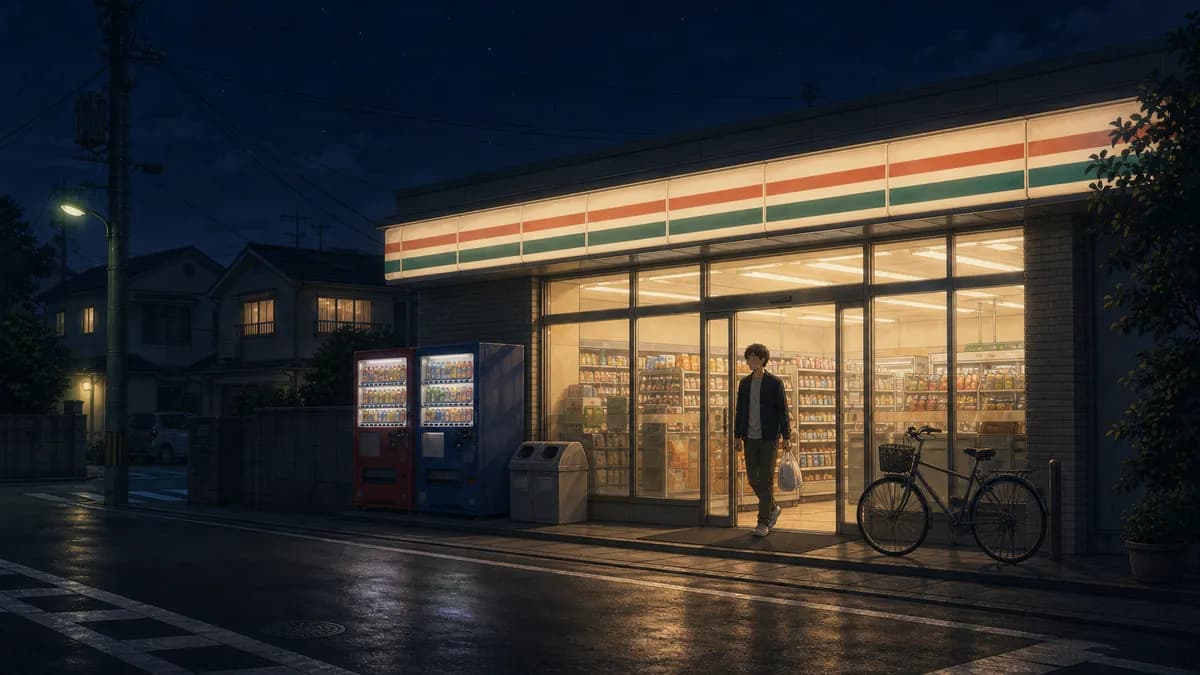
But the light in that window doesn't stay on by itself. Someone is behind the counter at 3 a.m. — often a part-time worker, a foreign student, a person who took the overnight shift because the alternatives were fewer or worse. The staffing economics of 24/7 retail aren't comfortable, and they rest disproportionately on workers with less leverage in the labor market.
The franchise model has attracted sustained criticism. Franchise owners — the people who actually run individual stores — bear the operational risk and the staffing burden while the parent company collects royalties regardless of whether the location is profitable. In 2019, a franchise owner in Osaka made national news when he reduced his store's hours without permission and was threatened with contract penalties. The story opened a wider public conversation about who actually benefits from "24 hours." Several chains subsequently announced optional hour-reduction trials, though full 24-hour operation remains the strong default across the industry.
The convenience is real. The quality is real. And the human cost of keeping that system illuminated, every hour of every night, is also real. Both things are true at once — and I think it's worth holding both, rather than letting the appeal of one erase the other.
Where to Feel It
If you're visiting Japan, the obvious move is to actually eat something — not as a tourist checklist item, but as a genuine test. Buy an onigiri. Peel it using the numbered tabs. Notice that the nori stayed crisp. Try a famichiki standing outside. Get a hot can of café au lait from the machine near the door and drink it in whatever light is available.
If you already live in Japan, you probably know all of this without having consciously thought about it. But try visiting a konbini in a small rural town somewhere that doesn't have a supermarket within easy walking distance. Notice how much that single store is carrying for the people around it — fresh food, financial services, parcel logistics, a warm place out of the rain. In some parts of Japan, it's the last general-purpose shop still operating in the neighborhood.
For a more structured look at how the industry evolved, the Japan Franchise Association publishes annual statistics that trace its growth clearly. Reporting from Nikkei Asia and NHK World on the 2019 franchise disputes offers a useful counterweight to the more celebratory coverage the konbini tends to receive.
The Question It Leaves
The Japanese convenience store is one of the more interesting things Japan has built in recent decades — not a tradition, not a historical artifact, but a practical, modern invention that iterated its way to surprising capability across a surprising number of domains.
The question I can't quite settle: did the konbini become this good because Japan's consumers demanded it? Or did Japan's daily rhythms gradually reorganize themselves around the konbini because it was already there and already dependable? The causation probably runs in both directions, which is part of why the model has proved genuinely difficult to replicate at the same quality level in other markets.
I have an older rescue memory, too. Coming home from school as a kid, stomach suddenly at its absolute limit, and the konbini I sprinted into. I still remember the relief of made it. I'm barely exaggerating when I say that store, that day, was a god. And the small ritual of buying one little thing on the way out, as thanks for the restroom — I think I learned that there as well.
Honestly, the konbini tends to rescue me at night. After dark, I suddenly want to eat all sorts of things. I'm too tired to muster the motivation for anything, and yet my stomach is insistently empty. In that state, with a little pang of guilt, my hand reaches for something sweet or a hot snack. And the fact that a place selling exactly that is open, lights on, in the middle of the night — when you stop and think about it, that's a genuinely fortunate thing.
What I'm confident about is simpler. Walk into one at midnight, onigiri in hand, with a bill to pay and a document to print, and you'll understand what "infrastructure" feels like when it's done quietly and well — and when someone else is paying the cost of keeping it that way.
If you ever walk a Japanese street after dark, that gratitude will probably reach you before words do — the moment the automatic door slides open. A single midnight onigiri can become one of the plainest, kindest memories of the whole trip.
Sources & References
- Japan Franchise Association (日本フランチャイズチェーン協会), Convenience Store Statistics — annual industry figures on store count and sales
- Japan Franchise Association, "Safety Station" (セーフティステーション) program — industry cooperation with police and local governments on neighborhood safety
- NHK World & Nikkei Asia reporting on konbini franchise disputes (2019–2020)
- Kohlbacher, F. & Igel, C. (eds.), The Silver Market Phenomenon — background context on Japanese retail evolution
- Personal observation; interpretive claims in this article are the author's own reading, not established findings
A Geek in Japan (Revised & Expanded)
A wide-angle introduction to the 'why' of Japanese culture — manga, anime, Zen, the tea ceremony and more. A natural companion to the topics Naze explores.
The Japanese Mind: Understanding Contemporary Japanese Culture
Chapters on aimai (ambiguity), amae, giri, wa and more — the values beneath the gestures and words. For readers who want to go deeper into the 'why.'
Share this article
Read Next
- Everyday JapanWhy Are Japanese Train Bento (Ekiben) So Special?Ekiben turn the train journey into a curated regional food tour. Here's the quiet logic behind Japan…
- Everyday JapanWhy Are There So Many Signs and Notices in Japan?Japan's streets and stations are layered with notices. Here's what the density reveals about preempt…
- Everyday JapanWhy Do Japanese People Care So Much About Seken?Seken — Japan's unnamed collective gaze — shapes everything from garbage etiquette to career choices…
- Everyday JapanWhy Do Japanese Households Still Keep a Handwritten Kakeibo? — The 1904 Method Behind the NotebookKakeibo — Japan's household account book — traces back to 1904, when journalist Hani Motoko proposed…
- Everyday JapanWhy Are Japanese 100-Yen Shops So Surprisingly Good? — The Daiso Model ExplainedJapan's 100-yen shops aren't just cheap stores — they run a specific model built on massive order vo…
Related Articles
Articles in the same category: