Why Does Japan Still Use So Much Cash? — The Quiet Logic Behind Every 'Cash Only' Sign
Everyday Japan · 2026-06-03 · ~1,500 words · ~6 min read
Contents (8)
- The gap is real — and worth naming plainly
- What a Tuesday morning actually looks like
- A few concrete reasons why cash stuck
- One way to see it — offered carefully
- Feelings need a shape — the money at weddings and funerals
- The shadow — which is real, and worth saying
- Where you'll feel it most
- Not a conclusion — a question
You're at a small ramen shop after a long evening. The broth is exactly right. You reach for your phone to pay — and then you see a hand-lettered sign by the register: 現金のみ. Cash only. If you arrived from a country where you tap your phone for everything from coffee to train tickets, this moment can feel like stepping backward in time.
But is it, really?
To be honest, I barely carry cash myself anymore. Since around the pandemic, cashless spread fast here, and there are whole days I never open my wallet. And yet it still trips me up — a cash-only diner, or a card reader that just won't catch a signal, and I'm stuck at the register with nothing to do but go find an ATM. Part of what keeps cash alive, I think, is trust in the note itself: counterfeits are so rare that you never doubt the bill in your hand. And when a disaster takes the network down and the phone dies, cash is what's still there.
Once, it went the other way: I didn't have enough cash on me at a register and had to hand a few items back to be reshelved. That one stings. The total is read out, you open your wallet, and you can see it won't reach — those few seconds. If there's a line forming behind you, the embarrassment doubles. The other face of a cash-only country is that when your cash runs short, there's nowhere to hide.
The gap is real — and worth naming plainly
According to METI's figures released in March 2026, Japan's cashless payment ratio reached about 58% in 2025 under a new domestic indicator (about 46% under the conventional international-comparison indicator) — a sharp rise over the past decade, whichever measure you use. Japan is often framed as lagging South Korea, the UK, or Scandinavia, but cross-country comparisons depend heavily on methodology, so those gaps should be read with some caution. Even so, cash remains important in concrete ways: small independent restaurants, rural shops, temple donation boxes, and festival stalls frequently accept only cash. Arrive in Japan without yen in your pocket and certain parts of the day become genuinely awkward.
That's the observable fact, stated plainly. It creates real friction for travelers — and I'll come back to the shadow side.
But the flip side is also true: Japan's cash infrastructure is, by any measure, exceptionally good. The yen is one of the most counterfeit-resistant currencies in the world. ATMs sit inside nearly every convenience store, post office, and train station. The bills themselves are crisp and uniform. Coins have distinct weights and ridged edges so you find the right one by touch in a dark bag.
Cash in Japan isn't a failure to modernize — it's a system that still works, and quietly says so.
What a Tuesday morning actually looks like
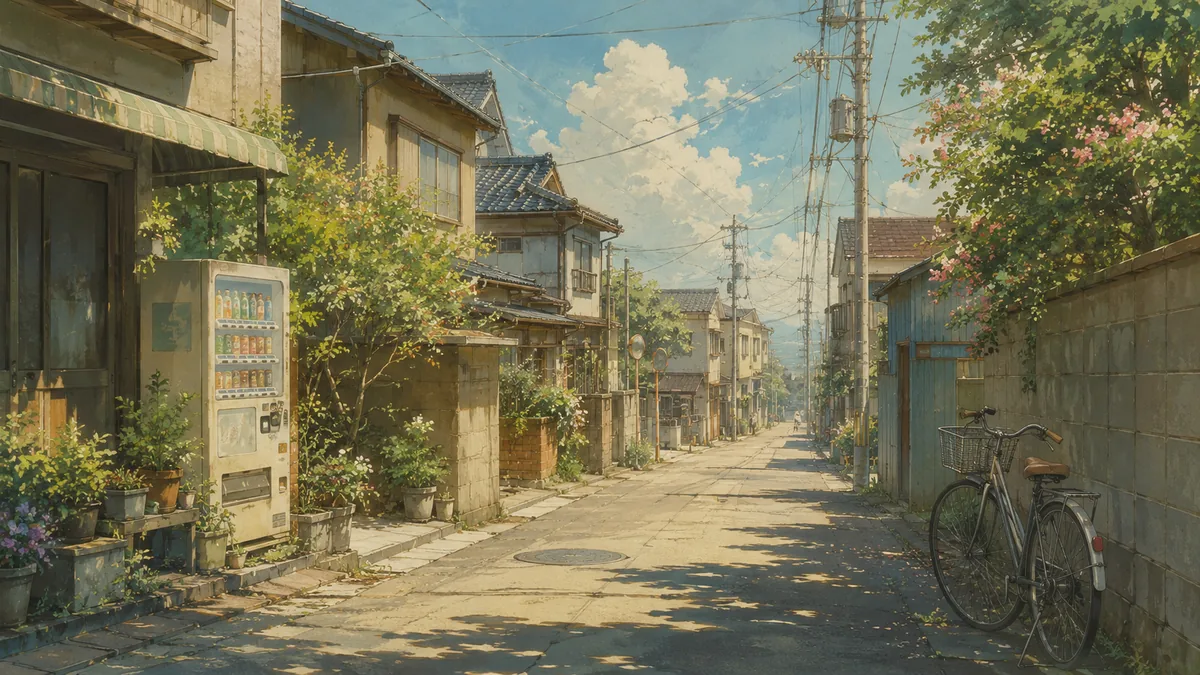
Imagine a typical weekday commute in Tokyo. You touch your Suica card at the station gate — cashless. You grab an onigiri at 7-Eleven and tap again — cashless. You stop at a vending machine that takes your IC card — cashless. So far, very modern.
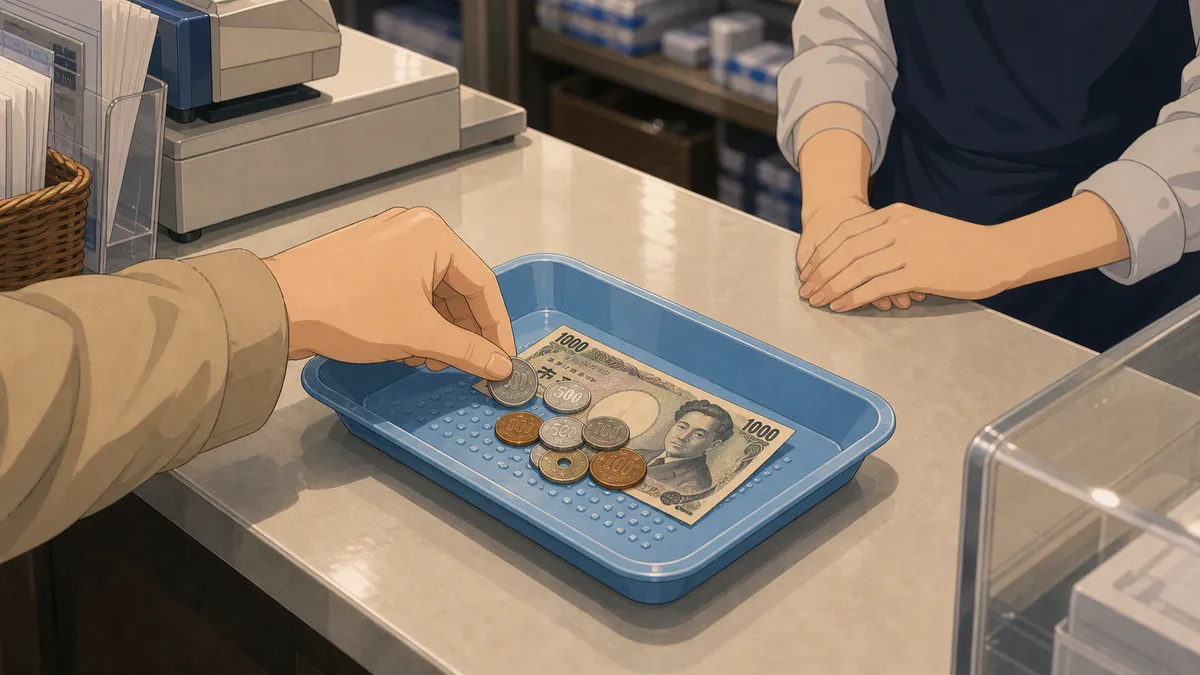
Then you duck into a standing-soba restaurant that's been in the same spot for thirty years. Hand-written menu on the wall. One woman running the whole counter. The meal costs 580 yen, and you slide exact change across the tray before she even looks up.
That moment — the specific texture of it — is where cash still lives in Japan. Not everywhere. Not even most places, in a big city. But in the small, long-running spots: the shotengai shops that have served the same neighborhood for decades, the rural vending machines that take only coins, the shrine where you toss a 5-yen coin and make a wish.
If you've watched Japanese anime, you've probably seen this. Characters handle cash carefully; the scene often lingers on coins counted into a palm. That's not just dramatic convenience — it reflects the actual texture of daily life here.
A few concrete reasons why cash stuck
There's no single cause. Several smaller ones stack up.
Card fees fall on the merchant. In Japan, credit card processing fees for small businesses historically ran 3–5%, sometimes higher. For a ramen shop operating on thin margins, that's not trivial — it can be the difference between profit and loss on a quiet Tuesday. A policy shift in 2023 pushed for more transparent fee structures, but the legacy of expensive card infrastructure remains in many small shops' quiet decision to simply not install a reader.
The IC card split the difference. Suica, PASMO, and similar prepaid transit cards emerged in the early 2000s and became the primary "digital" payment that most Japanese people actually use daily. They're fast, near-universal at convenience stores and transit hubs, and — crucially — they work when your phone battery is dead, when the network is slow, when you're running for a train. They occupy a practical middle ground: digital speed, but a physical card with a prepaid balance. Not quite cashless in the full sense, but close enough for daily life.
Japan's ATM network is genuinely dense. When you can withdraw cash at 2 AM from a convenience store in a small town, the inconvenience of carrying physical money falls considerably. The infrastructure quietly reduced the pressure to go fully cashless.
Disaster preparedness. This one doesn't get mentioned enough. Japan's own disaster prevention guidelines — issued by local governments and the Cabinet Office — routinely recommend that households keep some cash at home, including small bills and coins. Japan sits on one of the most seismically active regions on earth. In a major earthquake, card terminals go dark, mobile networks saturate, and power fails. Physical cash, by definition, works without infrastructure. The 2011 Tōhoku earthquake reinforced this memory for a generation of Japanese people: when everything digital stopped, cash still worked.
One way to see it — offered carefully
Here's where I'll hedge, because this next part is personal reading, not fact.
In a lot of places around the world, the move to cashless payment is framed as straightforward progress: faster, cleaner, more traceable. That's not wrong. But there's something in the physical handing-over of money that carries a certain directness — a finality — that a tap doesn't quite replicate. The transaction ends with a thing passing between two people.
I'm not saying that's the reason Japan kept cash. I genuinely doubt there's one reason. But perhaps, for many people who grew up here, the physical exchange retains a legibility that a beep on a reader quietly lacks. Maybe. I could also just be romanticizing what is, at its core, a story about merchant fees and ATM density.
Speaking only for myself: cashless is convenient, and I think it will keep becoming the default. Even so, when money passes from hand to hand, you feel its weight and quantity — and that, for me, is part of what makes me want to spend it carefully. I feel the same thing about books. E-books are convenient and take up no space. But somehow the paper ones stay in my memory better — the smell of the paper, the smell of the ink, the sound of a page turning. Maybe it's that you take them in through touch and smell, not sight alone. Money might be the same. Counting it with your fingertips, handing it over, receiving it back — perhaps it stays with you exactly to the degree that your body was involved.
Of course, not everyone feels a thing when counting coins. Plenty of Japanese people find cash-only shops annoying, slow, and inefficient. Both readings are true at once.
Feelings need a shape — the money at weddings and funerals
And there's one territory in Japan where cashless seems unlikely to ever fully arrive: ceremonial occasions. Wedding gifts, funeral condolence money, the New Year's money children receive — almost all of it still moves as cash.
When I think about why, the answer feels simple: that money was never a payment in the first place. It's kokorozashi — a feeling being handed over, not a transaction being settled. And handing over a feeling electronically, with nothing to hold, feels thin to me — flavorless, somehow. The ceremonial envelope itself carries layers of meaning. For a wedding, you prepare brand-new bills without a single fold: a sign that you looked forward to this day and got ready for it in advance. For a funeral, the opposite — crisp new bills are avoided, so it doesn't look as if you'd been waiting for the misfortune. Even the mizuhiki cord that ties the envelope has grammar: for weddings it's tied in a knot that cannot be undone, carrying the wish may this happen only once, and hold. The shape speaks before the amount does. Cash, here, is not a payment method. It's a container for feeling.
Which is why the reverse catches me off guard: some shrines have started accepting offerings by QR code. When I first heard that, I felt culture shock — in my own country. I understand the logic; handling thousands of coins is real work, and it's rational. But part of me keeps wondering where the small weight of that tossed coin goes. A Japanese person, surprised by Japan's own changes — the story of cash has probably reached that stage.
The shadow — which is real, and worth saying
It isn't only quiet logic. The lag in cashless adoption creates genuine, concrete problems.
For international travelers, it's a recurring friction: arriving at a fantastic-looking local restaurant or a local train line and finding no card reader. Japan's tourist infrastructure has improved rapidly since around 2019, and most major tourist-facing businesses now accept cards. But step even slightly off the beaten track and cash remains essential — not optional.
There's also a domestic gap. As Japan pushes toward digital-only services and apps, elderly people and those without smartphones can face their own form of exclusion. The cashless push has its own blind spots.
And there's a subtler issue that economists point to: cash transactions leave no trace. For a government tracking the informal economy or working to prevent tax gaps, that's a complication, not a feature.
Both things are true: cash here has a quiet, practical logic. And the gaps it creates are also real, and worth acknowledging honestly.
Where you'll feel it most
In 2026, cash still feels genuinely necessary in Japan in these situations:
- Small ramen shops, standing-noodle restaurants (tachigui), old-school kissaten coffee shops
- Rural areas, smaller cities, local markets and outdoor festivals
- Shrines and temples — the coin toss, the omamori charm purchase
- Coin lockers at train stations (many still coin-only)
- Vending machines in residential neighborhoods (increasingly IC-card capable, but not all)
Practical note if you're visiting: carry 10,000–20,000 yen in cash. Use an IC card for daily transit and convenience store runs. Don't assume a great-looking local restaurant takes cards — and don't let a cash-only sign spoil the meal.
Not a conclusion — a question
Japan is changing. The cashless ratio has risen sharply over the past decade — from roughly 13% in 2010 to about 58% in 2025 under METI's domestic indicator — driven by government incentive programs, the pandemic years, and the spread of smartphone payment apps. It will probably keep rising.
But I suspect the small ramen shop with the hand-lettered 現金のみ sign will be there for a while yet. Not because Japan is stuck — but because for the owner who has been running that counter for thirty years, the system works. Exactly. Every time.
Whether that's logic, or habit, or something harder to name — I'll leave that open.
How does cash feel where you live? Still completely normal, or already a little strange?
Sources & References
- Ministry of Economy, Trade and Industry (METI): "2025年のキャッシュレス決済比率を算出しました" (released 31 March 2026; about 58% under the new domestic indicator, about 46% under the international-comparison indicator); METI cashless policy portal
- METI: 「キャッシュレス・ビジョン」policy document (2018)
- Cabinet Office and municipal disaster prevention manuals (各自治体防災マニュアル) — standard recommendation to maintain emergency cash reserves
- QR-code / e-money offering boxes introduced at some shrines (widely reported since the late 2010s)
- Inner-meaning claims in this piece are offered as one personal reading, not a verdict; no hard data exists for the psychological dimension. Descriptions of gift-envelope and mizuhiki etiquette reflect common practice, which varies by region and family.
A Geek in Japan (Revised & Expanded)
A wide-angle introduction to the 'why' of Japanese culture — manga, anime, Zen, the tea ceremony and more. A natural companion to the topics Naze explores.
The Japanese Mind: Understanding Contemporary Japanese Culture
Chapters on aimai (ambiguity), amae, giri, wa and more — the values beneath the gestures and words. For readers who want to go deeper into the 'why.'
Share this article
Read Next
- Everyday JapanWhy Are Japanese Train Bento (Ekiben) So Special?Ekiben turn the train journey into a curated regional food tour. Here's the quiet logic behind Japan…
- Everyday JapanWhy Are There So Many Signs and Notices in Japan?Japan's streets and stations are layered with notices. Here's what the density reveals about preempt…
- Everyday JapanWhy Do Japanese People Care So Much About Seken?Seken — Japan's unnamed collective gaze — shapes everything from garbage etiquette to career choices…
- Everyday JapanWhy Do Japanese Households Still Keep a Handwritten Kakeibo? — The 1904 Method Behind the NotebookKakeibo — Japan's household account book — traces back to 1904, when journalist Hani Motoko proposed…
- Everyday JapanWhy Are Japanese 100-Yen Shops So Surprisingly Good? — The Daiso Model ExplainedJapan's 100-yen shops aren't just cheap stores — they run a specific model built on massive order vo…
Related Articles
Articles in the same category: