Why Does Japan Have So Many Vending Machines — and What Does That Actually Tell Us?
Everyday Japan · 2026-06-03 · ~1,200 words · ~5 min read
Contents (7)
- The Numbers
- Two Pillars: Safety and Cash
- Where You Find Them
- One Way to See It
- The Other Side
- Where to Feel This More Clearly
- A Closing Question
You step off a regional train at an unmanned station. The platform is empty. No ticket booth, no station staff, no convenience store in sight. But there, against the concrete wall, humming quietly in the afternoon heat, is a vending machine. Cold drinks, hot coffee, canned tea. A small light glowing in the shade.
No one watching it. No lock on the front. Just coins, and trust.
If you've spent any time in Japan — or watched enough anime set here — you've noticed this. Vending machines in alleys, on mountain trails, in hospital lobbies, on the platforms of stations that haven't had a human staff member in years. So: why?
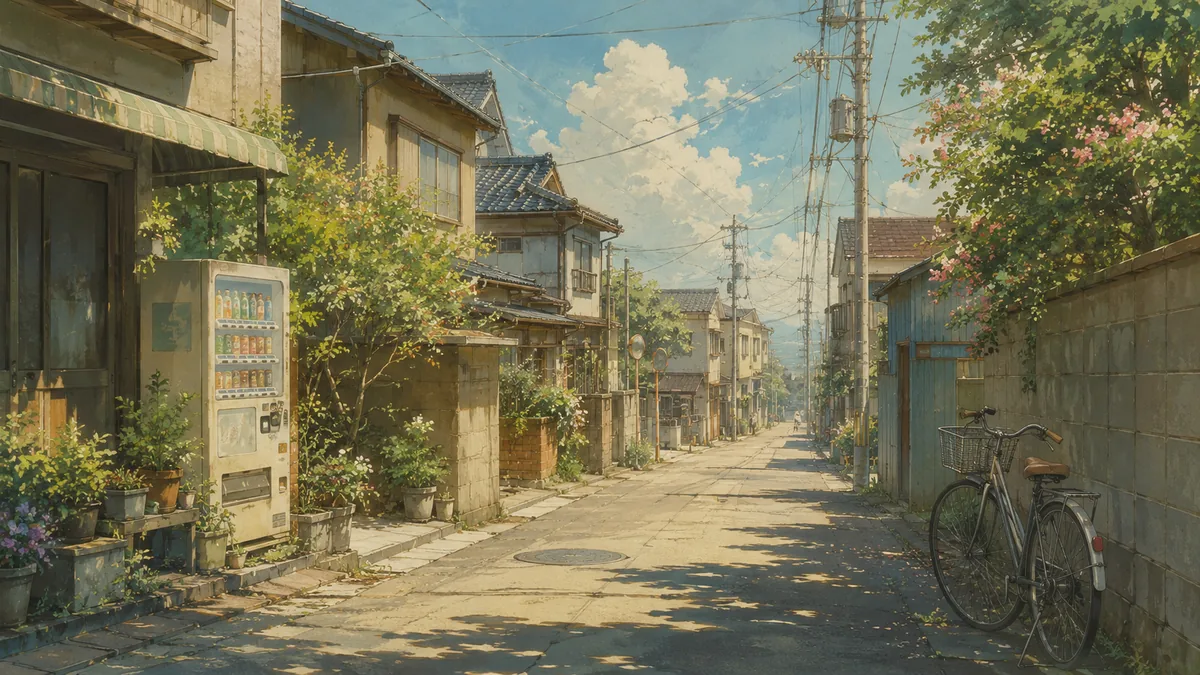
What gets me is the ones in places that can't possibly pay for themselves — and yet there they stand, year after year, never removed. At some point it stops being about convenience. They've become part of the landscape, as ordinary as a utility pole or a traffic light: closer to infrastructure than to shops.
The Numbers
Japan has approximately four million vending machines. The Japan Vending Machine Manufacturers Association (JVMA) publishes annual data, and the figure has held in this range for years. That works out to roughly one machine per thirty people. By most accounts, this is among the highest per-capita densities in the world.
The short answer — at the observable level, before any deeper reading — is this: Japan has this many vending machines because leaving a machine full of cash and products on an unmanned street corner actually works here in a way it doesn't in most other places. That's the core of it. Everything else builds from there.
Two Pillars: Safety and Cash
The economics of a vending machine rest on one thing: the machine needs to earn more than it costs to stock, maintain, and occasionally repair.
In Japan, theft and vandalism of street-level machines is genuinely rare — not zero, but rare enough that operators can place machines in locations that would be financially unviable elsewhere. The math works. And because the math works, machines spread.
The second pillar is cash. Japan remains a heavily cash-based society. Coins and bills are trusted, familiar, and in most people's pockets. The vending machine accepts what people already carry. (Contactless payment options are expanding, slowly — but the coin slot is still the default for many.) Where cash isn't trusted or isn't carried, the vending machine is a harder proposition.
Put those two conditions together — low risk of loss, high payment compatibility — and the business case is solid. It isn't a mystery. It's a particular combination of circumstances that happens to exist here.
Where You Find Them
The distribution is what really strikes you.
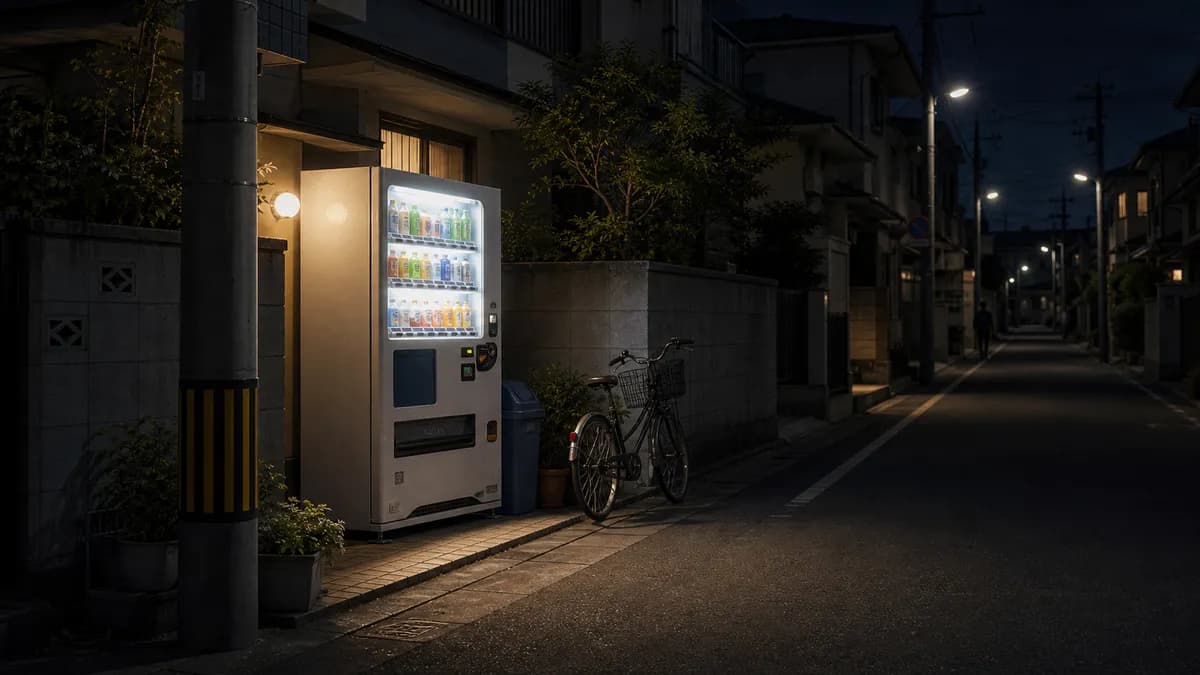
Outside convenience stores that are already open 24 hours. In hospital lobbies. At the top of hiking trails, where a cold drink after an hour of climbing feels genuinely earned. In the basement corridors of office buildings. On the platforms of unmanned rural stations where no human has staffed a ticket window in years. And in residential alleys — quiet ones, lined with houses — where a single machine hums between midnight and sunrise for the occasional person walking home late.
Japan's vending machine also does something that surprises most first-time visitors: it sells hot drinks. In winter, a can of hot coffee or hot corn soup sits in the same machine as cold drinks. A red label marks warmth; blue marks cold. This isn't just a technical novelty — it reflects the year-round nature of use. A machine that only sells cold drinks earns less in winter. The hot-cold split effectively doubles the machine's productive season.
There's also regional variation worth noticing. The machine on the mountain sells different things than the one in the office basement — local beer, local tea, seasonal drinks that rotate with the month. The range is its own small document of what people want, in that specific place, at that specific time of year.
If you've watched Japanese anime, you've probably seen a character stop at a machine, drop in a coin, and walk away holding a can. That's not set dressing. It's an accurate frame of ordinary life.
One Way to See It
Here's how I see it — and I'll say upfront that this is one reading, not a verdict.
A vending machine standing alone at night is a small, ongoing vote of confidence in the neighborhood around it. The operator trusts the machine won't be broken into. The passerby trusts it will work. That loop — trust offered, trust returned — repeats quietly, thousands of times a day, in small towns and big cities alike.
I suspect — and I'll only put it this way — that part of what sustains this density is the sheer repetition of that loop not breaking. The machine is there, it works, no one damages it, and so another is placed nearby. It isn't cultural destiny. It's closer to: a system that keeps proving it can sustain itself.
What I can't fully explain with economics alone is the maintenance. Sold-out indicators that are actually kept current. Machines wiped down regularly. A level of care applied to objects that, elsewhere, might be treated as functional but expendable. I won't pretend a spreadsheet explains that part.
Of course, not everyone experiences this the same way. And I won't claim that "trust" is some deep national trait — that's the kind of sentence that sounds meaningful and proves nothing.
The Other Side
It isn't only convenient.
A single vending machine can consume more electricity per year than a household refrigerator. With four million machines running year-round, the cumulative energy load is real and significant. After the 2011 earthquake and resulting power shortages, many operators voluntarily dimmed machine lighting and reduced heating functions. The question of whether this density is worth the environmental cost hasn't been resolved — it's still live.
The landscape question sits right alongside it. Stand at the gate of a historic shrine, look left, and there is almost certainly a vending machine. It isn't only useful — it's also, sometimes, an interruption. Both things are true, and neither cancels the other.
Where to Feel This More Clearly
If you want to understand the vending machine as something more than a curiosity:
Take a rural train line — not the shinkansen, one of the old regional lines — and notice the machines at unmanned stations. Something about a solitary machine in a quiet place carries more weight than the banks of them in Shibuya.
Buy a hot can in January. Hold it in your hands for a few seconds before opening it. That warmth — metal warming your palms in the cold — is something a convenience store bag can't quite replicate. The machine gives you heat before you've even opened a tab.
And pay attention to what each machine sells. The regional variation is small but real, and following it is one of the quieter pleasures of traveling around Japan.
A Closing Question
Japan has this many vending machines because the conditions that make them viable — physical safety, cash infrastructure, dense population, low vandalism — exist here in a particular combination. That's the observable answer, and honestly, it's probably enough.
But the machine humming alone at 2 a.m. on an empty street corner is, in a small way, measuring something. Whether that something is trust, habit, or just economics that happen to work — I'm not sure any of us can say for certain.
The one I always come back to is a machine I'd stop at on the walk home from school. It was old, and half the drinks were from makers whose names I didn't recognize — who even makes this? — and yet, somehow, they tasted good. Not one of today's sleek models; a slightly worn, humming box. I remember the whole thing, down to the coins held in my palm on the way there.
Summer has its own version of that memory: a school-holiday afternoon of chasing insects with friends, throat completely dry, and the ice-cold juice bought with my own pocket money on the way home. I couldn't tell you what the drink was. I can still tell you exactly how cold it was.
And one from adulthood. A winter business trip, too early for the meeting, in a neighborhood with not a single café open — just one vending machine standing alone by the road. I bought a hot coffee, wrapped my hands around the can, and caught myself thinking, at a machine: you're out here doing your best, aren't you. (An honest footnote: as the natural consequence of a hot can of coffee, the first thing I did at my client's office was ask to borrow the restroom.)
If you walk a Japanese street at night, buy a hot can of coffee from one of the machines that appear out of nowhere. That small light glowing on an empty corner is more reassuring than you'd expect.
Sources & References
- Japan Vending System Manufacturers Association (日本自動販売システム機械工業会), annual industry statistics
- Agency for Natural Resources and Energy (資源エネルギー庁) — energy efficiency standards for equipment including vending machines
- A personal reading from everyday observation; interpretive claims cannot be attributed to an external source
A Geek in Japan (Revised & Expanded)
A wide-angle introduction to the 'why' of Japanese culture — manga, anime, Zen, the tea ceremony and more. A natural companion to the topics Naze explores.
The Japanese Mind: Understanding Contemporary Japanese Culture
Chapters on aimai (ambiguity), amae, giri, wa and more — the values beneath the gestures and words. For readers who want to go deeper into the 'why.'
Share this article
Read Next
- Everyday JapanWhy Are Japanese Train Bento (Ekiben) So Special?Ekiben turn the train journey into a curated regional food tour. Here's the quiet logic behind Japan…
- Everyday JapanWhy Are There So Many Signs and Notices in Japan?Japan's streets and stations are layered with notices. Here's what the density reveals about preempt…
- Everyday JapanWhy Do Japanese People Care So Much About Seken?Seken — Japan's unnamed collective gaze — shapes everything from garbage etiquette to career choices…
- Everyday JapanWhy Do Japanese Households Still Keep a Handwritten Kakeibo? — The 1904 Method Behind the NotebookKakeibo — Japan's household account book — traces back to 1904, when journalist Hani Motoko proposed…
- Everyday JapanWhy Are Japanese 100-Yen Shops So Surprisingly Good? — The Daiso Model ExplainedJapan's 100-yen shops aren't just cheap stores — they run a specific model built on massive order vo…
Related Articles
Articles in the same category:
- Why Is Japanese Curry So Different from Indian Curry — and How Did It Become Japan's National Dish?
- Why Do Japanese People Eat KFC at Christmas? — The Ad Campaign That Became a Tradition
- Why Are Japanese Convenience Stores So Good? — How the Konbini Became Infrastructure
- Why Do Japanese People Queue So Neatly? — The Quiet Trust Behind the Line