Why Do Japanese Children Walk to School Alone? — The Hidden System Behind the Independence
Everyday Japan · 2026-06-19 · ~1,800 words · ~7 min read
Contents (6)
- The Scene That Stops Visitors Cold
- Not Alone — Just Watched Differently
- The Group Walk That Isn't Quite a Group Walk
- Why the Randoseru Is Bright Yellow
- The Shadow Side — Real and Worth Saying
- What It Actually Looks Like
Tokyo, 8 AM. The platform is packed. Salary workers in dark suits stare at their phones. Someone is eating a convenience store onigiri standing up. And threading through all of it, pulling a square school bag up to the ticket gate with both hands: a child who looks about six years old, alone, navigating the morning commute with the quiet efficiency of someone who has done this every day for three weeks, because they have.
For many visitors from countries where children are driven to school in cars or accompanied to the gate, this is the moment that stops them. Where are the parents? Is this allowed? What if something happens? (It's also a vivid piece of a larger pattern — the infrastructure of watchfulness explored in Why Is Japan So Safe?.)
The short answer is that Japan has built an elaborate, largely invisible system to make exactly this possible. The child isn't being abandoned. They're being watched — just not by their parents.
The Scene That Stops Visitors Cold
Research on school commuting in Chiba, Japan, published in the International Journal of Behavioral Nutrition and Physical Activity (2021), found that over 79% of elementary school children commuted independently — on foot, by bicycle, or by public transit — with negligible difference between boys and girls. That figure is strikingly high compared to most other developed countries, where independent school travel has been declining steadily for decades.
The conventional explanation is that Japan is a safe country, which is true in measurable ways. But safety alone doesn't explain the logistics. A parent who has just moved to Japan from the United States or Germany doesn't feel safe immediately just because the crime rate is lower. What changes over time is the discovery that a whole set of structures exists to support the commute — structures that aren't visible from outside the system.
Not Alone — Just Watched Differently
Every elementary school in Japan designates specific walking routes to school, called tsūgakuro (通学路). These aren't just lines on a map. They're surveyed, maintained, and marked with signs. The PTA — the parent-teacher association, which is active and taken seriously at most Japanese elementary schools — produces an annual safety map of the school's neighborhood. These maps note dangerous intersections, areas with poor sightlines, and spots where children have been approached by strangers. The maps feed into lobbying the local government for guardrails, crosswalk markings, and traffic signals.
Then there is the 110-ban no ie system — literally "110-number houses," named for Japan's emergency police number. This is a community safety scheme run in cooperation among police, local governments, schools, PTAs, and neighborhood crime-prevention groups; exactly who registers and operates the houses varies from one municipality to another. Participating homes and shops display a recognizable placard near their entrance. A child who feels threatened, gets lost, or is injured can knock on any of those doors and expect help. The placard is common enough that children are taught to look for it the way they're taught to look for a fire alarm.
On weekday mornings, community volunteers — often retired residents organized through the PTA or neighborhood associations — station themselves at crossings along the school routes. This isn't a rare gesture in a particularly civic-minded neighborhood; it's a routine structure across much of Japan. Some volunteers appear every single school day, year after year, in an identifying vest, watching the same intersection.
Nippon.com's analysis of this system describes it accurately as "tightly regulated independence" — the child appears free, but the freedom is structured, route-constrained, timed, and monitored. Deviating from the designated route, stopping at a convenience store on the way, or arriving outside the accepted window can trigger a call home from the school. The independence is real, and so is the scaffolding around it.
The Group Walk That Isn't Quite a Group Walk
Japan has a formal version of the school commute called shūdan tōkō (集団登校) — group school walking. Children from the same neighborhood are organized into small units called han (班), typically of five to eight children, and they walk to school together. An older student — usually a fifth or sixth grader — leads the group. The youngest children walk in the middle or at the back.
The origins of this system trace to the postwar period, when it developed partly as a response to the surge in traffic accidents as Japan motorized rapidly in the 1950s and 60s. Children walking in a visible, organized group were easier for drivers to spot than individual children weaving along the road. The educational ministry later formalized support for the model, though implementation varies by school and region.
The han unit shows up everywhere in Japanese elementary education. Classrooms are divided into hans for daily tasks: distributing materials, cleaning the room, serving lunch. The group commute extends this logic into the street. Learning to lead a group, to wait for the slowest member, to take responsibility for younger children — these are skills the morning walk is supposed to build, not incidentally but deliberately.
In practice, shūdan tōkō is most strongly maintained in the first weeks of the school year and in more rural areas. Urban schools often see it fade as children get older and their routes diverge across a more complex transport network. But the structure remains as a fallback, and most children experience it at some point.
Why the Randoseru Is Bright Yellow
The randoseru — the hard-sided, boxy school bag that has become a design icon in its own right — is not just a bag. It is a visibility device.
Standard randoseru have reflective panels and piping sewn in. When a car's headlights hit them, the bag lights up. This matters in the morning dark of winter commutes and in the early dusk of autumn.
Most schools require first graders to attach a large yellow cover over their randoseru. The yellow cover functions as a developmental signal: this child is new, in their first year, still learning the route. Other children, community volunteers, and drivers are informally expected to give these children extra attention. Many schools also supply yellow hats for first graders, or fluorescent safety vests in areas where the commute is particularly exposed to traffic.
The accumulated effect is that a six-year-old walking to school is, in fact, very visible. More visible, arguably, than a child sitting in the back seat of a car. The visibility is designed in.
The Shadow Side — Real and Worth Saying
None of this means the system is without failures, and it would be dishonest to suggest otherwise.
Traffic accidents involving children on their way to or from school continue to occur in Japan, and certain intersections see recurring incidents despite years of safety campaigns. Child abduction attempts — though statistically rare — are reported every year, and they tend to generate intense local response: more volunteers, more cameras, revised routes. The system is not a fixed solution but a process, continually updated when something goes wrong.
There is also a subtler tension in the system's design. The rules around the commute — use only the designated route, do not deviate, arrive within the time window — can feel restrictive to children who want to explore, take a different path home, or stop somewhere. A child reported as missing because they took a shortcut their parents didn't know about is not a hypothetical situation; it's a type of incident that school administrators recognize. The structure that enables independence also limits a certain kind of freedom.
And the volunteer infrastructure that underpins the system depends on having enough retired adults in a neighborhood who are willing and able to show up every morning. In areas with aging or declining populations, maintaining coverage is increasingly difficult. The system works partly because Japan's older generation has historically been available and community-oriented in ways that may not persist indefinitely.
Japan's school bullying statistics have also risen in recent years — a reminder that the commute infrastructure addresses external safety, not the social pressures children encounter among peers. The same child who navigates the morning rush-hour train competently may be facing something harder inside the classroom. Safety on the route is real. It is not the whole picture.
What It Actually Looks Like
If you're in Japan during a weekday morning and you want to see this system in motion, find a residential street near an elementary school between about 7:45 and 8:15. You'll see the han groups: a line of five or six children, the tallest in front, the smallest near the back, probably moving faster than you'd expect. At certain corners, a volunteer in a reflective vest will nod as they pass.
What you probably won't see is the PTA safety map on a wall somewhere, or the list of 110-ban no ie households, or the school's records of which children arrived and when. The visible part of the system is the children walking. The invisible part is considerably larger.
For context on what this looks like from the inside, the documentary series Hajimete no Otsukai ("My First Errand," which has been available on Netflix in some regions — availability changes by country and over time) follows young children — sometimes as young as two or three — completing small solo tasks in their neighborhoods. It's a useful lens for understanding the cultural logic: the errand is real, the child's anxiety is real, and the camera crew following them is also real. Independence in Japan is often staged and supported in ways that aren't immediately obvious from the outside.
A six-year-old commuting alone in Tokyo is not proof that Japan is magically safe or that Japanese parents are unusually relaxed. It's proof that the community around that child has done a significant amount of work — mostly invisible, mostly unacknowledged — to make that commute possible.
For what it's worth, here's my own memory of it. As a child I walked to school alone, a route that ran somewhere between thirty minutes and an hour. There were posters up warning about suspicious characters, as I recall — and yet I almost never felt anything like real danger. What my body remembers far more vividly is the rural stretch: a road with nothing but rice paddies, where the only sound was insects and frogs, loud enough to fill the whole air, and beneath it a silence so total that I'd sometimes feel I'd wandered into another world. That was the part that frightened me, a little. More than "safe" or "dangerous," it's that particular stillness I can still summon clearly.
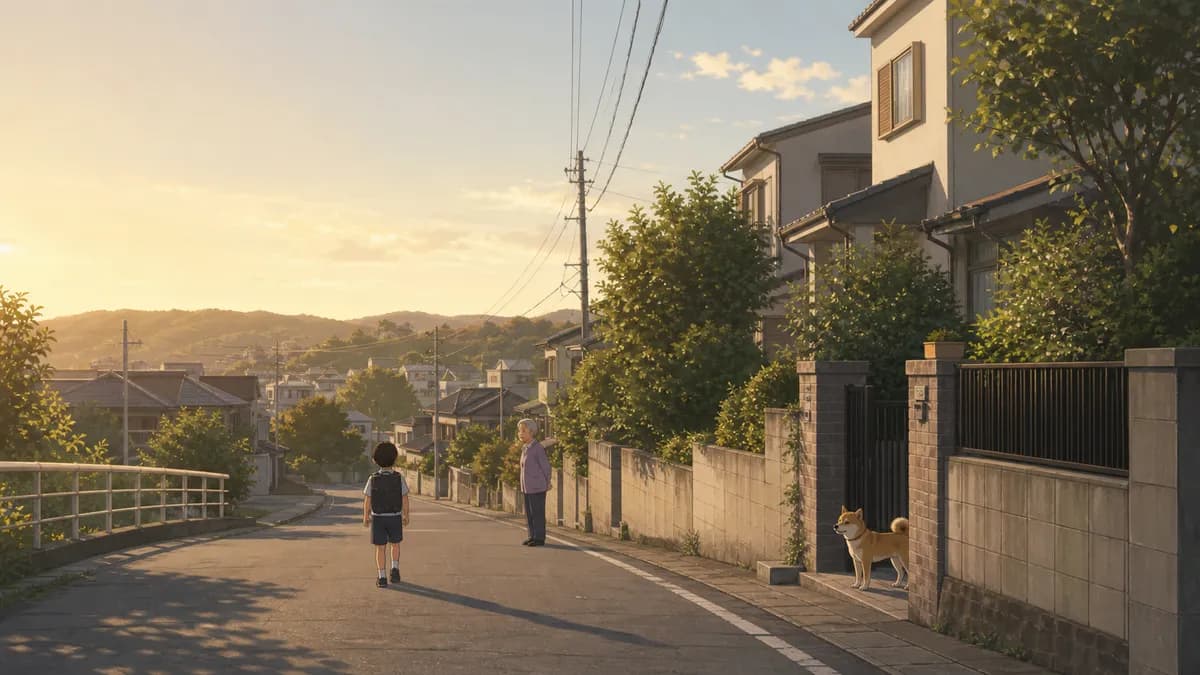
That work, and who does it, and whether it can be sustained, is a more complicated question than the image suggests.
Sources & References
- Independent school commute rates: International Journal of Behavioral Nutrition and Physical Activity — Associations of neighborhood built, safety, and social environment with walking to and from school among elementary school-aged children in Chiba, Japan (2021)
- System structure analysis: Nippon.com — The Tightly Regulated "Independence" of Japanese Children
- Community volunteer and 110-ban no ie system: Web Japan — Local Communities and Monitoring Services Support Children in Doing Things Independently
- Safe Routes Partnership case study: Safe Routes Partnership — SRTS Lessons and Inspirations from Japan
- Walking school bus history: ResearchGate — International Origins of Walking School Buses and Child Fatalities in Japan and Canada
- Interpretive sections represent a reading based on the above sources and everyday observation; cultural framing is offered as one possible reading, not as definitive explanation
A Geek in Japan (Revised & Expanded)
A wide-angle introduction to the 'why' of Japanese culture — manga, anime, Zen, the tea ceremony and more. A natural companion to the topics Naze explores.
The Japanese Mind: Understanding Contemporary Japanese Culture
Chapters on aimai (ambiguity), amae, giri, wa and more — the values beneath the gestures and words. For readers who want to go deeper into the 'why.'
Share this article
Read Next
- Everyday JapanWhy Are Japanese Train Bento (Ekiben) So Special?Ekiben turn the train journey into a curated regional food tour. Here's the quiet logic behind Japan…
- Everyday JapanWhy Are There So Many Signs and Notices in Japan?Japan's streets and stations are layered with notices. Here's what the density reveals about preempt…
- Everyday JapanWhy Do Japanese People Care So Much About Seken?Seken — Japan's unnamed collective gaze — shapes everything from garbage etiquette to career choices…
- Everyday JapanWhy Do Japanese Households Still Keep a Handwritten Kakeibo? — The 1904 Method Behind the NotebookKakeibo — Japan's household account book — traces back to 1904, when journalist Hani Motoko proposed…
- Everyday JapanWhy Are Japanese 100-Yen Shops So Surprisingly Good? — The Daiso Model ExplainedJapan's 100-yen shops aren't just cheap stores — they run a specific model built on massive order vo…
Related Articles
Articles in the same category: