Why Does the Japanese Convenience Store Checkout Ask So Many Questions?
Everyday Japan · 2026-06-15 · ~1,650 words · ~6 min read
Contents (6)
- The Full Lineup
- What Changed in 2020
- Why Ask Rather Than Assume?
- The Script Outlives Its Meaning
- What Actually Helps at the Register
- A Question Back
You've been in Japan for three days. You've figured out the IC card, survived the ticket machine, and successfully bought a hot coffee from a vending machine without pressing the wrong button. You walk into a Lawson, grab a rice ball from the cold case, and join the short queue feeling fairly capable.
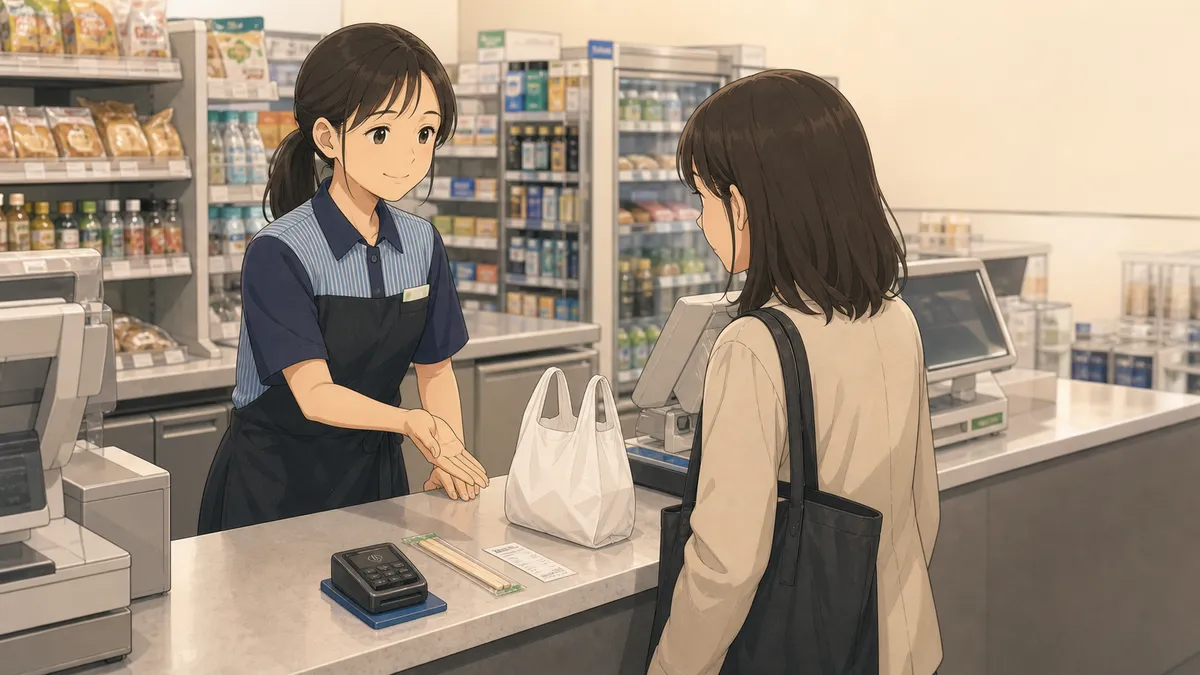
Then the cashier scans your onigiri and turns to you. "Fukuro wa go-riyō desu ka?" "Atatame masuka?" "Ohashi wa go-riyō desu ka?" "Ponto kādo wa o-mochi desu ka?" "Reshīto wa yoroshii desu ka?" — five questions, in about fifteen seconds, delivered in practiced, friendly, rapid-fire Japanese.
If you catch maybe two words out of each sentence, you are not alone. Plenty of first-time visitors report the same experience: nodding in the wrong place, accidentally agreeing to a bag they didn't want, or freezing entirely while the person behind them shifts their weight. By the time the total appears on the screen, the rice ball feels earned.
For a 160-yen purchase, that is a genuinely impressive number of questions.
The Full Lineup
Before getting into why this happens, it helps to know exactly what you're being asked. Here is the standard checkout sequence at most major Japanese convenience store chains — Seven-Eleven, Lawson, FamilyMart — roughly in order:
1. "Do you need a bag?" (袋はご利用ですか?) Plastic bags cost between ¥2 and ¥10. This is an opt-in, not a default. Say yes and it's added to your total; say no or show a reusable bag and the question is done.
2. "Would you like this heated?" (温めますか?) For rice balls, bento boxes, nikuman steamed buns, and anything flagged as warm-able. The microwave is right there at the register. Yes or no.
3. "Do you need chopsticks? Or a spoon?" (お箸・スプーンはおつけしますか?) Some chains separate these into two distinct questions. Either way, if you're eating at home with your own utensil drawer, you probably don't need them.
4. "Do you have a point card?" (ポイントカードはお持ちですか?) Nanaco for Seven-Eleven, Ponta or d-point for Lawson, T-Point or FamiPay for FamilyMart. If you don't have one, "daijoubu desu" works perfectly.
5. "Would you like your receipt?" (レシートはよろしいですか?) Many chains have moved away from printing automatically and now ask. You can say yes if you want one for an expense report; otherwise decline.
6. "Please confirm your age" (年齢確認をお願いします) For alcohol or tobacco only. A touchscreen prompt appears; you tap a button confirming you're 20 or older. No ID check — just the tap.
Six checkpoints in roughly ninety seconds. The order varies slightly by chain and by individual staff member, but the questions themselves are remarkably consistent across the major chains. This is not improvisation. This is a script.
What Changed in 2020
The bag question is the newest addition to be formally scripted in — and it's arguably why the whole sequence became noticeable to people who had been sleepwalking through it for years.
In July 2020, Japan's Ministry of Economy, Trade and Industry (METI) made charging for plastic shopping bags mandatory at all retailers nationwide, as part of broader efforts to reduce single-use plastic consumption. Before that, individual chains had their own policies, and a significant number simply bagged your items by default, silently, without asking. From July 2020 onward, defaulting to a bag became non-compliant. Asking became mandatory.
This had an interesting side effect on perception. For regular konbini customers — Japanese and otherwise — the checkout had been automatic for long enough that the questions registered as background noise, something to process and respond to without really hearing. The 2020 change forced active engagement with at least one question. And once you're actually listening to the bag question, the others stop fading into the ambient hum. People who had been absorbing the checkout ritual passively for years suddenly started actually hearing it.
The question list didn't get dramatically longer in 2020. It just got louder.
Why Ask Rather Than Assume?
Here's how I read it — not a verdict, just one angle among several.
Each of those questions is there because assuming the answer means making a decision that isn't yours to make. If a cashier warms your rice ball without asking, they've overridden a choice that belonged to you. If they skip the chopsticks question, the person who actually needed chopsticks goes without. If they automatically print a receipt you didn't want, that's wasted paper. If they skip printing and you needed it for an expense claim, that's a genuine problem.
There's a phrase that comes up in Japanese customer-service contexts: 勝手に決めない — roughly, "don't decide things on your own authority." I'm not claiming every cashier consciously holds that phrase in mind while scanning your 11 p.m. nikuman. But the structure of the checkout clearly encodes something like it. Each question hands a small decision back to the customer, explicitly, rather than absorbing it invisibly into the cashier's own judgment. The checking becomes the form of care.
I won't say this is the reason — I suspect there are several reasons operating simultaneously, including corporate liability concerns, franchise training standards, and the accumulated weight of policy decisions made over decades. Some of the questions may have started as genuine hospitality and gradually become compliance. Probably all of those things are true in different combinations, at different stores, at different hours.
But the pattern — confirm before acting, even when the answer seems obvious — shows up in enough other Japanese service contexts that it feels like more than coincidence. The question is the form of respect for your preference, even when your preference is entirely predictable.
The Script Outlives Its Meaning
Here is the other side, and it is also true.
For visitors who don't speak Japanese — or who speak it but aren't prepared for the pace of retail Japanese — the checkout can feel like an obstacle course with no patience for uncertainty. The questions arrive in rapid succession. There is no built-in pause in the script for processing. If you're still decoding "atatame masuka?" the next question has already started. The consideration embedded in the design doesn't help much when you can't decode the questions fast enough to respond to them.
For frequent customers, the exchange often becomes mechanical on both ends. The cashier produces the sequence; the customer fires back answers in matching cadence. No real exchange takes place. The form of consideration is still there — the questions are still asked — but the interaction they were designed to produce has dissolved into reflex. Think of a flight attendant's safety demonstration that passengers sleep through, or a "how are you?" that nobody expects an actual answer to. The gesture references care without performing it.
That is worth sitting with, without making too much of it. A checkout script designed around consideration can, over time, become a script designed around the shape of consideration rather than its contents. Neither the original intention nor its gradual erosion cancels the other out. Both exist at once, often in the same transaction.
Personally, I do sometimes find it a hassle. But I also figure it's probably unavoidable, given the character of Japanese society. And if you become a regular at the same store, I suspect a lot of that back-and-forth quietly drops away. In fact, konbini staff often remember your face — or "the usual" — and get ahead of it for you. The script runs as a script, and yet, inside it, an actual relationship between two people quietly takes shape.
What Actually Helps at the Register
If the konbini checkout is giving you trouble, here is what actually makes it manageable.
Carry a small reusable bag. (エコバッグ, eco-bag — sold in the accessories aisle at most ¥100 shops.) Hold it up as you approach the register. The bag question evaporates. Question one, handled without a word.
Learn "daijoubu desu" (だいじょうぶです — roughly "I'm fine, thank you"). It works as a polite decline to almost every question in the sequence. Bag? Daijoubu desu. Chopsticks? Daijoubu desu. Point card? Daijoubu desu. Receipt? Daijoubu desu. Four of six questions resolved with two words.
For heating: "Hai" warms it. Or point at the item and say "atatame" — that works too.
For the age confirmation touchscreen: Just tap the button. Nobody is checking your ID. The tap is the confirmation.
The sequence becomes manageable once you understand it's a fixed loop, not improvisation. You stop reacting to questions as surprises and start anticipating them in order. By your fourth or fifth konbini visit, the whole thing takes about eight seconds.
A Question Back
I sometimes think about what this looks like from the reverse direction — from the perspective of someone who grew up somewhere the bag is assumed, the receipt is automatic, and a fast transaction is itself a mark of good service.
Not worse, not better. Just organized around a different default assumption. In a system where the operating assumption is "you probably want what most people want," the transaction is quieter and faster. In a system where the assumption is "I'll check, because maybe you don't," the transaction is slower and noisier — and theoretically more precise about your actual preferences in that specific moment.
Each says something quiet about what "good service" is understood to mean. Neither is obviously correct.
Where you're from — who decides what ends up in the bag?
Sources & References
- Ministry of Economy, Trade and Industry (METI) — Plastic Bag Charging System (mandatory from July 1, 2020)
- Personal observation from everyday konbini visits; cultural interpretation reflects personal reading only, not external sources.
A Geek in Japan (Revised & Expanded)
A wide-angle introduction to the 'why' of Japanese culture — manga, anime, Zen, the tea ceremony and more. A natural companion to the topics Naze explores.
The Japanese Mind: Understanding Contemporary Japanese Culture
Chapters on aimai (ambiguity), amae, giri, wa and more — the values beneath the gestures and words. For readers who want to go deeper into the 'why.'
Share this article
Read Next
- Everyday JapanWhy Are Japanese Train Bento (Ekiben) So Special?Ekiben turn the train journey into a curated regional food tour. Here's the quiet logic behind Japan…
- Everyday JapanWhy Are There So Many Signs and Notices in Japan?Japan's streets and stations are layered with notices. Here's what the density reveals about preempt…
- Everyday JapanWhy Do Japanese People Care So Much About Seken?Seken — Japan's unnamed collective gaze — shapes everything from garbage etiquette to career choices…
- Everyday JapanWhy Do Japanese Households Still Keep a Handwritten Kakeibo? — The 1904 Method Behind the NotebookKakeibo — Japan's household account book — traces back to 1904, when journalist Hani Motoko proposed…
- Everyday JapanWhy Are Japanese 100-Yen Shops So Surprisingly Good? — The Daiso Model ExplainedJapan's 100-yen shops aren't just cheap stores — they run a specific model built on massive order vo…
Related Articles
Articles in the same category: