Why Is Japan So Safe? What the Streets Actually Tell You
Everyday Japan · 2026-06-14 · ~1,700 words · ~7 min read
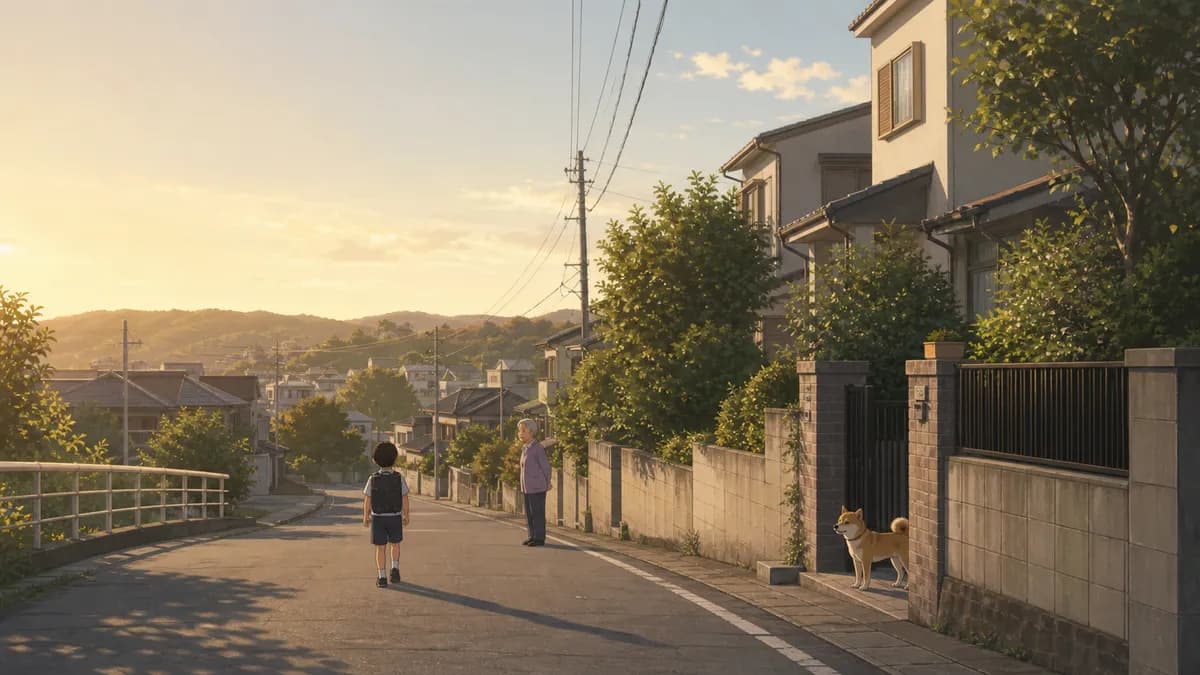
Quick answer: Japan's low crime rate — an intentional homicide rate around 0.23 per 100,000 people, among the lowest on earth (UNODC/World Bank, 2023) — comes less from an absence of dangerous people than from dense, everyday infrastructure: roughly 6,200 neighborhood koban police boxes plus about 6,000 rural chuzaisho, active community networks (neighborhood associations, PTA patrols, watched school routes), strict gun control, and a lost-property system efficient enough that wallets and cash routinely make their way back to their owners. Together, that makes casual crime harder to get away with unnoticed. The real exception: sexual harassment and assault, particularly groping (chikan) on crowded trains, is genuinely common and significantly underreported — the safety reputation is real, but it isn't uniform, and normal precautions still apply, especially for women traveling alone at night.
Contents (6)
- Safety as Goodwill Running by Default
- The Everyday Details That Explain Themselves
- Here's How I See It — One Reading Only
- Not Everyone, and the Shadow That Has to Be Named
- Where to Feel This Most Clearly
- No One Is Watching. People Still Pay.
Walk through a quiet residential street at midnight, well outside the city center. A woman walks alone, earphones in, no visible tension in her posture. There's almost no one around — just the sound of her own footsteps. Nobody is watching her. And yet the air isn't tense.
That quiet ordinariness is often the thing that surprises first-time visitors most. Not the temples, not the technology — the fact that the streets feel safe at any hour. If you've seen it in anime or read about it before arriving, you probably assumed it was idealized. It usually isn't.
So what's actually going on?
Safety as Goodwill Running by Default
Here's the most direct, observable answer: Japan's safety doesn't come primarily from having fewer dangerous people. It comes from goodwill running as the default assumption — the quiet, widely shared bet that the other person probably won't do anything bad — with a lot of small systems built on top of that bet.
That's the core of it. Everything else is texture around that one line.
By the raw numbers, Japan's intentional homicide rate sits around 0.23 per 100,000 people (UNODC figures via the World Bank, 2023) — against a global average closer to 5.6 — among the lowest on earth. But a statistic like that describes the result, not the reason. The reason is more interesting, and most of it is visible on the street.
The koban — the small neighborhood police box — sits at major intersections throughout Japanese cities and towns. According to the National Police Agency, there are about 6,200 koban nationwide, alongside roughly 6,000 chuzaisho (residential police posts staffed by an officer who lives on site) serving smaller towns and rural areas — places too thinly populated for "safety in numbers" to mean much, yet still covered by a face you can go and find. Officers don't just wait inside; they do regular community visits in their assigned area (junkai renraku), staying in touch with local households and businesses, getting a feel for the neighborhood, and noting which corners tend to draw trouble at certain hours.
This isn't abstract community policing — it's a specific, institutionalized system with a physical presence on the street. When you ask a koban officer for directions (genuinely one of their listed functions), you're interacting with a node in a network that covers the whole neighborhood. (How that same network holds up in the world's largest metropolis is its own question — see Why Is Tokyo So Safe?.)
Add to that neighborhood associations (chōnaikai), PTA groups and volunteer fire corps — the fine mesh of people who know each other by face. A circulating notice board (kairanban) passes house to house; neighbors meet at the local festival and the group clean-up; formally designated school routes are watched by community members each morning. Even without the packed-in "many eyes" of a big city, a thin web of we more or less know each other is stretched into the country's most sparsely settled corners.
Safety, here, looks less like surveillance than like a standing assumption of goodwill — gentle, mundane, almost invisible, and quietly renewed every day.
The Everyday Details That Explain Themselves
A few things stand out once you start looking:
Children walk to school alone. A first-grader with a backpack the size of their own torso navigates a crosswalk, bows to the neighborhood crossing guard, and continues on their way — no parent visible. This is standard. The route is called tsūgaku-ro, formally designated in many municipalities, with community members scheduled to stand at key corners each morning during arrival time. Foreign visitors often name this as the most striking thing they notice in Japan — more arresting than any famous landmark. (The full system behind it is broken down in Why Do Japanese Children Walk to School Alone?.)
Unmanned stalls exist — and they're spreading. They used to be a rural thing: a roadside box of vegetables or fruit, the price hand-written in marker on a scrap of cardboard, a cash tin with no lock, no vendor, often no camera. Look closer and sometimes the money box itself is just cardboard — not unlocked so much as unlockable. And the prices sit around a hundred yen, cheaper than any supermarket could ever go: pricing that reads less like commerce than like goodwill with a price tag. But lately the shelves have started carrying stranger things — frozen gyoza, baked sweets and pastries, even racks of secondhand clothes — all sold from a stand nobody is minding, the whole arrangement resting on one unlocked money tin. In much of the world this would be unthinkable. You could simply not pay; no one is watching. But people pay. The easy explanation is "Japanese people are honest," but the more interesting fact runs the other way: the sellers trust that customers will pay, and so they keep adding more kinds of goods. Safety and honesty here look less like a fixed national trait than like something alive — still running on goodwill, quietly widening its range as each side keeps proving the other right.
Lost wallets come back. The Tokyo Metropolitan Police publishes annual lost-property statistics; in its figures reported for 2025, more than ¥4.5 billion in lost cash was turned in to Tokyo police, and over half of it was returned to its owners. This isn't magic; it's a combination of individual honesty and a well-designed return system — station staff, koban officers, central lost-property offices — that makes returning things genuinely easier than keeping them. Both factors matter. Neither alone is sufficient. (How that return system actually works, step by step, is covered in Why Does Lost Property Get Returned in Japan?.)
None of this is unique to Japan in the sense that no other culture values honesty or community. But the infrastructure that makes these behaviors consistently sustainable — and the social expectation that they will be sustained — is unusually dense.
If you'd rather see these scenes than read about them — the koban, the unmanned stall, the child walking to school — we made a quiet three-minute animated version of this question:
Here's How I See It — One Reading Only
I'll be honest: I won't call this "the essence of Japanese culture." I genuinely don't think that phrase does useful work.
What I'd offer instead is this: over decades — arguably longer — Japan has built social and physical infrastructure that makes goodwill the path of least resistance. The trust isn't primarily about fear or control, though it can shade into that. It looks more like a default setting that a great many small systems quietly assume and keep topping up: someone extends good faith, and the systems are arranged to make good faith easy to keep — even out where the population is thin and there aren't many eyes at all.
Perhaps. That's one way to frame it.
Others lean harder on postwar community-rebuilding efforts, on Japan's specific legal structures (low gun ownership is often cited, and the correlation with violent crime is real), on the cultural inheritance of communal responsibility. I'm not in a position to adjudicate between these — and honestly, they're probably all partially true at once, tangled together in ways that resist clean separation.
What I can say is that the everyday observable fact — the glowing koban at the corner, the unmanned vegetable stand, the six-year-old walking alone — does add up to something real and consistent. What exactly that something is, is harder to pin down than the experience of it.
And — having insisted it's about design — let me add one personal thing. When you drop coins into an unwatched box, there's a small choice folded into the gesture: to trust people rather than suspect them. What if you get cheated? Fair enough — you might. And still, to live trusting and occasionally be fooled feels, to me, better for the way I live and easier on my own heart than living on guard. There are moments when that genuinely seems true. The infrastructure may build the safety — but what keeps the infrastructure running is probably this: a great many people quietly making that same small choice.
Not Everyone, and the Shadow That Has to Be Named
Of course, not everyone experiences Japan as safe. That's not a footnote — it's a central part of the picture.
Sexual harassment and assault are significantly underreported in Japan. A 2024 Cabinet Office survey — the first national study focused specifically on groping and molestation (chikan) — found that about 10.5% of respondents aged 16–29 (around 13.6% of women and 3.6% of men in that group) reported experiencing such incidents, and roughly 80% of those affected did not report it to police: a stark example of what criminologists call the "dark figure" of crime. Groping on crowded trains is recognized as a persistent, widespread problem; women-only train cars were introduced on many lines specifically in response.
The official crime statistics look low partly because reporting barriers are high — in the wrong direction.
Japan's "safety" is also sometimes wielded as a silencing argument: "This is Japan, things like that don't happen here." That's a myth, and a damaging one. Safety infrastructure and safety mythology are completely different things. One helps people; the other can prevent them from asking for help.
The child walking to school alone is a real, largely functioning system. The underreported assault is also real. Both need to be said in the same breath.
If you are planning to travel to Japan solo as a woman, the practical side of this picture — women-only train cars, emergency numbers, what to do if something happens — is covered in detail in Is Japan Safe for Solo Female Travelers?.
If you're weighing the more practical, trip-planning version of this question, the specifics are broken out by situation: is it safe to travel to Japan as a general first-timer's overview, is Japan safe at night for what a late walk actually feels like, is Japan safe for solo travelers regardless of gender, and is Japan safe for families if you're traveling with kids.
Where to Feel This Most Clearly
If you want to understand Japan's safety infrastructure concretely rather than statistically:
Visit a koban and ask for directions. Officers expect it; it's in their stated job description. Notice the interior — the neighborhood maps on the wall, the logbook, the way the space is arranged for interaction. Watch who else stops in during the few minutes you're there.
Stand at a neighborhood corner on a weekday morning. Watch the crossing guard — often an elderly volunteer — see the first-graders across the road, and watch the kids bow back. No one is paid much for this; it runs on people showing up, day after day. It's a practiced system operating quietly.
If you find a mushinsho hanbaiki roadside stand, buy something. The transaction will feel unexpectedly deliberate for the seventy yen you're paying for a sweet potato.
These aren't tourist sites. They're the texture of the thing itself.
No One Is Watching. People Still Pay.
Think back to that unmanned shelf by the road. The small exchange that happens there every day — no one watching, and people paying anyway — is a miniature of how this whole street feels safe.
The koban, the watched school route, the lost-and-found office: at root, maybe they're all the same thing. Someone extends a bet — the other person probably won't do anything bad — and for every time that bet goes unbetrayed, the sense of safety thickens a little. Safety may not be the absence of dangerous people. It may be the accumulated thickness of that.
I won't generalize that into a verdict about Japan or anywhere else. But I'll keep thinking about it.
What does your city's sense of reassurance rest on — and what quiet, daily bet is holding it up?
Sources & References
- National Police Agency (警察庁) — Koban & Police Box statistics: about 6,239 koban and 6,026 chuzaisho as of April 1, 2023 (令和5年警察白書), rounded here to ~6,200 koban and ~6,000 chuzaisho
- Tokyo Metropolitan Police Department — Lost Property Annual Report; figures reported via Japan Today (2025): record ¥4.5 billion in lost cash turned in to Tokyo police
- Cabinet Office, Government of Japan (2024) — First national survey on chikan/molestation offenses, via Nippon.com
- Institute for Economics & Peace — Global Peace Index 2025 (Japan 12th of 163)
- UNODC intentional homicide rate, via World Bank — Japan ~0.23 per 100,000 (2023)
A Geek in Japan (Revised & Expanded)
A wide-angle introduction to the 'why' of Japanese culture — manga, anime, Zen, the tea ceremony and more. A natural companion to the topics Naze explores.
The Japanese Mind: Understanding Contemporary Japanese Culture
Chapters on aimai (ambiguity), amae, giri, wa and more — the values beneath the gestures and words. For readers who want to go deeper into the 'why.'
Share this article
Read Next
- Everyday JapanHUBIs Japan Safe for Solo Female Travelers? An Honest LookMany solo female travelers report feeling remarkably safe in Japan — and the country's crime rates b…
- Everyday JapanIs Japan Safe for Families Traveling With Kids?Japan's streets are calm enough that six-year-olds commute alone, but safe and easy aren't the same …
- Everyday JapanIs Japan Safe to Travel To? An Honest Look for First-Time VisitorsJapan's safety reputation is largely deserved — returned wallets, quiet midnight trains, orderly cro…
- Everyday JapanWhy Are Japanese Train Bento (Ekiben) So Special?Ekiben turn the train journey into a curated regional food tour. Here's the quiet logic behind Japan…
- Everyday JapanWhy Are There So Many Signs and Notices in Japan?Japan's streets and stations are layered with notices. Here's what the density reveals about preempt…
Related Articles
Articles in the same category: