Why Japan Has a Dedicated Space Just for Taking Off Your Shoes — Inside vs. Outside
Everyday Japan · 2026-06-08 · ~1,800 words
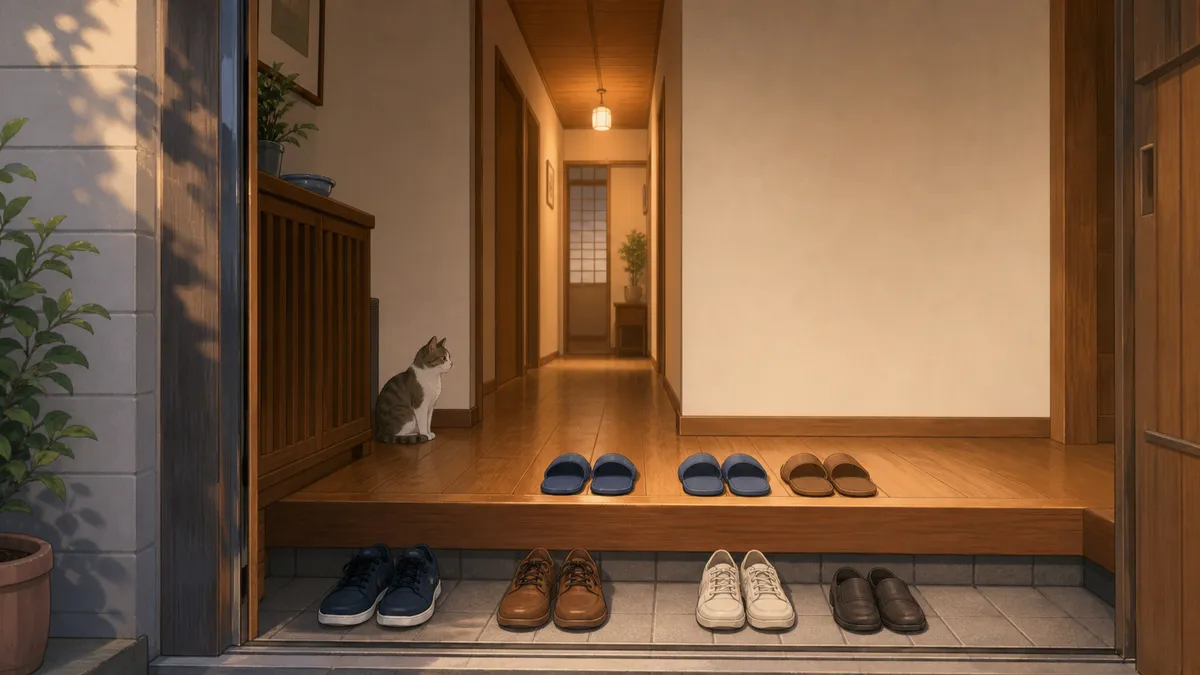
The moment you open the front door of a home in Japan, you step down — not up — into a narrow transitional zone called the genkan. The floor is hard and unfinished compared to what lies beyond. You unlace your shoes, line them up neatly with the toes pointing outward, then step up onto the indoor floor. The material changes. The temperature shifts slightly. Even the acoustics feel different.
That small elevation — sometimes just a few centimeters — might be one of the most symbolically loaded pieces of architecture in everyday Japanese life. It's not just a doormat situation. It's a declared boundary: from here, you are inside.
What the Genkan Actually Is
The genkan is the entryway built into virtually every Japanese home — apartments, detached houses, share houses, old farmhouses. It sits between the front door and the rest of the living space, and it's designed around a single assumption: you will remove your shoes here.
The lower area — called tataki, typically tiled or concrete — is where you stand in your outdoor shoes. The raised portion is the indoor floor. Between them is a step. Alongside the step, you'll almost always find a geta-bako (shoe cabinet), often a tall built-in unit that keeps footwear out of sight.
The expected etiquette: remove shoes on the tataki, arrange them with toes toward the door, and step up. It's not complicated, but it's specific. And the specificity is the point.
What strikes people coming from countries where you walk straight from the door to the sofa is that this isn't an afterthought. The shoe-removal zone is built into the architecture from the start. There's no awkward mat by the door. The structure itself tells you what to do.
It's Not Just Homes
If it were only private residences, you might chalk this up to personal preference. But in Japan, taking off your shoes extends far beyond the home — and the range of places is wider than most newcomers expect.
Traditional ryokan (Japanese inns) have grand genkan where staff greet you and you transition from the street into the inn's world. Seated dining rooms (zashiki) in many restaurants require shoes off before you step onto the tatami. Buddhist temples often ask you to remove footwear before entering the main hall. Some schools have indoor shoe areas where students change into uwabaki (soft slippers) at the start of every school day. Fitting rooms in clothing stores sometimes have a small tatami section. Some hospital wards. Some corporate meeting rooms with traditional furniture.
There's usually a visual cue: a step up, a shoe rack at the entrance, or a sign reading dosoku kinshi (no outdoor shoes). When in doubt, look at what others are doing, or just ask — in my experience, people are happy to clarify, and mistakes are almost always met with a smile and a gentle redirect rather than any real irritation.
The Idea Underneath: Inside and Outside Are Different Worlds
Here's where I'll offer a reading rather than a fact — because the history is genuinely complicated and no single explanation covers it cleanly.
One concept that comes up repeatedly when Japanese scholars and writers discuss this custom is the distinction between uchi (inside, one's own domain) and soto (outside, the external world). This polarity shows up in lots of contexts in Japanese social life — the way people behave differently with close friends versus acquaintances, the way language shifts between formal and informal registers, the way a torii gate marks the transition into sacred shrine space.
The shoe-removal moment can be read through this lens. You are not just cleaning your feet. You are switching modes. Whatever accumulated outside — the grime, the noise, the social pressures of the street — stays behind at the tataki. The step up is a small ceremony of arrival.
If pure hygiene were the only goal, you could theoretically wear clean indoor shoes brought from outside, or just clean the floor more often. But that misses the ritual quality of the act. The physical gesture — bending down, removing the shoes, feeling the different floor material under your socks — does something that a shoe brush at the door doesn't. It marks the transition in your body.
Some researchers connect this to Shinto notions of kegare (ritual impurity) and the importance of purification before entering sacred or domestic space. Others point to more practical origins: Japan's historically wet climate, the prevalence of tatami floors (which are damaged by outdoor shoes and comfortable to sit and sleep on directly), and the earthen doma floors of traditional farmhouses where working footwear was simply left behind. Most likely it's a layered accumulation of all of these, rather than one clean origin story.
I'd be cautious about any single authoritative explanation. What I can say is that the practice is widespread, consistent, and clearly meaningful to many people — even if they've never consciously thought about why.
How It Shows Up in Modern Life
Modern Japan runs on this system with barely a second thought. Walk into any contemporary apartment — even a tiny studio in Tokyo — and there's the genkan step. Sleek minimalist condos, century-old wooden houses, prefab suburban homes: the architecture accommodates it every time.
For people who grow up with it, the rhythm becomes automatic. You get home, step down, shoes off, step up, slippers on (many households keep a pair of indoor slippers near the step). The whole sequence takes maybe fifteen seconds and happens without thinking.
For visitors or newer residents, it takes a bit longer to internalize. There's a period — usually a few weeks — where you have to consciously remind yourself. Then at some point it flips, and arriving home without doing it starts to feel slightly wrong.
One thing I've noticed: the genkan also functions as a kind of decompression chamber. The few seconds it takes to remove your shoes is a small enforced pause between whatever was happening outside and whatever is about to happen inside. It's a reset, however minor. Whether that's intentional or just a byproduct, it seems to do something psychologically.
What People Visiting Japan Often Say
A common observation from first-time visitors — especially those staying in ryokan or traditional guesthouses — is that the shoe removal feels awkward at first, then surprisingly pleasant. The tactile shift from outdoor shoes to inn slippers, combined with the visual shift from street to interior, creates a sense of having genuinely arrived somewhere. It's more immersive than a hotel check-in with a key card.
Practically speaking, the main stumbling point for visitors is reading the cues correctly. A step and a shoe rack are usually enough to signal the expectation. If you accidentally walk in with shoes on, you'll almost certainly be told — kindly — before you get very far. The better prepared you are for this expectation, the less likely you are to cause anyone embarrassment (including yourself).
For what it's worth: wearing shoes with easy on-off closures makes a day of temple visits significantly smoother. This is the kind of thing travel guides mention but doesn't fully land until you're standing at your third shoe-removal threshold of the afternoon.
The Honest Counterpoint: It's Sometimes Just a Hassle
I want to be fair here, because not everyone who lives in Japan finds this system charming or symbolically rich. Many people simply find it normal — neither meaningful nor burdensome — because it's all they've ever known. And others actively find it inconvenient.
Forget something inside when you're already halfway to work? You have to go back through the whole shoe ritual. Guests arrive and there's not enough space in the genkan for everyone's footwear. Winter mornings when the floor is cold and you haven't located your slippers yet. These are minor frictions, but they're real ones.
There's also a growing accessibility conversation. Elderly people with limited mobility, wheelchair users, visitors with certain physical conditions — the step-and-bend-down routine isn't comfortable or possible for everyone. Some temples, inns, and public buildings have been expanding shoe-on zones as part of barrier-free renovations. Some newly built homes opt for flat, level entryways that blur the distinction. The idea that Japan always means shoes off is, slowly, becoming a bit less absolute.
That said, the practice isn't going anywhere soon. In most private homes and many traditional venues, it remains the default — and for many people, the moment of stepping up into the indoor space still carries that quiet sense of having crossed into somewhere different.
Whatever its origins — climate, tatami culture, Shinto ideas about purity, architectural convention — the genkan step is one of those small things that ends up telling you something larger about how a particular society has decided to organize its world. Inside and outside are different. The threshold between them deserves a moment of acknowledgment.
Your front door at home — does it have a step?
Sources & References
- General references on Japanese residential architecture and the genkan tradition; interpretations of uchi/soto distinctions in Japanese social life draw on widely discussed frameworks in cultural anthropology — multiple competing explanations exist and no single origin is academically settled.
- Shinto concepts of kegare and purification: various introductory texts on Japanese religious practice; the connection to shoe removal is one proposed interpretation among several.
- Barrier-free and accessibility developments in Japanese public and traditional spaces: ongoing topic in Japanese architecture and hospitality sectors as of mid-2020s.
A Geek in Japan (Revised & Expanded)
A wide-angle introduction to the 'why' of Japanese culture — manga, anime, Zen, the tea ceremony and more. A natural companion to the topics Naze explores.
The Japanese Mind: Understanding Contemporary Japanese Culture
Chapters on aimai (ambiguity), amae, giri, wa and more — the values beneath the gestures and words. For readers who want to go deeper into the 'why.'
Share this article
Read Next
- Everyday JapanWhy Are Japanese Train Bento (Ekiben) So Special?Ekiben turn the train journey into a curated regional food tour. Here's the quiet logic behind Japan…
- Everyday JapanWhy Are There So Many Signs and Notices in Japan?Japan's streets and stations are layered with notices. Here's what the density reveals about preempt…
- Everyday JapanWhy Do Japanese People Care So Much About Seken?Seken — Japan's unnamed collective gaze — shapes everything from garbage etiquette to career choices…
- Everyday JapanWhy Do Japanese Households Still Keep a Handwritten Kakeibo? — The 1904 Method Behind the NotebookKakeibo — Japan's household account book — traces back to 1904, when journalist Hani Motoko proposed…
- Everyday JapanWhy Are Japanese 100-Yen Shops So Surprisingly Good? — The Daiso Model ExplainedJapan's 100-yen shops aren't just cheap stores — they run a specific model built on massive order vo…
Related Articles
Articles in the same category: