Why Is Japan So Clean If There Are Almost No Trash Cans?
Everyday Japan · 2026-06-03 · ~2,000 words · ~7 min read
Contents (8)
- The Answer Isn't in the Infrastructure
- A Bit of History: Where the Bins Went
- The Habit, and Where It Comes From
- The Deeper Layer of "Being Allowed to Throw It Away"
- How I See It — One Reading, Not a Verdict
- The Shadow That Goes With It
- Where to Notice It
- A Quiet Agreement
You step off the Shinkansen with a conbini coffee and the wrapper from the rice ball you ate on the platform. Kyoto Station stretches out in front of you. You look around for a trash can. There isn't one nearby — or there's one somewhere near the platform exit, already packed to the rim. You walk the length of Shijo-dori for the better part of an hour and find perhaps two public bins the whole way.
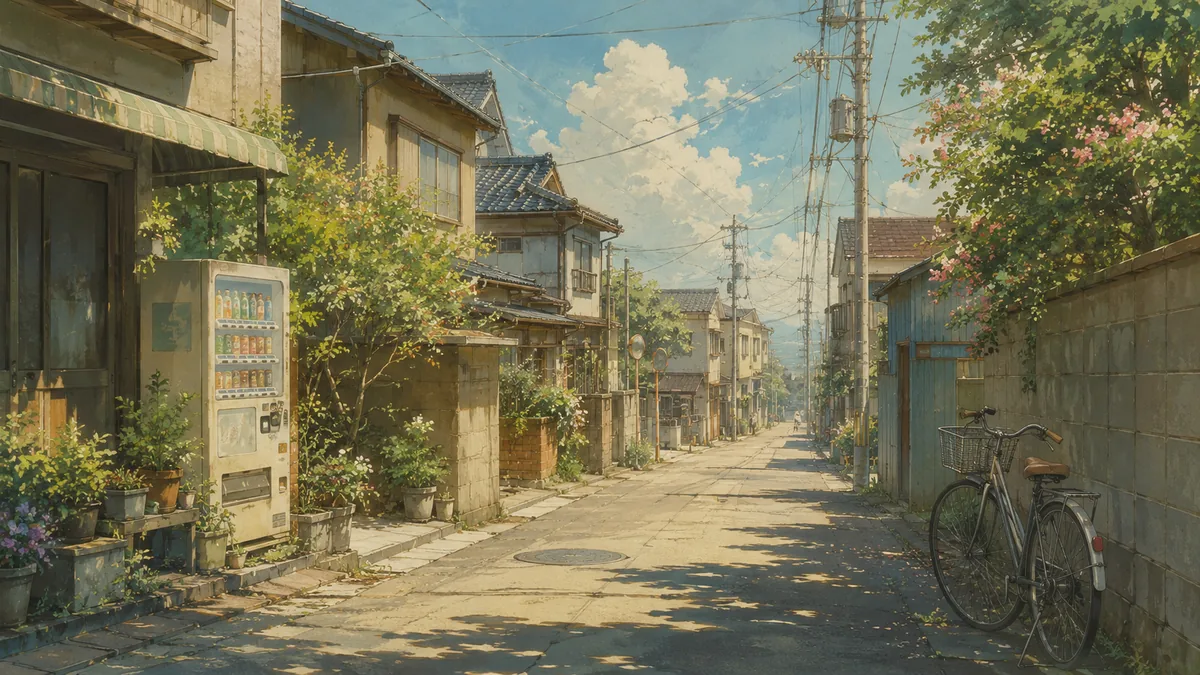
And yet: not a single cup on the ground. No wrappers in the gutter. The pavement is clean.
It's one of the first things visitors notice, and it genuinely puzzles people. Where does the trash go?
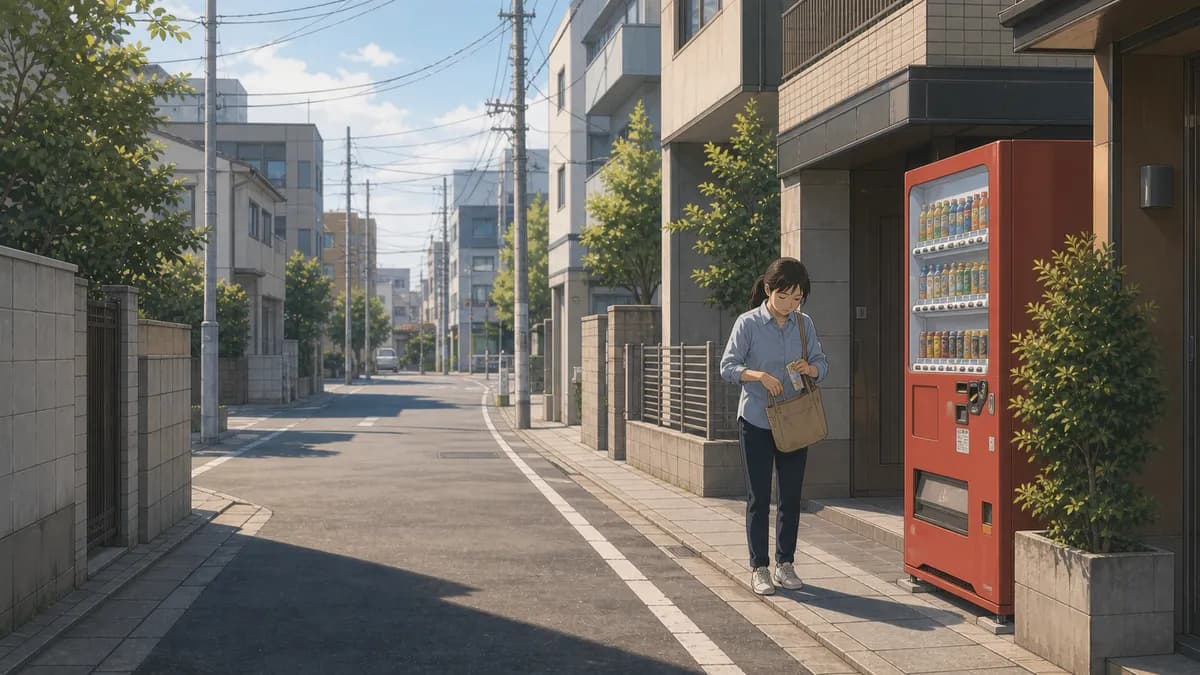
I'll confess my own answer up front: usually, into the bottom of my bag. Right now there's a small piece of yesterday's trash in there — not because I forgot to bin it, but because there was nowhere to, so I carried it home. That small weight at the bottom of a bag is, honestly, closer to the real explanation for "clean" than anything about the streets themselves.
The Answer Isn't in the Infrastructure
The cleanliness isn't in the bins — because there aren't enough bins to explain it. The answer is in the assumption. In Japan, the default expectation carried quietly by most people — learned early, rarely stated out loud — is that whatever you bring out with you, you bring back. The street is not the place to leave things.
That shared assumption is what keeps things clean. Not the city's systems. The individual's default.
A Bit of History: Where the Bins Went
There used to be more. After the 1995 Aum Shinrikyo sarin attack on the Tokyo subway system — one of the most serious acts of domestic terrorism in Japan's postwar history — many public trash cans were removed from stations and public spaces as a security precaution. An enclosed bin is a place to hide something dangerous.
They were never fully reinstated. Some cities, including parts of Tokyo and Osaka, have added bins back near busy stations in the years since. But the general drift has been toward fewer, not more. And the streets stayed clean — not because of the policy alone, but because the policy both reflected and reinforced an underlying habit that was already embedded.
Convenience stores — konbini — are the practical release valve of the current system. Small bins sit at the exit, meant for packaging from in-store purchases only. Beyond that perimeter, in most of Japan's public streets, you carry it.
The Habit, and Where It Comes From
The ritual plays out everywhere once you know to look. A salaryman pockets his cigarette ash-packet without pausing his walk. A schoolchild folds her bread bag and tucks it neatly into her backpack. Someone at a summer festival ties up their yakitori skewers in the small bag they came in and carries the bundle for the next two hours, barely registering it as a choice.
Honestly, my own version goes like this. If I end up with trash while I'm out, I usually just put it in my bag and carry it all the way home. Or I'll think, "I'll dispose of it at the next mall or building I go into." If a public facility happens to have a bin, I use it gratefully. What all of these have in common is that the option of simply setting it down and walking away never seems to enter my head in the first place. Littering makes me uncomfortable — not because it's costly, not because someone might be watching, but in a plainer way: it just doesn't sit right.
That phrasing — "let me dispose of it here" — matters to me more than it might seem. In Japanese there's a real difference between suteru ("to throw it away here") and sutesasete-morau ("to be allowed to throw it away here"). Same physical act, different posture. A bin is something someone put there and someone else empties, and I'm adding one more thing to it by their grace. It's only trash, but that one grammatical difference carries, pretty exactly, the sense that the town is a thing you share with people you'll never meet.
Where does the habit come from? One answer points to school. Sōji — daily cleaning time — is standard in most Japanese public schools. Students clean their own classrooms, hallways, and in many schools, their own toilets. Not as punishment. As routine: typically twenty minutes at the end of each school day. The idea that maintenance is your job — not someone else's, not the janitor's, not the city's — gets embedded early, and stays.
Whether that produces a deeper felt sense of shared responsibility, or simply a well-drilled habit, is something I honestly can't answer. Probably both, in different people.
The Deeper Layer of "Being Allowed to Throw It Away"
Let me pull on that phrase — sutesasete-morau, "to be allowed to throw it away" — a little more.
Trash, after all, is just an object that finished its job a moment ago. And this country still keeps customs, here and there, of pressing your hands together for exactly such objects — a memorial service for broken sewing needles is a real, documented example. Something dwells even in a worn-out tool: at the lowest hem of that old sensibility, the one called yaoyorozu no kami, the eight million gods, even taking out the trash seems to hang on. I can't state any of this as the cause. But look at throwing trash away from that angle —
Setting a can down on the street and walking off. What stops me isn't the law, and it isn't fear of a fine. It may be a faint sense that something dwells in that street, in that bin, in the strangers I'll never meet who walk there. Not so much "don't dirty the town" as "don't be quietly discourteous to whatever lives in it — the presence of other people's lives." That small deference folded into sutesasete-morau rather than the plain suteru probably leaks out from exactly there.
I don't want to inflate this into a story about religion. But it's possible this city's cleanliness sits, more or less unchanged, on an old substrate: the habit of minding even the things you cannot see.
How I See It — One Reading, Not a Verdict
Here's where I want to be careful, because it's easy to read too much into a clean street.
One interpretation is that this connects to a felt sense of shared space — that the street belongs to everyone, and leaving your trash there is a kind of taking from the commons. I've heard older Japanese people describe the feeling as something close to low-key embarrassment: not moral outrage, just the quiet social discomfort of being the person who makes a mess where others have to live.
Another interpretation, which I find equally plausible, is simpler: the behavior is normalized to the point of invisibility. Not a choice that gets consciously made each time, but something that barely registers as a choice at all. "Of course I take this with me — what else would I do?" That level of normalization is different from discipline. It might actually be harder to shift, in either direction.
I lean toward the second reading, personally. The cleanliness feels less like civic pride and more like a shared, mostly unspoken assumption. And that's interesting — not as evidence of some special virtue, but as an example of how far a default can travel once it's embedded in enough people at once.
Of course, not everyone experiences it the same way. There are many views on this.
The Shadow That Goes With It
This is the part that usually gets left out of the "Japan is so clean!" conversation.
A street clean because people genuinely care is a different thing from a street clean because nobody wants to be the one who doesn't comply. For some people who grew up here, the cleanliness carries a low-grade ambient pressure — the awareness that someone might notice, that being visibly out of step with the unwritten rule is a small but real social cost.
The expectation can curdle. "Keeping clean" and "keeping in line" can start to feel like the same pressure. When a visitor drops something accidentally, the response is often helpful and gentle; when someone appears to be flouting the norm, the atmosphere around them can turn noticeably cool. I don't want to overstate this. But it's real — and it's the same mechanism that keeps the street clean.
The warmth and the coolness come from the same root. It isn't only beautiful. Both are true.
Where to Notice It
The contrast is sharpest right after a major public gathering. Hanami season in Yoyogi Park in Tokyo, or Maruyama Park in Kyoto: thousands of people picnic all day under the cherry trees, generating real amounts of waste. By the time the crowds leave — sometimes before they fully clear — volunteer groups are already working through the space with bags and tongs.
Worth watching, if you get the chance. Not as a performance of virtue, but because the range of people involved — elderly residents, people in their twenties, families with small kids — suggests the habit isn't stored in one generation or one type of person.
If you're visiting Japan and wondering what to do practically: carry a small bag. Konbini bags work perfectly. You may not find a bin when you need one, and that's not an oversight — that's the system. A bag folded into a coat pocket makes the whole day easier.
A Quiet Agreement
A clean street with almost no bins is, when you sit with it, a genuinely strange thing. Every clean block in Japan is, in a sense, a quiet ongoing agreement among people who have never met and never discussed the matter — sustained entirely by a shared default that most of them couldn't fully articulate if you asked.
I find that more interesting than "Japanese people are disciplined." It raises a different question: what other things in daily life run on unspoken defaults that nobody consciously chose, and that nobody could easily undo?
I don't have a clean answer. But I notice that when I'm somewhere with bins on every corner, I don't feel more free. I just feel slightly less certain what the rule is.
Today, too, there's one small piece of trash at the bottom of my bag, with nowhere it could go. I've somehow never once felt it as a weight.
How does the street look where you live?
Sources & References
- Ministry of Education, Culture, Sports, Science and Technology (MEXT): school sōji (daily student cleaning) as part of standard curriculum guidance for special activities
- National Police Agency and widely reported public record on the 1995 Tokyo subway sarin attack and subsequent public-space security measures
- No reliable survey data exists on the proportion of Japanese people who consistently carry their trash home; the framing here reflects personal observation, not a measured statistic
A Geek in Japan (Revised & Expanded)
A wide-angle introduction to the 'why' of Japanese culture — manga, anime, Zen, the tea ceremony and more. A natural companion to the topics Naze explores.
The Japanese Mind: Understanding Contemporary Japanese Culture
Chapters on aimai (ambiguity), amae, giri, wa and more — the values beneath the gestures and words. For readers who want to go deeper into the 'why.'
Share this article
Read Next
- Everyday JapanWhy Are Japanese Train Bento (Ekiben) So Special?Ekiben turn the train journey into a curated regional food tour. Here's the quiet logic behind Japan…
- Everyday JapanWhy Are There So Many Signs and Notices in Japan?Japan's streets and stations are layered with notices. Here's what the density reveals about preempt…
- Everyday JapanWhy Do Japanese People Care So Much About Seken?Seken — Japan's unnamed collective gaze — shapes everything from garbage etiquette to career choices…
- Everyday JapanWhy Do Japanese Households Still Keep a Handwritten Kakeibo? — The 1904 Method Behind the NotebookKakeibo — Japan's household account book — traces back to 1904, when journalist Hani Motoko proposed…
- Everyday JapanWhy Are Japanese 100-Yen Shops So Surprisingly Good? — The Daiso Model ExplainedJapan's 100-yen shops aren't just cheap stores — they run a specific model built on massive order vo…
Related Articles
Articles in the same category:
- Why Do Japanese Children Walk to School Alone? — The Hidden System Behind the Independence
- Why Is Japanese Curry So Different from Indian Curry — and How Did It Become Japan's National Dish?
- Why Do Japanese People Eat KFC at Christmas? — The Ad Campaign That Became a Tradition
- Why Are Japanese Convenience Stores So Good? — How the Konbini Became Infrastructure