Why Do Japanese People Soak in the Bath? — The Ofuro as a Daily Boundary
Everyday Japan · 2026-06-03 · ~1,800 words · ~6 min read
Contents (7)
- The Two-Step Structure
- What That Something Else Might Be
- What Anime Gets Right About the Bathtub
- Cleansing, Not Just Washing
- The Side That Doesn't Get Mentioned Enough
- Where to Feel It
- A Question to Leave With
The bathroom in a Japanese home tends to stop first-time visitors mid-step. There's a showerhead, yes — but also a deep, square tub already filled with steaming water. And when the person before you finished bathing, they didn't drain it. The water is still there, kept warm, waiting.
If you grew up in a shower-first culture, this raises questions fast. Is it hygienic? Does everyone use the same water? Why bother with the tub when the shower is right there?
The short answer: washing and soaking are two completely separate acts in Japanese bathing. That one distinction makes the whole system make sense — and opens up something more interesting than hygiene.
The Two-Step Structure
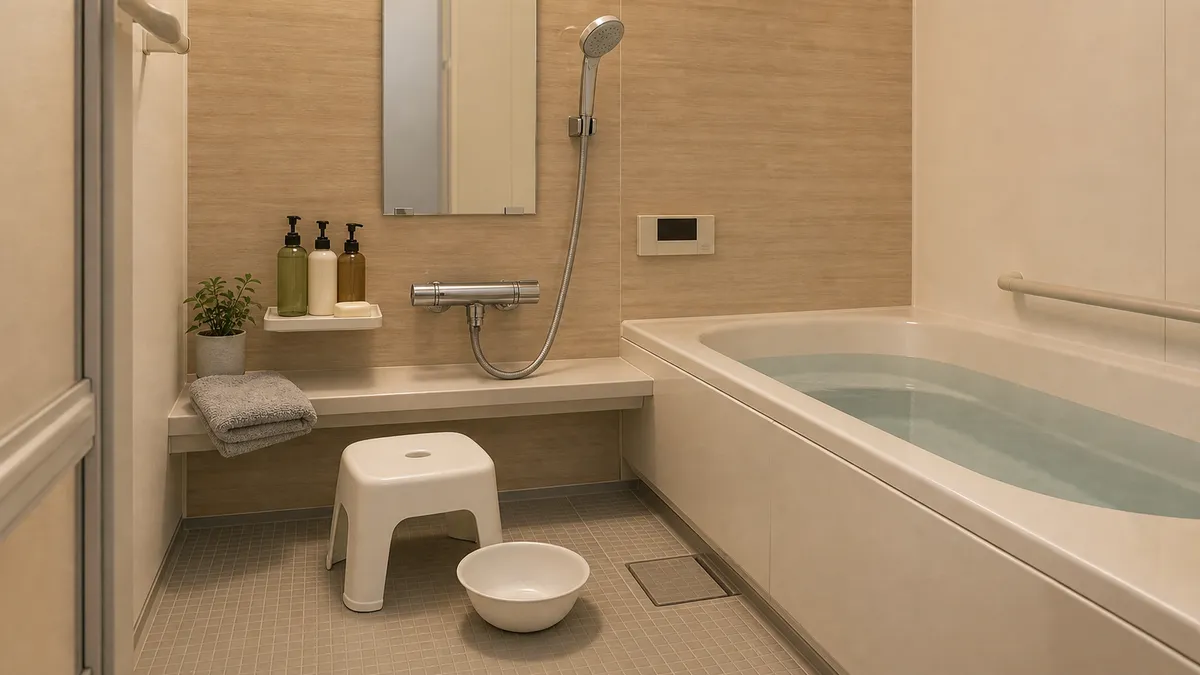
Walk into a standard Japanese bathroom and the layout tells you what to do. On one side: a tiled washing area with a low stool, a showerhead, and soap. On the other: a deep soaking tub. The order is fixed. Sit on the stool, wash your body thoroughly with soap and shampoo, rinse off completely — then step into the tub.
Because everyone enters the tub already clean, the water stays usable across the whole household. A modern gas water heater (kyūtōki, 給湯器) maintains temperature or reheats on demand, so the warmth holds through multiple family members. Nobody drains between turns. The system depends entirely on the wash-first step — and it works because of it.
For someone used to climbing into a bathtub to wash, this feels backwards. But flip the assumption and there's a quiet efficiency to it: washing handles hygiene; soaking handles something else.
What That Something Else Might Be
Japanese bath water typically runs at 40 to 42 degrees Celsius — hotter than what many Western bathtubs aim for. Sink in up to your shoulders and the heat moves through you in a way that takes a moment of adjustment. A typical soak lasts ten to twenty minutes. You can't really do much else in there.
In Japanese households, the announcement that the bath is ready — "O-furo, waita yo" — carries a specific weight. It signals the transition point of the evening: from outside to inside, from public self to private self. The bath often comes before dinner, or just after; the sequence varies by household, but the bath's role as a daily hinge tends to hold.
Here's how I see it — not as a verdict, just one reading. The tub, by being deep and hot and offering no easy distractions, creates a small forced pause. You can't comfortably scroll. You can't half-finish the task you left open on your desk. There's just the sound of water and the heat working through your shoulders.
I suspect — though I can't prove it — that what the ofuro quietly does is give the body a clear signal: this is where the day ends. Not the train home. Not dinner. This.
Of course, not everyone experiences it that way. Plenty of people step in and out in five minutes without a philosophical thought. That's probably the majority. But the fact that Japanese bathroom architecture physically separates washing from soaking — that the tub is a dedicated space, not a dual-purpose one — suggests that getting clean was never the only intention behind the design.
What Anime Gets Right About the Bathtub
If you first encountered Japanese culture through anime, you've almost certainly seen the bath scene. A character sinks into a steaming tub and stares at the ceiling. Steam rises. Something quiet gets said, or thought, that couldn't happen anywhere else in the episode.
These scenes aren't filler. The bath, in everyday Japanese life, is one of the few spaces where the social roles of the day are literally shed — clothes off, nothing to perform, nowhere to be. Anime uses that geography because it reflects something real. Conversations that happen in the bath, in fiction and in life, tend to be more honest than the ones that happen at the dinner table.
The real version is less cinematic: harsher lighting, smaller tubs, the occasional draft from a window that doesn't quite seal. But the underlying geography — a space that sits slightly outside the rest of the day — holds up.
Cleansing, Not Just Washing
Earlier I said the tub seems to dissolve not just dirt but the memory of the hours spent outside. That feeling probably isn't only mine. Across Japan, the idea of cleansing the body with water turns up in all sorts of places. Ascetics stand under waterfalls. Festival-goers pour cold water over themselves before a rite — mizugori (水垢離). A sumo wrestler rinses his mouth before stepping onto the ring. None of these is really about scrubbing off grime; each looks closer to using water to rinse away something invisible — whatever it is that collects on a body over the course of a day and never quite gets a name.
The nightly bath may sit at the low edge of that same current. As the phrase yaoyorozu no kami (八百万の神) — "eight million gods" — suggests, this culture has long received the world as full of unseen presences dwelling in things. In a world felt that way, keeping the body clean was less religion than plain everyday manners. I can't state it as fact. But read that way, that moment of sinking to your shoulders and feeling the day is over looks like more than warmth on the skin — it looks like handing the day you wore outside over to the water to be rinsed off, a faint remnant of a very old use of water.
Nobody soaks while actually thinking any of this, of course. You're just warm, with your eyes closed. And yet, beneath the plain diligence of that fixed order — wash at the stool, then step into the tub — the sense of cleansing before soaking still seems to be alive. No one ever taught us to — and yet tonight, again, we wash first, then soak.
The Side That Doesn't Get Mentioned Enough
I want to be straightforward about what makes this more complicated.
Filling a deep soaking tub every evening costs real water and real energy. For single-person households — which now make up a large share of Japanese homes — running a full bath for one person every night is a genuine calculation. Many people who live alone default to showers on weekday evenings, reserving the tub for weekends or when they're feeling run-down.
The gas bill is real. And "you should soak properly" can quietly become ambient social pressure rather than warm tradition — the feeling that skipping the tub means you're not taking care of yourself in the expected way. That isn't always comfortable to sit with.
The ofuro isn't only a peaceful ritual. For some people, coordinating bath times is just another logistical task at the end of an already exhausting day. Both things are true, and a romanticized version of the habit that ignores the cost isn't quite honest.
Where to Feel It
If you want to understand the soaking in your body rather than your head, a sento (public bathhouse) is the most direct route. The tubs are larger, the contrast between the busy street outside and the bath hall inside is sharper, and you'll see the wash-first structure followed by people of every age with complete naturalness. Entry fees are typically a few hundred yen.
Honestly, when I get into a big communal bath, there's a certain self-consciousness I can't pretend away. But even so — stretching your legs all the way out in a wide tub and sinking down to your shoulders — there's a pleasure in it you simply can't get from the bath at home. It's a completely different kind of unwinding than hugging your knees in a small tub. Every time, the comfort wins out over the embarrassment.
Onsen — natural hot spring baths — push the experience further. The minerals, the open-air settings at some facilities, the way time seems to dilate slightly: it's the same principle scaled up. What's worth noticing is that the ritual is identical wherever you go. Wash first, then soak. The logic scales from the smallest apartment bathroom to a hillside outdoor rotenburo.
If you're staying in a Japanese household or guesthouse: pay attention when someone announces the bath is ready. Notice who goes first, when dinner happens relative to the bath, when the lights in the house start to dim. That sequence is where the culture lives — more than any explanation of it.
A Question to Leave With
I've been trying to answer why Japanese people soak in the bath, and I've landed here: the bathroom is designed to make washing and warming two separate acts, and that separation quietly makes room for something that isn't quite hygiene and isn't quite leisure. A small boundary. A daily crossing.
Whether that boundary carries emotional or psychological weight — whether the heat does something the shower doesn't — I genuinely don't know. I suspect it does, for many people, without them thinking about it. But I wouldn't call that a conclusion.
What I can say is this: the tub is there, the water is kept warm, and "O-furo, waita yo" is one of the more welcoming phrases in the Japanese home.
If you travel in Japan, sink up to your shoulders in a big bath at the end of one long day — stretch out your walked-tired legs and just look up at the ceiling for a few minutes. That doing-nothing time may turn out to be the deepest rest of the trip.
Sources & References
- Personal observation and everyday experience. Etymology of 風呂 (furo) traceable through standard Japanese dictionaries, which note its evolution from steam bath (mushifuro) to hot-water immersion during the Edo period.
- General residential energy and water usage information available through Japanese municipal household guidance documents (publicly accessible via local government websites).
A Geek in Japan (Revised & Expanded)
A wide-angle introduction to the 'why' of Japanese culture — manga, anime, Zen, the tea ceremony and more. A natural companion to the topics Naze explores.
The Japanese Mind: Understanding Contemporary Japanese Culture
Chapters on aimai (ambiguity), amae, giri, wa and more — the values beneath the gestures and words. For readers who want to go deeper into the 'why.'
Share this article
Read Next
- Everyday JapanWhy Are Japanese Train Bento (Ekiben) So Special?Ekiben turn the train journey into a curated regional food tour. Here's the quiet logic behind Japan…
- Everyday JapanWhy Are There So Many Signs and Notices in Japan?Japan's streets and stations are layered with notices. Here's what the density reveals about preempt…
- Everyday JapanWhy Do Japanese People Care So Much About Seken?Seken — Japan's unnamed collective gaze — shapes everything from garbage etiquette to career choices…
- Everyday JapanWhy Do Japanese Households Still Keep a Handwritten Kakeibo? — The 1904 Method Behind the NotebookKakeibo — Japan's household account book — traces back to 1904, when journalist Hani Motoko proposed…
- Everyday JapanWhy Are Japanese 100-Yen Shops So Surprisingly Good? — The Daiso Model ExplainedJapan's 100-yen shops aren't just cheap stores — they run a specific model built on massive order vo…
Related Articles
Articles in the same category: