Why Is Japanese Bread So Soft? The Science Behind Shokupan
Everyday Japan · 2026-06-29 · ~1,900 words · ~7 min read
Contents (8)
- The Technique: Yudane
- The Everyday Reality
- Why Softness, Though?
- The High-End Shokupan Boom
- The Other Side
- Variety Might Be the Real Achievement
- Where to Feel This
- One Question to Leave With
You pick up a loaf at a Japanese convenience store — plastic wrap, neat rectangular brick — and when you press the side, the crumb gives like a pillow. Not squishy in the cheap sense. Dense and cloud-soft at the same time. You slice it and the knife barely needs to try.
If you've spent any time in Japan, you've probably eaten this bread and thought: why is it this soft?
The answer involves a specific baking technique that most Western bakeries don't use — and a cultural preference for a texture that Japanese has a dedicated word for. Japanese bread doesn't just aim to be soft. It aims to dissolve.
One honest caveat first: not all Japanese bread is soft. Bakers develop many kinds, changing the base dough itself depending on the flour and the ingredients, and there's plenty of firm, chewy, crust-forward bread on the shelves too. But the sheer degree to which softness gets pursued here — as a value in its own right — is hard to find anywhere else.
The Technique: Yudane
Japanese shokupan (食パン — literally "eating bread") achieves its signature softness primarily through a method called yudane (湯種), which translates roughly as "hot water dough." Before the main dough is made, a portion of flour is mixed with boiling water. The heat pre-gelatinizes the starch in that flour — and gelatinized starch holds onto water far more stubbornly than raw starch does.
The result: the finished loaf contains more moisture than a standard loaf, that moisture stays bound for longer, and the crumb has a supple, almost stretchy softness that persists even two or three days after baking.
A related technique — tangzhong in Chinese baking, sometimes called 水種 in Japanese — uses a cooked flour-and-water paste at a lower temperature to achieve something similar. Both were standard practice in Japanese and East Asian baking long before Western sourdough enthusiasts began writing tutorials about them online.
On top of the yudane: Japanese bread flour is typically finely milled with a protein profile suited to a fine, elastic crumb; doughs are often taken to high hydration; and proofing is carefully managed to maximize volume. Every variable is tuned in the same direction.
The bread is engineered to be soft. That's not an accident.
The Everyday Reality
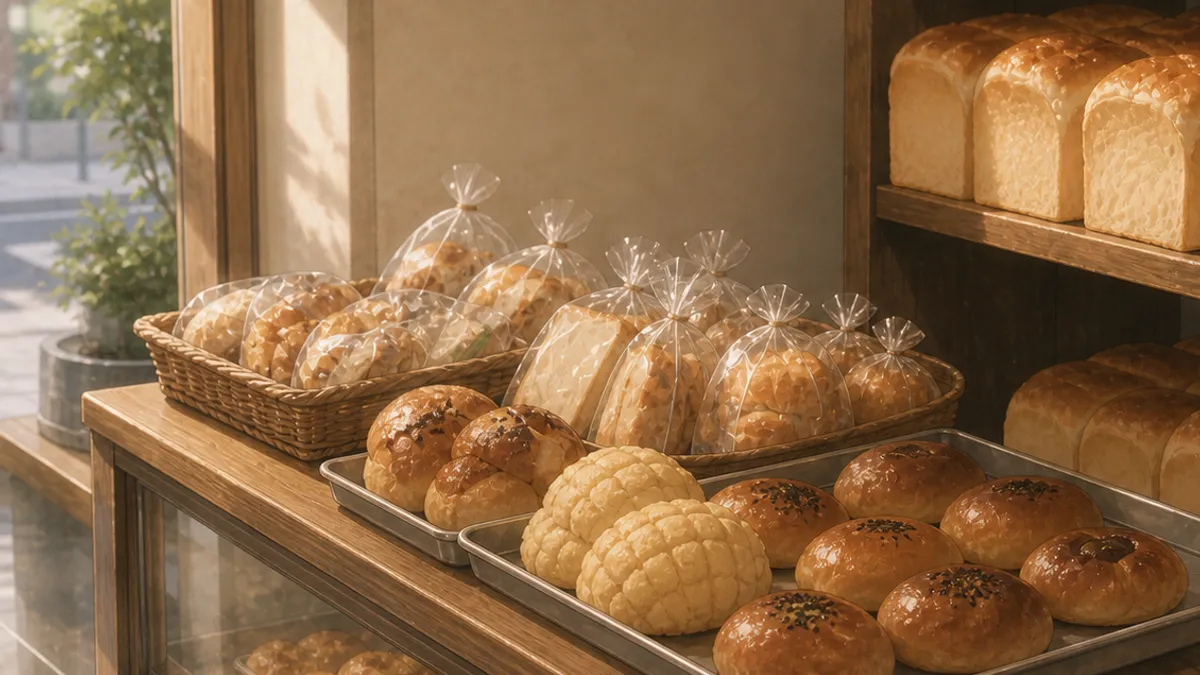
Walk the bread aisle of any Japanese supermarket and you'll see what this engineering produces in practice. Tower upon tower of shokupan — all roughly rectangular, all white, in variations of 4-slice, 5-slice, 6-slice, 8-slice. The thicker the slice, the more clearly you feel the crumb.
Convenience stores are the same. Packaged sandwiches — egg salad, tuna, katsu — use the same pillowy white bread as their selling surface. At school lunch (kyushoku), the bread has been soft enough to compress in your fist for decades. Most Japanese people grew up eating this, and many simply think of it as what bread is.
If you've seen bread in Japanese anime — the corner of toast that a character bites while running late for school, or the fat sandwich in a lunchbox — that texture is accurate. It isn't a stylized version.
Why Softness, Though?
Technique explains how shokupan gets soft. It doesn't explain why Japanese bakers, consumers, and eventually an entire premium-loaf industry converged on softness as the highest good.
Here's where I'll stop asserting and start noticing.
Japanese has a specific and unusually rich vocabulary for food texture. もちもち (mochi-mochi): a stretchy, elastic give, like the surface of fresh mochi. ふわふわ (fuwa-fuwa): light, feathery, buoyant. しっとり (shittori): moist with substance, the word you'd use for a well-made castella sponge. And 口どけ (kuchidoke, literally "mouth-melt"): the quality of something dissolving smoothly on the tongue, without effort, without resistance.
These aren't casual words. They appear in recipe titles, on product packaging, in restaurant reviews. They function as genuine quality markers. And 口どけ in particular — that effortless dissolving — shows up as a value across a lot of Japanese food: good silken tofu, smooth chawanmushi, fine wagashi. There may be a pattern there, of treating the absence of effort at the moment of eating as a positive attribute.
I won't say this is why Japanese bread is soft. I'm not sure anyone could say that with confidence, and I'd be wary of anyone who tried. But when I trace something like the same sensibility through different foods and different contexts, the texture vocabulary starts to feel like more than a coincidence. One reading, not a verdict.
The High-End Shokupan Boom
Around 2016 to 2019, Japan experienced what food media called the 高級食パンブーム — the premium shokupan boom. Specialty bakeries began selling single loaves of white bread for ¥900 to ¥1,200 (roughly $6–9 USD at the time). No unusual grains, no sourdough starter, no toppings. Just white bread, sold as a luxury item, with queues around the block.
Brands like 乃が美 (Nogami) and 銀座に志かわ (Ginza Nishikawa) became national names. Their selling point wasn't complexity in the sourdough sense — it was the perfection of a single quality: softness so complete that the 耳 (mimi — "ear," the crust) was soft enough to eat without cutting.
That detail matters. Cutting the crust off is genuinely common in Japan, especially when making sandwiches for children. Many families remove it as a routine. The premium shokupan brands made making the crust unnecessary into a competitive differentiator — which tells you how seriously this softness project is taken.
The Other Side
Not everyone in Japan is on the soft-bread team. I want to say this clearly.
The ハード系 (hard-type) bread scene — sourdough, baguettes, levain loaves with crackling crusts and a dense, irregular crumb — has a genuine and growing following. Tokyo neighborhoods like Shimokitazawa, Nakameguro, and Yanaka have excellent artisan bakeries producing bread that would be unremarkable, in the best sense, in Paris or Copenhagen.
But if you prefer a rustic loaf and you're standing in front of the bread aisle of an average Japanese supermarket, what you face is a wall of identical soft white rectangles. For people whose tastes run differently, that can be a quiet frustration. The richness of Japanese bread culture and a certain uniformity are, in a sense, the same coin.
Variety Might Be the Real Achievement
I want to try a different angle here.
When soft shokupan dominates the shelf this thoroughly, it's easy to read it as uniformity — a single answer that crowded everything else out. But I'm not sure that's the whole picture.
I recognize something similar from my own work. In fabric, the same base material can be finished to feel soft and yielding, or deliberately left with a stiffer, rougher hand — not because one is objectively better, but because different people want different things against their skin. Taken far enough, thinking hard about the consumer tends to land you in the same place: offering a real range, not a single verdict on what's "right."
Bread might follow the same logic. The supermarket shelf really is dominated by soft shokupan — that's true. But the range that actually exists in Japan, if you go looking for it, runs from crustless nama shokupan all the way to a properly chewy baguette. Maybe "soft is correct" isn't quite the right way to frame it. Maybe the underlying instinct is closer to "meet whatever texture someone is actually asking for, as precisely as possible" — and softness just happens to be what won out as the mainstream default.
To be fair, it's genuinely harder to find hard-crust bread in Japan, and that's worth admitting plainly rather than smoothing over. But I'd rather locate this country's manufacturing instinct in the range of options than in a single-minded devotion to softness. That reading feels a little more honest than straightforward praise for fuwa-fuwa alone.
Where to Feel This
If you're visiting Japan and want to understand the shokupan obsession from the inside:
- Find a 生食パン (nama shokupan, "fresh-eating bread") specialty shop — look for 乃が美 locations, or any bakery advertising 生食パン. Try a thick slice (厚切り, 4–5 cm) untoasted, plain. The texture is the entire point.
- For contrast, Shimokitazawa, Nakameguro, or Kyoto's Fuyacho area have artisan bakeries that take the opposite approach entirely — worth seeking out if you prefer your bread chewy and irregular.
- And for a baseline reference: any convenience store egg-salad sandwich, the crustless kind, is a reasonable place to start.
One Question to Leave With
Why did much of the world reach for chew, crust, and the tang of long fermentation as the marks of quality — while Japan, at least in its mainstream, decided that dissolving without effort is the higher standard?
I don't have a clean answer. I'm not sure there is one.
What I personally think of is childhood. In some regions, elementary schoolers go on field trips to a bread factory, and on the way home they're given fresh-baked bread to take with them. That bread, too, was soft, and faintly sweet — that warm, just-baked, cloud-light feel in the hand. For a lot of Japanese people, I suspect, fluffy bread is a memory of taste and a memory of nostalgia at the same time, folded into one.
But the next time you press the side of a Japanese loaf and watch it spring back without complaint — that's a lot of technique behind it, and possibly a particular view of what eating should feel like. Whether that's better, or just different, I'll leave to your own palate.
Sources & References
- 乃が美 (Nogami) official site — background on the nama shokupan (生食パン) category and production method
- Yudane technique: standard Japanese bread-making technical references; Japan Bread Technology Institute (日本パン技術研究所) publishes relevant material
- The "variety" section draws on personal experience and observation from fabric-related work
- A personal reading from everyday observation in Japanese convenience stores and bakeries; cultural interpretation is one view, not a conclusion
A Geek in Japan (Revised & Expanded)
A wide-angle introduction to the 'why' of Japanese culture — manga, anime, Zen, the tea ceremony and more. A natural companion to the topics Naze explores.
The Japanese Mind: Understanding Contemporary Japanese Culture
Chapters on aimai (ambiguity), amae, giri, wa and more — the values beneath the gestures and words. For readers who want to go deeper into the 'why.'
Share this article
Read Next
- Everyday JapanWhy Are Japanese Train Bento (Ekiben) So Special?Ekiben turn the train journey into a curated regional food tour. Here's the quiet logic behind Japan…
- Everyday JapanWhy Are There So Many Signs and Notices in Japan?Japan's streets and stations are layered with notices. Here's what the density reveals about preempt…
- Everyday JapanWhy Do Japanese People Care So Much About Seken?Seken — Japan's unnamed collective gaze — shapes everything from garbage etiquette to career choices…
- Everyday JapanWhy Do Japanese Households Still Keep a Handwritten Kakeibo? — The 1904 Method Behind the NotebookKakeibo — Japan's household account book — traces back to 1904, when journalist Hani Motoko proposed…
- Everyday JapanWhy Are Japanese 100-Yen Shops So Surprisingly Good? — The Daiso Model ExplainedJapan's 100-yen shops aren't just cheap stores — they run a specific model built on massive order vo…
Related Articles
Articles in the same category: