Why Do Japanese People Sleep on Trains? — Trust, Safety, and the Price of Rest
Everyday Japan · 2026-06-03 · ~1,600 words · ~6 min read
Contents (6)
- The Numbers Are Real
- What You Actually See
- The Deeper Layer — and I'll Hedge This
- The Shadow You Can't Ignore
- Where to See This Most Clearly
- The Question It Leaves Me With
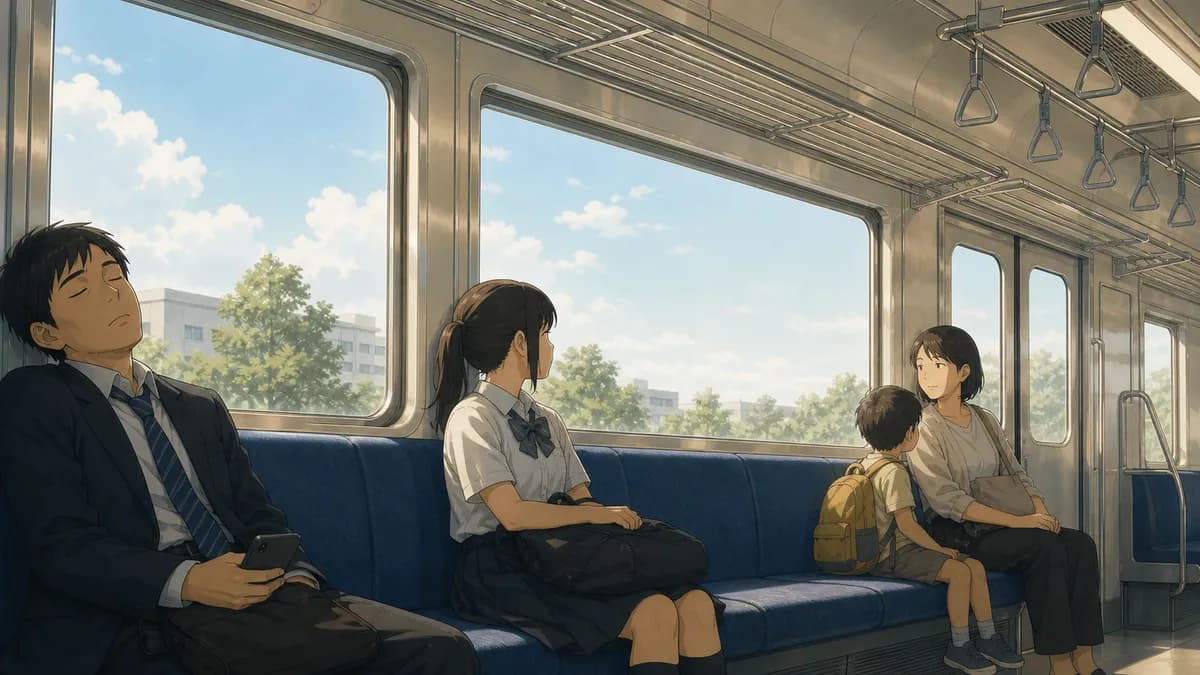
Picture a rush-hour train in Tokyo. The carriage is packed. A man in a suit sits with his head tilted forward, fast asleep — phone loose in his hand, briefcase between his feet, completely unguarded. Nobody around him looks twice. Nobody takes anything.
If you've traveled in Japan, or watched enough slice-of-life anime, you've seen this exact scene. The person asleep in public, wallet half-out of a jacket pocket, bag unzipped, earbuds in. In most cities I can think of, that's how you lose your phone before you reach the next stop.
So why does this happen here? And what does it actually mean?
The Numbers Are Real
The short answer starts with documented fact: theft on trains and in stations is relatively uncommon in Japan compared with the sheer scale of passenger traffic. National Police Agency crime statistics bear this out as a year-over-year pattern in public records. That's not a claim made to make Japan sound impressive — and it does not mean theft never happens; it does.
Lost-and-found data from the Tokyo Metropolitan Police points to a related social infrastructure. Wallets, phones, umbrellas, bags — enormous volumes are handed in each year, often within hours, and processed through police and railway systems. A substantial proportion is eventually reclaimed by owners. The system works, and — crucially — people seem to know it works.
So there's a practical, observable foundation under all of this. Sleeping on a train in Japan isn't naive. It's a calculation, even when it happens without any conscious thought.
What You Actually See
Spend a few days on the Yamanote Line or the Chuo Line and the scene becomes oddly familiar. Salarymen with loosened ties. High school students in uniform, textbook open on their lap but eyes closed. A young woman with earbuds in, head resting against the window glass. A construction worker in dusty work clothes, completely gone.
What strikes most first-time visitors — and I've heard this many times — isn't just that people sleep. It's how they sleep. Deeply. Arms not crossed, body not tensed, sometimes mouth open. The kind of sleep that says they genuinely needed it, not just a polite doze.
And the train itself is almost suspiciously well designed for it. The rocking is gentle, the carriage is warm in winter and cool in summer, and nobody is talking. After a day of holding yourself together at work, this quiet box arrives with nearly all the conditions of a bedroom.
You've probably seen this in anime too. A character on a commuter train, dead to the world, nearly missing their stop. It's played as completely normal background texture. Because it is.
I know it from my own experience. Being pickpocketed while asleep is something that, honestly, has basically never happened to me. What happens instead is the opposite: dozing off, riding all the way to the last stop, and being woken by the conductor — "this is the terminus" — that slightly awkward but somehow reassuring moment. In lived terms, the worry isn't theft. It's oversleeping your stop.
Once, on a business trip to Tokyo, heading back to the hotel after a long day, I dozed off on the loop line and woke up two stations past mine. Here is the complete list of consequences: I crossed to the opposite platform and rode a few minutes back. Nothing taken. Nothing lost but minutes. When the price of falling asleep is a short ride in the other direction — on a loop line that comes every few minutes — the city itself seems built on the assumption that people will sleep.
The Deeper Layer — and I'll Hedge This
Here's where it gets harder to be certain, and I want to be honest about that.
One way to read the train-sleep is as a small, daily expression of social trust. Not trust in any grand philosophical sense — just the basic, tested assumption that the people around you are not going to exploit a moment of vulnerability. That assumption has been tested by millions of commuters over decades. It has, largely, held.
I suspect — and this is a personal reading, not a verdict — that sleeping in public in Japan carries a kind of unspoken social permission that isn't available everywhere. There's an implicit agreement running through most Japanese commuter carriages: I won't disturb you; please don't disturb me. The sleeping passenger is relying on that agreement. The people around them are, quietly, upholding it.
Some people reach for the concept of anshin (安心) here — a kind of baseline ease or safety that certain social environments provide. I find that framing useful, though I'd be careful about leaning on it too hard. Social norms aren't invisible cultural forces; they're maintained by real people making real choices, day after day. They can erode.
Of course, not everyone experiences this ease. Plenty of visitors find the silence and social distance on Japanese trains unsettling rather than reassuring. And that same norm of "don't disturb anyone" cuts both ways — it can feel like safety, or it can feel like invisibility. Both are legitimate readings.
The Shadow You Can't Ignore
This is the part I can't leave out, because leaving it out would be dishonest.
A lot of those people sleeping on trains are not comfortably resting. They are exhausted. Not pleasantly tired after a good day — genuinely, deeply spent. Japan's work culture has been criticized for decades for precisely this: long hours, unpaid overtime, the social pressure not to leave before your manager does, the quiet shame of being seen to "go home early." The train isn't only a place where people feel safe enough to sleep. For many, it's the only place — the only minutes in the day — where they actually can.
The man in the suit, head drooping at 11 PM on a Friday, may be experiencing a comfortable expression of social trust. He may also simply have nowhere else to close his eyes.
I don't think these two things cancel each other out. They're both true, simultaneously, in the same carriage. The sleeping commuter is a small portrait of a society where public safety is genuinely well-maintained — and also a portrait of a society that asks a great deal of the people inside it. The honest view holds both frames at once.
Where to See This Most Clearly
The clearest place to observe this is on long-distance commuter lines, not tourist routes — for example, the Chuo Line running west from Shinjuku, or private railways connecting central Tokyo with the suburbs such as the Keio Line. Late-night trains after 11 PM on weekdays are striking: commuters who've clearly been at the office or a work dinner, asleep before the train has left the station.
If you're visiting Japan, try a late-evening departure from a major hub on a weekday. Watch what happens around you. Nobody shifts to protect their belongings. Nobody glances nervously at the person leaning into their shoulder. The carriage hums, the fluorescent light holds steady, and half the people around you are somewhere else entirely.
It's one of those scenes that looks completely unremarkable once you're used to it — and then, if you stop and really look, becomes quietly remarkable again.
The Question It Leaves Me With
I've thought about what it would feel like to fall asleep on a commuter train in a city where I didn't trust the social environment. I think the answer is: I wouldn't. Not fully. I'd stay tense — bag in my lap, one hand on my phone, half-present in a way that isn't really rest at all.
The fact that a large number of people in Japan simply let go — that they stop monitoring, stop gripping, stop watching — tells you something. I won't say exactly what. It might be a sign of a healthy social compact, carefully tended. It might be a sign of fatigue so deep that vigilance stops feeling possible. Probably it's some of both, in proportions that vary from person to person, carriage to carriage, decade to decade.
What I keep returning to is this: sleep, in public, is vulnerability. And choosing to be vulnerable in front of strangers — even if the choice happens without thinking — is, in some quiet way, an act of trust.
How does that look in the city where you live?
Sources & References
- National Police Agency (警察庁), crime statistics: theft and pickpocketing figures on public transport
- Tokyo Metropolitan Police Department (警視庁), lost-and-found service: annual reports on returned property
- The interpretive readings in this piece are personal observations and should be taken as one view among many; no external sources are cited for those sections
A Geek in Japan (Revised & Expanded)
A wide-angle introduction to the 'why' of Japanese culture — manga, anime, Zen, the tea ceremony and more. A natural companion to the topics Naze explores.
The Japanese Mind: Understanding Contemporary Japanese Culture
Chapters on aimai (ambiguity), amae, giri, wa and more — the values beneath the gestures and words. For readers who want to go deeper into the 'why.'
Share this article
Read Next
- Everyday JapanWhy Are Japanese Train Bento (Ekiben) So Special?Ekiben turn the train journey into a curated regional food tour. Here's the quiet logic behind Japan…
- Everyday JapanWhy Are There So Many Signs and Notices in Japan?Japan's streets and stations are layered with notices. Here's what the density reveals about preempt…
- Everyday JapanWhy Do Japanese People Care So Much About Seken?Seken — Japan's unnamed collective gaze — shapes everything from garbage etiquette to career choices…
- Everyday JapanWhy Do Japanese Households Still Keep a Handwritten Kakeibo? — The 1904 Method Behind the NotebookKakeibo — Japan's household account book — traces back to 1904, when journalist Hani Motoko proposed…
- Everyday JapanWhy Are Japanese 100-Yen Shops So Surprisingly Good? — The Daiso Model ExplainedJapan's 100-yen shops aren't just cheap stores — they run a specific model built on massive order vo…
Related Articles
Articles in the same category:
- Why Does Japan Still Use So Much Cash? — The Quiet Logic Behind Every 'Cash Only' Sign
- Why Don't Japanese Addresses Have Street Names? — The Block Number System
- Why Do Japanese Children Walk to School Alone? — The Hidden System Behind the Independence
- Why Is Japanese Curry So Different from Indian Curry — and How Did It Become Japan's National Dish?