
Why Does Lost Property Get Returned in Japan? — The System Behind the Stories
Everyday Japan · 2026-06-08 · ~1,300 words · ~4 min read
Contents (6)
- This Is Not a Remarkable Story in Japan
- Three Things Working Together
- The Extra Effort Nobody Had to Make
- Why the Reward Goes Unclaimed
- What the 33% Who Don't Get Their Wallets Back Reminds Us
- Where to Feel It
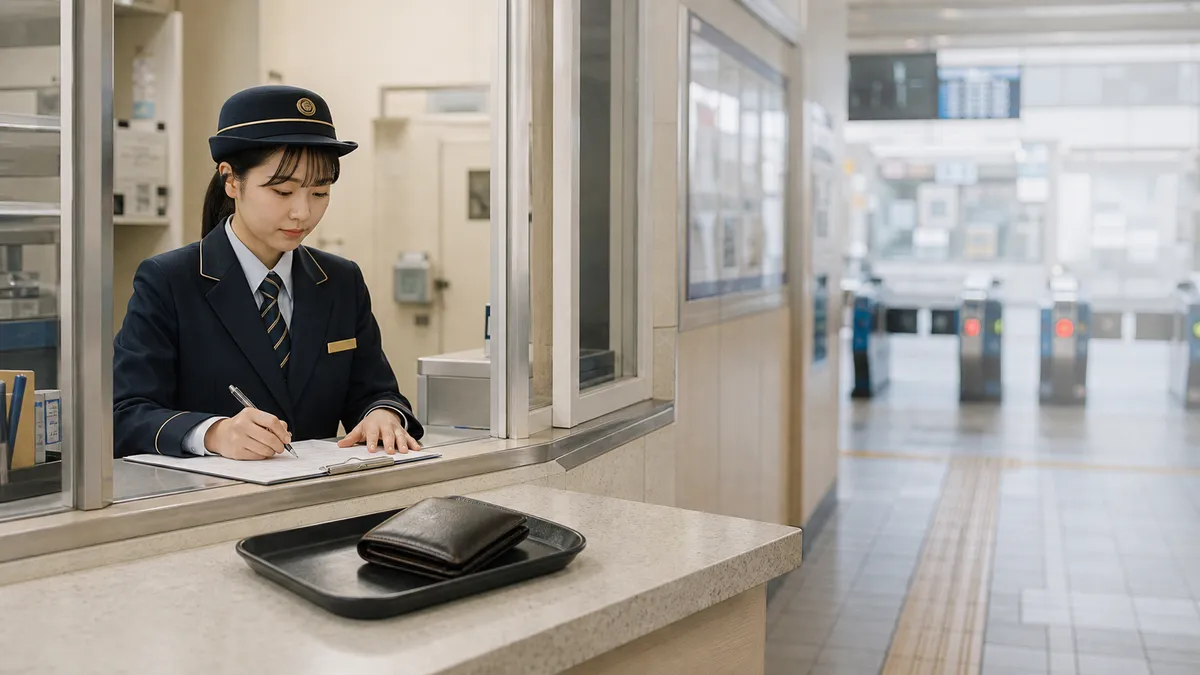
You left your phone on the seat of a Yamanote Line train at Shinjuku Station. You realized it seventeen stops later. You reported it to the station staff — and two hours later, the phone was at the lost property office, exactly where you'd left it, screen uncracked, passcode intact.
This is not a remarkable story in Japan. It is a Tuesday. Returned wallets are one of the clearest everyday signs of the bigger system explored in Why Is Japan So Safe?.
This Is Not a Remarkable Story in Japan
The numbers behind that Tuesday are specific. According to Japan Today's 2025 report citing Tokyo Metropolitan Police figures, more than ¥4.5 billion in lost cash was turned in to Tokyo police in the figures reported for 2025 — a record at the time. According to those figures, more than half of that cash was returned to its owners.
As of 2020, Bloomberg's investigation of Tokyo's lost-and-found system put wallet return rates at roughly 67%, and smartphones at approximately 83% — figures from that reporting, not a continuously updated official rate. Visitors regularly describe returning to Japan partly because they trust the country will give their things back.
Three Things Working Together
The cultural explanation — "Japanese people are honest" — has some truth in it but explains less than it seems to. Three structural elements do at least as much work:
Infrastructure density. Japan has about 6,200 koban (police boxes) nationwide — plus roughly 6,000 chuzaisho (residential police posts) in smaller towns — according to the National Police Agency. In Tokyo, koban coverage is dense. Handing in found property requires almost no detour. Since 2023, some train operators have layered AI matching on top of this: in a vendor case report (Thanks Boomerang, 2024), Keio Corporation said an AI-assisted system roughly tripled its lost-property return rate. That's a single company's reported result, not a nationwide statistic.
Legal framework. Japan's Lost Property Act (revised 2006) creates a real incentive structure: finders must report promptly, and if no owner claims the item within three months of public notice, ownership can legally transfer to the finder. A finder is also entitled to a reward of 5–20% of the item's value (民法 / Civil Code Art. 240) — though the exact share, and whether storage and handling costs apply, vary with where the item was found and who held it (items found inside a facility are split with the facility operator). Returning something isn't just culturally preferred — it's legally structured as the rational path.
Behavioral norm. Harder to quantify, but the expectation that found property gets handed in is widespread enough to function as a default assumption. People don't deliberate much about it.
The Extra Effort Nobody Had to Make
Here's where I want to be careful not to overstate anything.
The infrastructure and the law explain why returning something is easy and incentivized. They don't quite explain why someone picks up a stranger's wallet and walks it to the koban, which involves genuine extra effort. The three-month ownership transfer rarely applies to wallets. There's no immediate reward.
One way to think about it: Japan's lost-and-found behavior may be an expression of a broader orientation toward the person who isn't present. The same logic that keeps someone from placing their bag on an empty train seat — because someone who hasn't arrived yet might need it — may, in some diffuse way, inform why a stranger carries your wallet to a police box.
I'm cautious about overstating this. "Inherently honest culture" is the kind of explanation that flattens a complicated system into a story. The 67% return rate is impressive — and it means one in three wallets doesn't come back.
Why the Reward Goes Unclaimed
Here's the part the infrastructure and the law don't reach.
Legally, the finder may claim a reward of 5–20% of the value — a real right, not a favor. And yet, in practice, many people wave it off on the spot, or simply hand the wallet in and leave without giving a name. I should be clear that this is an impression drawn from reporting and lived experience, not a clean statistic. But someone who already took the detour to a koban, and then lets go of a reward they were entitled to, is doing something the system can't quite account for.
One way to read it: what moves the hand may be less being watched than imagining. If it were my wallet, how would I feel? The owner must be frantic. How relieved would they be to get it back? You can't see the stranger's face, yet you picture their distress and their relief as if they were your own. That act of imagining — more than any sense of being seen — seems to be what does the work.
Leaving without a name comes from the same place. Not to collect thanks or credit, but something closer to if it helps someone in trouble, that's enough. Raised from childhood on "be useful to others" (hito no tame ni nare), handing something in stops being an achievement and becomes an ordinary gesture.
Underneath sits an old proverb: nasake wa hito no tame narazu. It's easy to misread as "don't coddle people," but it means almost the opposite — kindness is not only for the other person, because it circulates and comes back around to you. Not sainthood, but a quiet bet that goodwill travels. The stranger who returns your wallet today may be half-counting, without ever saying so, on someone returning theirs tomorrow.
That's one reading, of course — not a verdict.
What the 33% Who Don't Get Their Wallets Back Reminds Us
Not all lost things are returned. Not all finders make the effort. The AI database and the koban network exist precisely because the system needs infrastructure to function — cultural norms alone don't run a database.
There is also a cost that the system's impressive reputation can obscure. Japan's policing model dedicates significant officer time to lost property processing — time that isn't available for other work. The trade-off is real, even when the outcome is good.
And for the visitor who loses something critical — a passport the night before a flight, a medication that can't wait — the system's reputation offers cold comfort. The 67% return rate is something to know, not something to bet on.
Where to Feel It
- To experience the pipeline: if you lose something at a train station, report it to the station staff directly — don't wait to look for a police box. Most major stations have their own lost property offices, and the routing between station staff, central offices, and police is well-established.
- In film: Tokyo Story (Yasujiro Ozu, 1953) is not about lost property. But it is deeply about the obligations people feel toward those not present — the same ethical texture that seems to underlie the return culture.
- For a thorough account: Bloomberg's 2020 piece "Why Japan's Lost-and-Found System Works So Well" is the most rigorously reported English-language treatment of the mechanics.
Sources & References
- Bloomberg, "Why Japan's Lost-and-Found System Works So Well" (February 10, 2020) — basis for the 2020 wallet (~67%) and smartphone (~83%) return rates
- Japan Today, "Record ¥4.5 billion in lost cash turned in to Tokyo police in 2025" — Tokyo Metropolitan Police lost-cash statistics
- National Police Agency (Japan): about 6,239 koban and 6,026 chuzaisho as of April 1, 2023 (令和5年警察白書), rounded here to ~6,200 / ~6,000
- Lost Property Act (遺失物法) and Civil Code Art. 240 (民法240条) — three-month rule and 5–20% reward; reward share and cost reimbursement vary by where the item was found
- Thanks Boomerang (2024) — single-company AI lost-property case report (Keio Corporation); not a nationwide statistic
A Geek in Japan (Revised & Expanded)
A wide-angle introduction to the 'why' of Japanese culture — manga, anime, Zen, the tea ceremony and more. A natural companion to the topics Naze explores.
The Japanese Mind: Understanding Contemporary Japanese Culture
Chapters on aimai (ambiguity), amae, giri, wa and more — the values beneath the gestures and words. For readers who want to go deeper into the 'why.'
Share this article
Read Next
- Everyday JapanWhy Are Japanese Train Bento (Ekiben) So Special?Ekiben turn the train journey into a curated regional food tour. Here's the quiet logic behind Japan…
- Everyday JapanWhy Are There So Many Signs and Notices in Japan?Japan's streets and stations are layered with notices. Here's what the density reveals about preempt…
- Everyday JapanWhy Do Japanese People Care So Much About Seken?Seken — Japan's unnamed collective gaze — shapes everything from garbage etiquette to career choices…
- Everyday JapanWhy Do Japanese Households Still Keep a Handwritten Kakeibo? — The 1904 Method Behind the NotebookKakeibo — Japan's household account book — traces back to 1904, when journalist Hani Motoko proposed…
- Everyday JapanWhy Are Japanese 100-Yen Shops So Surprisingly Good? — The Daiso Model ExplainedJapan's 100-yen shops aren't just cheap stores — they run a specific model built on massive order vo…
Related Articles
Articles in the same category: