Why Are Japanese Toilets So High-Tech? The Logic Behind the Control Panel
Everyday Japan · 2026-06-03 · ~1,500 words · ~6 min read
Contents (7)
- The Short Answer — and Why It Doesn't Quite Satisfy
- The Design Faces Outward
- A Room That Took Its Job Seriously
- One Reading of the Control Panel
- The Shadow Side
- Where to Feel This Directly
- The Question the Panel Doesn't Ask
Walk into a convenience store restroom in Japan — not a luxury hotel, just a neighborhood 7-Eleven — and there's a control panel on the wall. Heated seat. Bidet spray. Warm-air dryer. A button that plays the sound of running water. An automatic deodorizer. Sometimes a temperature readout in degrees.
It's a lot of technology for a room you're meant to occupy for two minutes.
If you've seen Japanese bathrooms come up in travel videos, in anime, in your friends' Tokyo trip photos, you've probably had some version of this thought: why? What sequence of decisions led a country to pour this much engineering into a toilet?
Here's what strikes me, though. In all the times I've shown that panel to friends from abroad, I've almost never seen a negative reaction. Once someone actually uses one, the face they make is closer to why don't we have this at home? Which quietly flips the question around. Maybe the real puzzle isn't why Japan built this — it's why something that so plainly raises the quality of an ordinary day hasn't become normal elsewhere.
The Short Answer — and Why It Doesn't Quite Satisfy
TOTO, a Japanese ceramics and plumbing fixtures company, launched the Washlet — a bidet toilet seat with washing and drying functions — in 1980. The product caught on with remarkable speed. By the 1990s and 2000s, washlet-style seats were standard in most Japanese homes, and the technology spread to hotels, train stations, offices, and convenience stores. Today, walking into a Japanese restroom without a control panel can feel slightly unusual.
But knowing when doesn't really explain why here and not elsewhere. Bidets existed in Europe and parts of Asia long before 1980. Plenty of countries with high living standards and sophisticated engineering never ended up with heated seats and sound-masking buttons. Something about the direction of Japanese toilet design is distinct, and it's worth looking at carefully.
The Design Faces Outward
Here is the thing I kept noticing once I started paying attention: most of the features on a Japanese toilet aren't designed for the comfort of the person using it. They're designed to leave no trace for the next person.
Take the otohime (音姫) button — literally "princess of sound" — found in many Japanese public restrooms. It plays the sound of flushing water so that no sounds from inside the stall travel outside. It exists specifically for the people outside the stall, not for the person inside. The automatic deodorizer neutralizes odors before the next user arrives. The bidet function reduces paper use, which keeps plumbing cleaner and stalls less messy over time. Even the heated seat has an argument beyond personal comfort: it discourages the "hover" posture, which reduces mess for whoever cleans the restroom.
One feature after another, the logic points outward.
I want to be precise here — I'm not saying this proves a deep cultural philosophy, and I'd be wary of anyone who claimed that. But as a pattern of observable design choices, it's consistent. The features that became standard in Japan are, almost uniformly, the features that reduce the burden on shared space for whoever comes next.
A Room That Took Its Job Seriously
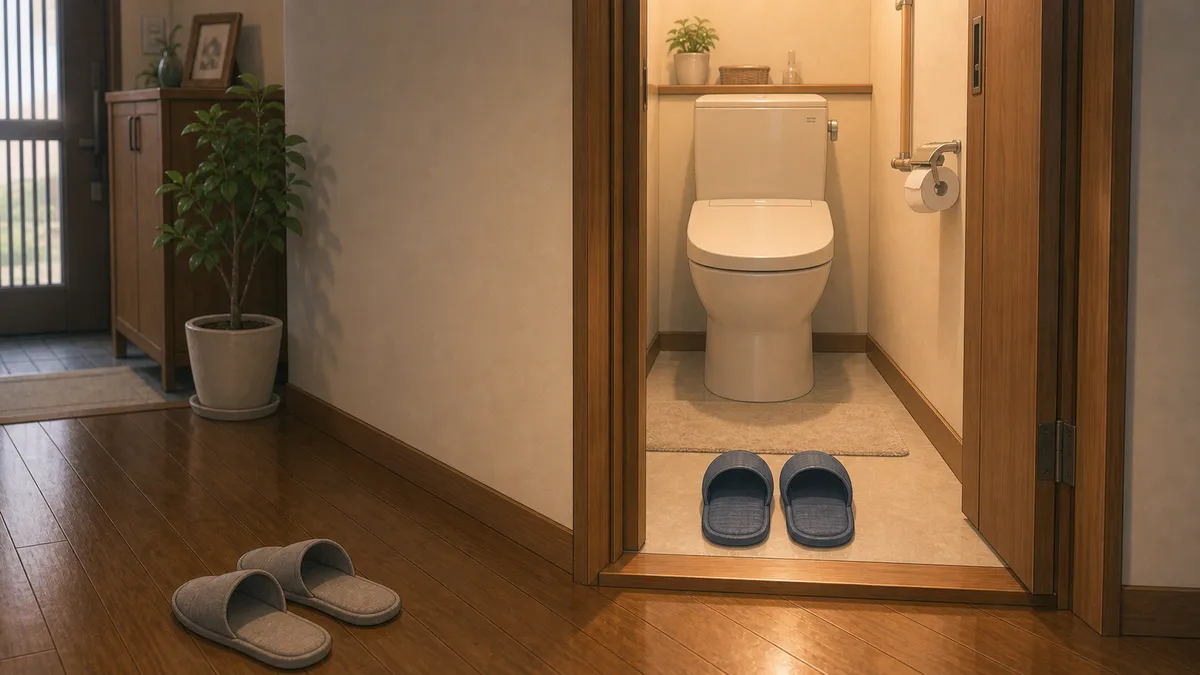
In Japanese homes, the toilet is typically in its own dedicated room — separate from the bath, separate from the sink. A small, fully private box at the end of a hallway. This layout isn't universal, but it's common enough that it shapes how the toilet is understood as a space.
The separation matters. It means the toilet room is treated as something complete in itself: a place where privacy is total for however many minutes you're inside. The design logic follows from this — both inward (comfort, warmth, cleanliness while you're there) and outward (sound, smell, no residue when you leave).
If you've watched enough anime, you've probably seen this room without thinking about it. A character closes a door somewhere along a hallway — it isn't dramatized, it's just an ordinary feature of Japanese domestic space. The high-tech toilet fits naturally into a room that has always been taken seriously as its own space.
Public restrooms follow the same logic at greater scale. Train stations, highway rest stops, convenience stores — the maintenance standard in Japan consistently surprises visitors from abroad. Honestly, there are moments I catch myself thinking: isn't even this highway rest-stop restroom a little too clean? Places most of the world writes off as unavoidably rough are, here, kept to the same quiet standard. The technology is part of that standard, not separate from it — and so is the unseen daily work of whoever maintains it. A stall that is clean, warm, quiet, and neutral-smelling when you leave it is a stall that treated its job as real work.
Break that cleanliness down and the first thing you find is labor. Early mornings in convenience stores, in station corridors: cleaning staff resetting each stall, one by one. Not magic — someone's work. I want to say that part first.
The other half is a small behavior on the user's side: leave it clean, because someone uses it after you. Nobody instructs anyone to think this way, and it never shows up in a statistic, but it runs. It works like a relay of small gifts between strangers. The clean stall you walked into was kept that way by someone you will never meet — and when you close the door quietly behind you, you pass the baton to the next stranger.
So two relays run through this one small room. The features are a relay from the makers to the next person. The cleanliness is a relay from the users to the next person. Exactly the direction the control panel already points.
There is an older vocabulary for this direction, too. Japan has a real folk tradition that a deity dwells in the toilet — the belief that cleaning the toilet makes you beautiful traces back to household guardian spirits, and in 2010 it became a nationwide hit song. Whether anyone literally believes it today is beside the point. The relay runs on small everyday choices — it just happens to have a thousand years of vocabulary quietly backing it up.
One Reading of the Control Panel
Here's how I personally see it — offered as one reading, not a verdict.
A lot of design in Japanese shared spaces seems to operate on a principle of not leaving a burden for the next person. There are many ways to understand where this comes from: ideas about cleanliness in Shinto practice, the practical pressures of dense urban living where everyone genuinely does share walls and trains and restrooms, or simply the straightforward problem-solving of engineers who listened carefully to what people actually needed. I genuinely don't know which of these is "the reason," and I suspect there isn't one single answer.
But when I think about the otohime button specifically — the button whose entire purpose is to manage how the outside world hears your time in the stall — it's hard to read it as a luxury feature. It's an anxiety-reduction feature. Someone felt a specific kind of social discomfort in a public restroom, and someone else decided that was a real problem worth solving with engineering.
That's a very human problem to take seriously. Whether solving it through technology is the right approach is a different question — but the impulse behind it isn't vanity.
The Shadow Side
Of course, not everyone's experience of this design is warm.
For many foreign visitors, the control panel is genuinely disorienting — especially when labels are in Japanese only, or when icons don't clearly communicate what they do. The accidental high-pressure bidet activation is practically a rite of passage for first-time visitors. The very comprehensiveness of the system creates friction for anyone who didn't grow up with it.
There's a broader point worth naming. A design philosophy of "leave no trace, make everything perfect for the next person" carries a pressure as well as a kindness. For some people who live with this standard constantly — not just in restrooms, but in every shared space — the expectation of total consideration can feel exhausting. The same design that reads as thoughtfulness from one angle reads as a high bar that's difficult to meet from another.
Both reactions are honest. The thoroughness is real, and so is the pressure. Neither cancels the other out.
Let me add the mirror image, from my own side. Where you feel the gratitude most keenly is, almost always, when you travel abroad. No warm-water wash, of course — but in a surprising number of countries and regions, you can't even flush the paper: pipes are narrower, treatment systems are built differently, and a sign asking you to put used paper in the bin beside the toilet is perfectly ordinary. Meeting that sign on a trip, my hand hesitated for a moment — even though I understood, perfectly well, that it's simply a matter of plumbing. And to be clear, it isn't a question of which way is correct: every place has its own pipes, its own history, its own habits. But coming home and looking at that unremarkable control panel in a convenience store restroom, I think again: this was a quiet invention.
Where to Feel This Directly
You don't need a luxury hotel to understand what Japanese restroom culture actually feels like at ground level. Walk into any convenience store — a FamilyMart, a 7-Eleven, a Lawson. That's the baseline. The restroom will be clean, heated, and equipped. That is the ordinary standard, not an exception.
If you want a more deliberate experience, TOTO operates public showrooms in Tokyo (Shinjuku area), Osaka, and Nagoya where their full product range is on display — including models designed for elderly care, hospital use, and children. The practical thinking behind each feature becomes very visible there. It reads less as luxury and more as: we noticed a specific problem, and here is the solution.
For anyone navigating one of these panels for the first time: the icons are fairly consistent across Japanese brands. Most buttons do exactly what a moment of close looking would suggest. The spray buttons are worth approaching at the lowest setting first. The rest tends to figure itself out.
The Question the Panel Doesn't Ask
The Japanese toilet wasn't designed to impress you. It was designed so the next person finds nothing wrong.
That's a different design goal than most of us are used to — a product whose primary audience isn't the buyer, but the unnamed stranger who comes after. Whether that feels like thoughtful design or like a quiet social contract you didn't sign, I'll leave to you.
What stays with me is this: there's something oddly honest about a piece of design that keeps asking about other people. The panel doesn't want your admiration. It just wants you to leave cleanly.
If you come to Japan, try one of those panels once — a convenience store will do. A room you'll occupy for two minutes, taking this much care of you: whatever a restroom is fundamentally for, you'll probably end up smiling at it.
Sources & References
- TOTO Ltd., Washlet History: Washlet first launched 1980
- The design logic analysis in this article is a personal reading based on everyday observation; no single academic or institutional source is cited for the cultural interpretation.
The high-tech washlet from this article. Bidet toilet seats can be added to an existing toilet, too.
A Geek in Japan (Revised & Expanded)
A wide-angle introduction to the 'why' of Japanese culture — manga, anime, Zen, the tea ceremony and more. A natural companion to the topics Naze explores.
The Japanese Mind: Understanding Contemporary Japanese Culture
Chapters on aimai (ambiguity), amae, giri, wa and more — the values beneath the gestures and words. For readers who want to go deeper into the 'why.'
Share this article
Read Next
- Everyday JapanWhy Are Japanese Train Bento (Ekiben) So Special?Ekiben turn the train journey into a curated regional food tour. Here's the quiet logic behind Japan…
- Everyday JapanWhy Are There So Many Signs and Notices in Japan?Japan's streets and stations are layered with notices. Here's what the density reveals about preempt…
- Everyday JapanWhy Do Japanese People Care So Much About Seken?Seken — Japan's unnamed collective gaze — shapes everything from garbage etiquette to career choices…
- Everyday JapanWhy Do Japanese Households Still Keep a Handwritten Kakeibo? — The 1904 Method Behind the NotebookKakeibo — Japan's household account book — traces back to 1904, when journalist Hani Motoko proposed…
- Everyday JapanWhy Are Japanese 100-Yen Shops So Surprisingly Good? — The Daiso Model ExplainedJapan's 100-yen shops aren't just cheap stores — they run a specific model built on massive order vo…
Related Articles
Articles in the same category: