Why Japanese Restaurants Give You a Wet Towel
Everyday Japan · 2026-06-15 · ~1,600 words · ~6 min read
Contents (7)
- The Oshibori: Not a Napkin, a Different Gesture
- A Brief History (With Honest Caveats)
- The Feeling of Arriving Clean
- Not All Oshibori Are Equal
- The Limits: When a Wet Towel Isn't Enough
- Where You Feel It Most
- A Question I Can't Quite Answer
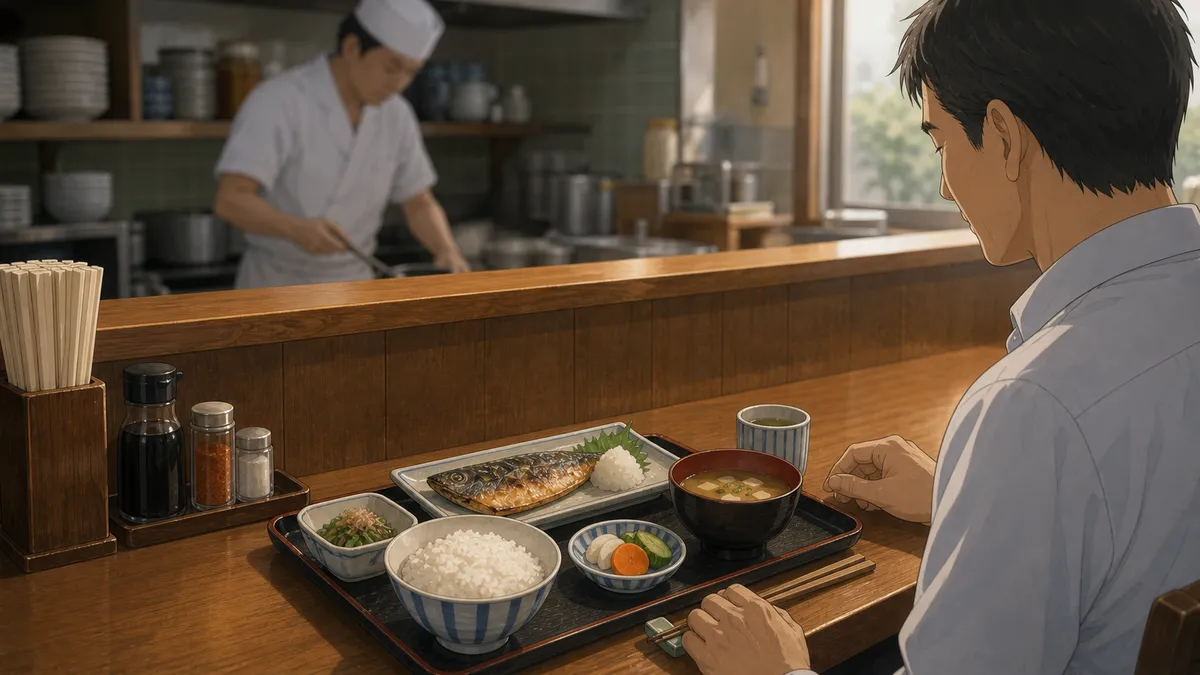
You sit down at a Japanese restaurant — a ramen counter, an izakaya, a neighbourhood sushi bar — and before the menu arrives, before you've said a word to the staff, a small rolled towel appears in front of you. Warm in winter. Startlingly cold in summer. You unwrap it, wipe your hands, set it on the little tray, and push it aside.
Then you look around for napkins. There might be a thin paper square tucked somewhere at the table's edge. Maybe not even that.
If you've spent time in Japan, this is background noise. But if you're visiting for the first time — or if you've eaten at a Japanese restaurant abroad and noticed that something about the experience felt different without quite knowing what — the question is fair: why wet towels? And why so few paper napkins at all?
The Oshibori: Not a Napkin, a Different Gesture
The item is called oshibori (おしぼり), from the verb meaning "to wring out." It's so embedded in Japanese dining that most people — Japanese included — don't pause to think about it. You sit, you get one, you wipe your hands. It's just what happens.
But notice the timing: the oshibori comes before the meal. Not during, not after a spill — before anything else. That timing is the whole point.
Paper napkins, as used across much of the world, operate on an after-the-fact logic. Something drips; you blot it up. They sit at the table waiting for a mess. The oshibori logic runs in the opposite direction: before the food arrives, the restaurant has already thought about your hands. The transition from outside world to this table, this meal, has a physical marker.
The core of it: the oshibori isn't a substitute for a paper napkin — it's doing something a paper napkin was never meant to do.
A Brief History (With Honest Caveats)
The oshibori's origins are generally traced to teahouses and roadside inns (hatago) of the Edo period, roughly 1603–1868, where travelers arriving on foot would be offered a damp cloth to wipe their hands and cool their faces. The exact origin is genuinely debated — I've seen several confident-sounding accounts that disagree on the details, so I won't pretend otherwise. What seems clear is that by the Meiji and Taisho eras the practice had spread broadly to restaurants and become associated with hospitality.
Today the oshibori is an entire industry. Japan has a specialized rental sector: companies that launder, sterilize, and deliver fresh towels to restaurants on a daily schedule. The practice falls under sanitation standards within Japan's Food Sanitation Act (Shokuhin Eiseiho), administered by the Ministry of Health, Labour and Welfare. There are inspection standards, temperature guidelines, and a whole logistics chain that a paper napkin simply doesn't have.
The temperature variation itself — warm in winter, cold in summer — is part of the hospitality formula. It's a small sensory reading of the guest's likely state on arrival. You've been in August heat; here's something cool. You've walked in from January air; here's something warm. The towel reads the room before you've said anything. A paper napkin doesn't do that. It just waits.
Personally, that temperature touch gets me every time. Cold in summer, warm in winter — such a small thing, yet the moment you sit down, a little of the day's tiredness lifts. And — an honest confession — what I really want to do is wipe my whole face and neck with it. In Japan that gets you filed under oji-san (a middle-aged-uncle move), but on a sweaty day, that particular relief is hard to give up.
One more honest thought: none of it is strictly necessary. A restaurant could skip the chilling and the warming — could skip the towel entirely — and I doubt a single customer would stop coming. The care continues anyway, past the point where any business case requires it. That, more than anything, is what the word omotenashi is trying to point at.
That supply chain and seasonal logic partly explain why paper remains minimal at many Japanese restaurants: the oshibori is the welcome gesture. Stacking paper on top of it would feel redundant — like serving two appetizers when the point of the first was already to signal care.
The Feeling of Arriving Clean
Here's how I see it — not as a verdict, just one reading.
Japan has several moments in ordinary life where you prepare before beginning rather than clean up after. Before entering an onsen, you shower at the rinse station — that's the first step, not a formality. Before approaching a Shinto shrine, you purify your hands at the stone basin (temizuya). Before a meal at home, you wash your hands; at a restaurant, the restaurant does that gesture for you, in the form of a rolled towel.
I won't say the oshibori carries the same ritual weight as a shrine visit — that would be overstating it. But I do think there's a consistent orientation: beginning something well means arriving at it clean and settled. Less "here's something for when things go wrong" and more "here's something to begin with."
Perhaps — and I'm genuinely uncertain here — there's something in the Japanese hospitality concept (omotenashi) about anticipating your condition before you have to ask. You've been outside. You were on a train, on a street, in transit. Now you're here, at this table, and the meal is about to start. The oshibori is the moment the restaurant acknowledges that transition.
Of course, not everyone consciously feels this. Plenty of people unwrap an oshibori on autopilot without any such reflection. That's fine. The gesture works whether or not you're thinking about it — which might actually be the point.
Not All Oshibori Are Equal
One thing that doesn't get mentioned enough: the oshibori itself is a signal.
At a high-end kaiseki restaurant, it might be a thick, plush cloth, hot enough that you unwrap it carefully. At a neighbourhood izakaya, it's a medium-weight cotton roll, warm-ish. At a ramen chain or a karaoke box, it's a thin disposable wrapped in plastic film, room temperature at best. At a standing-only bar, you might not receive one at all.
The quality and type of the oshibori maps roughly to the restaurant's level of care — not as a rule, but as a tendency. Regulars notice. A limp, lukewarm oshibori at a place that charges ¥8,000 a head says something. A hot, tightly rolled cloth at a ¥900 lunch set says something different. It's the first thing you touch, before the food, before the chopsticks. First impressions travel through the hands.
The Limits: When a Wet Towel Isn't Enough
The oshibori logic has real limits, and it's worth being direct about them.
Families with small children run into the problem immediately. Kids spill things continuously, and one oshibori per person at the start of a meal covers none of that. Eating genuinely messy food — ramen broth, tonkatsu sauce, anything drippy — means you want something to hand throughout, not just at the beginning. The paper napkin exists across the world for good reason.
The oshibori's own cost picture is easy to overlook. Cloth oshibori require laundering, delivery logistics, water, and energy. Disposable oshibori — the thin, individually wrapped ones increasingly common at cheaper restaurants and convenience-store food counters — generate packaging waste. Neither option is without friction. A beautiful hospitality habit doesn't automatically resolve the practical equation.
Some newer cafes and Western-style eateries in Japan, especially in cities, have shifted toward paper napkin dispensers. The oshibori isn't a universal law — it's a strong cultural tendency with real exceptions, and probably some ongoing negotiation as dining habits evolve. Both the warmth of the gesture and the inconvenience of its limits are true.
Where You Feel It Most
The clearest oshibori moment, for me, is at an izakaya on a summer evening, when the cold damp towel arrives before your first beer does. Or at a small regional restaurant in January, when the hot cloth is the first warmth after walking in from the cold. In those moments it isn't background at all — it's an announcement: the evening has started.
If you want to actually notice what the oshibori is doing rather than just receive it, try slowing the unwrap slightly. Those two or three seconds before you wipe your hands — that small pause is the gesture. The meal hasn't started yet. But something has already been offered.
If you're learning Japanese, you'll encounter o-shibori wo dōzo (おしぼりをどうぞ) — "please, an oshibori." It appears in textbooks as practical vocabulary, but folded inside it is a whole orientation toward dining that's harder to put in a word list.
A Question I Can't Quite Answer
Why wet towels instead of paper napkins? The surface answer: because the oshibori is the hygiene gesture, and it comes first.
The deeper reading — which I offer only as a reading, not a conclusion — is that the logic runs in reverse from what many first-time visitors expect. Not "here's something for your mess" but "here's something to arrive with."
Why that feels natural here and unusual elsewhere, I can't fully explain. There are food-culture reasons, hospitality-history reasons, restaurant-industry reasons, all layered in ways I wouldn't want to reduce to a single clean explanation. Anyone who hands you one probably isn't telling the whole story.
What I can say with confidence: the next time you unwrap an oshibori, notice that it comes before everything else. The food hasn't arrived. The order hasn't been taken. The conversation hasn't fully started. But the restaurant has already thought about you.
That small sequence says something. I'm just not entirely sure what.
Sources & References
- Oshibori rental sanitation standards: Ministry of Health, Labour and Welfare — Food Sanitation Act
- Oshibori historical background: general accounts in Japanese food and hospitality history; Edo-period origins are debated across sources, no single authoritative account
- Interpretive sections (purification framing, omotenashi connection) represent a personal reading based on everyday observation; no external source is cited for cultural framing
A Geek in Japan (Revised & Expanded)
A wide-angle introduction to the 'why' of Japanese culture — manga, anime, Zen, the tea ceremony and more. A natural companion to the topics Naze explores.
The Japanese Mind: Understanding Contemporary Japanese Culture
Chapters on aimai (ambiguity), amae, giri, wa and more — the values beneath the gestures and words. For readers who want to go deeper into the 'why.'
Share this article
Read Next
- Everyday JapanWhy Are Japanese Train Bento (Ekiben) So Special?Ekiben turn the train journey into a curated regional food tour. Here's the quiet logic behind Japan…
- Everyday JapanWhy Are There So Many Signs and Notices in Japan?Japan's streets and stations are layered with notices. Here's what the density reveals about preempt…
- Everyday JapanWhy Do Japanese People Care So Much About Seken?Seken — Japan's unnamed collective gaze — shapes everything from garbage etiquette to career choices…
- Everyday JapanWhy Do Japanese Households Still Keep a Handwritten Kakeibo? — The 1904 Method Behind the NotebookKakeibo — Japan's household account book — traces back to 1904, when journalist Hani Motoko proposed…
- Everyday JapanWhy Are Japanese 100-Yen Shops So Surprisingly Good? — The Daiso Model ExplainedJapan's 100-yen shops aren't just cheap stores — they run a specific model built on massive order vo…
Related Articles
Articles in the same category: