Why Do Japanese People Queue So Neatly?
Everyday Japan · 2026-06-03 · ~1,600 words · ~5 min read
Contents (6)
- The System That Makes Itself Work
- What You'll Actually See
- Here's How I See It — One Reading, Not a Verdict
- It Isn't Only Beautiful
- Where to Notice It
- The Stranger You'll Never Meet
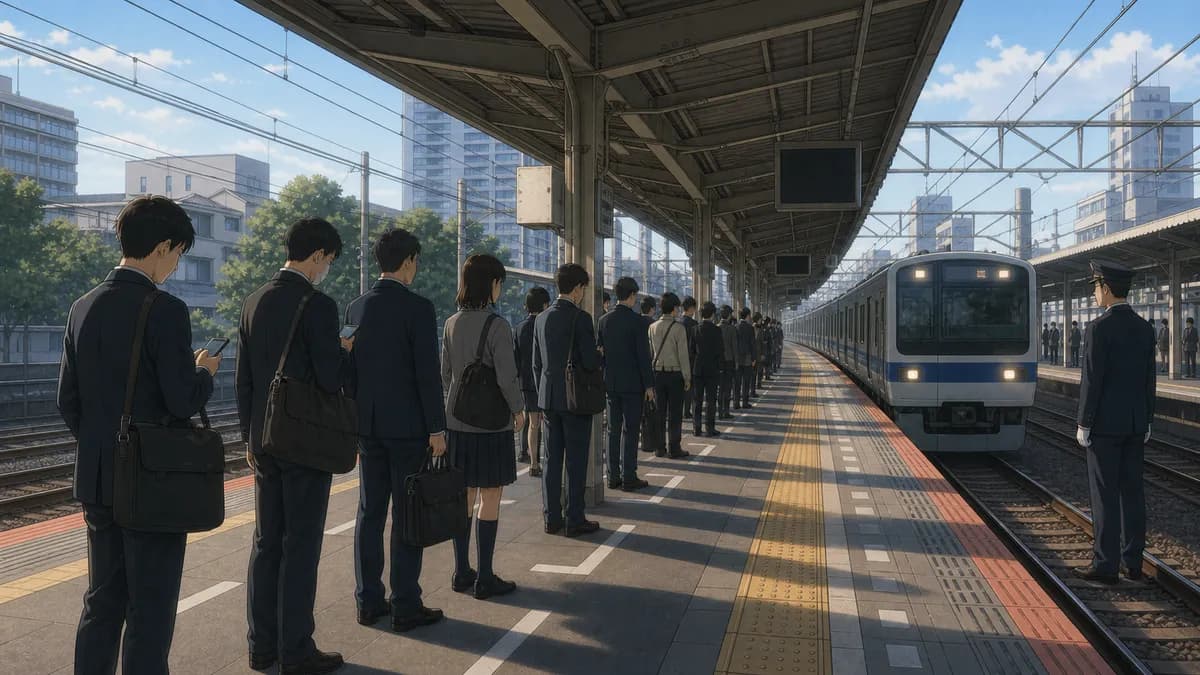
Standing on a Tokyo train platform for the first time, you might notice the floor markings before you notice anything else. Small arrows. Painted footprint shapes on the tiles. And without anyone being told to, without a guard watching, people are already standing there — two neat lines, same direction, gaps preserved with quiet precision.
If you come from somewhere queuing is more of a suggestion than a rule, this can feel like a small magic trick. So what is actually going on?
The System That Makes Itself Work
The most direct answer is structural. Japanese train platforms, convenience stores, and post offices are physically organized for queuing: floor markings, rope barriers, numbered tickets at busier counters. These cues remove ambiguity. You don't have to decide whether to queue; the floor tells you where to stand.
But the markings alone don't explain it. Lines form in Japan even without them — at disaster-relief distribution points after earthquakes, at overnight camping spots during cherry-blossom season, at temporary festival stalls with bare concrete underfoot. The physical design helps, but something else is doing most of the work.
Here is the core of it: a Japanese queue is a self-reinforcing promise between strangers. The first person arrives and stands in a sensible spot. The second person stands behind them. By the time a third, fourth, fifth person arrive, the social contract is already written. Breaking it requires visible effort — walking past people who are already waiting, drawing looks, causing meiwaku (inconvenience, trouble to others). Most people simply don't make that choice.
The queue works because every person in it is trusting that the person ahead of them is keeping the promise — and is therefore keeping it themselves.
What You'll Actually See
This shows up in ordinary Japanese life in small, consistent ways.
At a train station, doors open precisely where the platform markings said they would. Boarding only begins after every exiting passenger has stepped off. No announcement required; it just happens, platform after platform, every morning across the country.
At a popular ramen shop, people queue outside in a single file even in rain — phones out, umbrellas angled, no pushing, no murmuring. The wait carries an almost meditative quality, as if it's part of the meal itself.
After the 2011 earthquake, photographs circulated internationally of disaster survivors queuing calmly for food and water distribution. Journalists noted the absence of shoving. That the images surprised people overseas says something about how unusual the norm appeared from outside.
If you've watched enough anime set in ordinary Japanese school life, you've probably seen this — the morning commute scene, the school canteen line. That detail isn't invented for the story. It comes from the actual rhythm of daily Japanese life.
Here's How I See It — One Reading, Not a Verdict
There are a few ways to explain why this norm holds so consistently, and I won't pretend there's one clean answer.
One view is purely practical: Japan is a dense country. Tokyo has over thirteen million people in the city proper, and more than thirty million in the greater metropolitan area. When physical space is shared this tightly, small transgressions ripple outward in ways that feel genuinely disruptive. Orderly systems reduce friction, and people feel that reduction in their daily lives.
Another view reaches toward something harder to pin down. In Japanese there is the word meiwaku — causing trouble or inconvenience to others — and the avoidance of it is genuinely felt, not merely performed. There is also an unspoken sense that the social space is shared, that what you do affects the people around you in ways that carry real weight. I suspect, for many people who grew up inside this system, queuing neatly isn't really a sacrifice. It's simply the expected shape of the situation. They're not thinking about it.
But I won't claim that's the explanation. I doubt there is one. And honestly, staying uncertain here feels like the more honest place to land.
Speaking for myself, I queue so automatically that when someone asks "why?", I can't really explain it. What I can say is that it genuinely is efficient. And queuing isn't only time spent enduring a wait. In a really long line — the kind you get at a World Expo, hours on end — you sometimes end up exchanging a few words with the strangers ahead of and behind you, and become a little friendly. Somewhere in that shared waiting, the person you were quietly keeping a "no cutting in" pact with turns into someone to chat with. Inside the neat orderly line, that small warmth occasionally springs up too.
It Isn't Only Beautiful
Of course, not everyone feels at ease inside a well-ordered queue.
For a visitor from outside, walking into what turns out to be a line you didn't recognize as a line is an entirely understandable mistake — and can produce a low-level guilt that stays with you for hours. The queue is legible to people raised inside the system; it can be invisible or confusing to those outside it.
And for some people raised inside the system, the pressure isn't neutral. The same social weight that keeps lines orderly can feel, at its heavier end, like a demand to conform without asking why. Standing in the right spot, maintaining the correct interval, not drawing attention — the accumulation of small self-management acts can become exhausting, particularly on days when you're already stretched.
Both things are true at once. The queue is often a small, practical act of consideration for strangers. It can also be a form of ambient social pressure. The same behavior, felt differently by different people in different moments. One isn't more real than the other.
Where to Notice It
If you want to see Japanese queuing in its most ordinary form, a morning commute at any large train station will do it — Shinjuku, Osaka's Umeda, Nagoya. Watch the floor markings. Watch the gap held at the door while people exit. Watch how quickly order reassembles after the surge of a busy rush.
For a slower version: a popular ramen shop at lunchtime, or a convenience store checkout in a business district around noon. The patience in the line has an almost physical weight to it.
And if you're studying Japanese: the verb narabu (並ぶ) — to line up, to queue — appears early in practical vocabulary. Directions, polite requests, signs. Its frequency is itself a small hint about what everyday Japanese life is organized around.
The Stranger You'll Never Meet
A queue, at its simplest, is a deal between people who don't know each other: I'll wait for you now, because someone waited for me before, and someone will wait for the person behind me next.
In Japan, that deal tends to hold — quietly, without enforcement, without much visible negotiation. Whether that reflects a deeply internalized cultural orientation, a practical response to density and shared space, or just a set of habits that became infrastructure over decades — I genuinely don't know. All of those might be part of it.
What I do know is that when you stand in one of those lines for the first time — marked spots on the platform, the door sliding open exactly where you expected — you feel the reliability of it before you've thought through the reason. You realize, a moment later, that you were already trusting a stranger before you understood you were doing so.
If you come to Japan, join one of those lines yourself — on a platform, outside a shop. No one is directing it, yet a single clean line simply forms. That quiet order will probably help you, again and again, across the whole trip.
Sources & References
- A personal reading from everyday observation; no external sources cited. For population figures, see Japan Statistics Bureau. For earthquake-response documentation, see NHK World coverage of the 2011 Great East Japan Earthquake.
A Geek in Japan (Revised & Expanded)
A wide-angle introduction to the 'why' of Japanese culture — manga, anime, Zen, the tea ceremony and more. A natural companion to the topics Naze explores.
The Japanese Mind: Understanding Contemporary Japanese Culture
Chapters on aimai (ambiguity), amae, giri, wa and more — the values beneath the gestures and words. For readers who want to go deeper into the 'why.'
Share this article
Read Next
- Everyday JapanWhy Are Japanese Train Bento (Ekiben) So Special?Ekiben turn the train journey into a curated regional food tour. Here's the quiet logic behind Japan…
- Everyday JapanWhy Are There So Many Signs and Notices in Japan?Japan's streets and stations are layered with notices. Here's what the density reveals about preempt…
- Everyday JapanWhy Do Japanese People Care So Much About Seken?Seken — Japan's unnamed collective gaze — shapes everything from garbage etiquette to career choices…
- Everyday JapanWhy Do Japanese Households Still Keep a Handwritten Kakeibo? — The 1904 Method Behind the NotebookKakeibo — Japan's household account book — traces back to 1904, when journalist Hani Motoko proposed…
- Everyday JapanWhy Are Japanese 100-Yen Shops So Surprisingly Good? — The Daiso Model ExplainedJapan's 100-yen shops aren't just cheap stores — they run a specific model built on massive order vo…
Related Articles
Articles in the same category:
- Why Do Japanese People Wear Masks So Often? — Courtesy, Habit, and the Quiet Shield
- Why Does the Japanese Convenience Store Checkout Ask So Many Questions?
- Why Does Lost Property Get Returned in Japan? — The System Behind the Stories
- Why Is There No Tipping in Japan? — The Logic Behind the No-Tip Rule