Why Does Japan Still Have So Many Utility Poles?
Everyday Japan · 2026-06-20 · ~1,950 words · ~8 min read
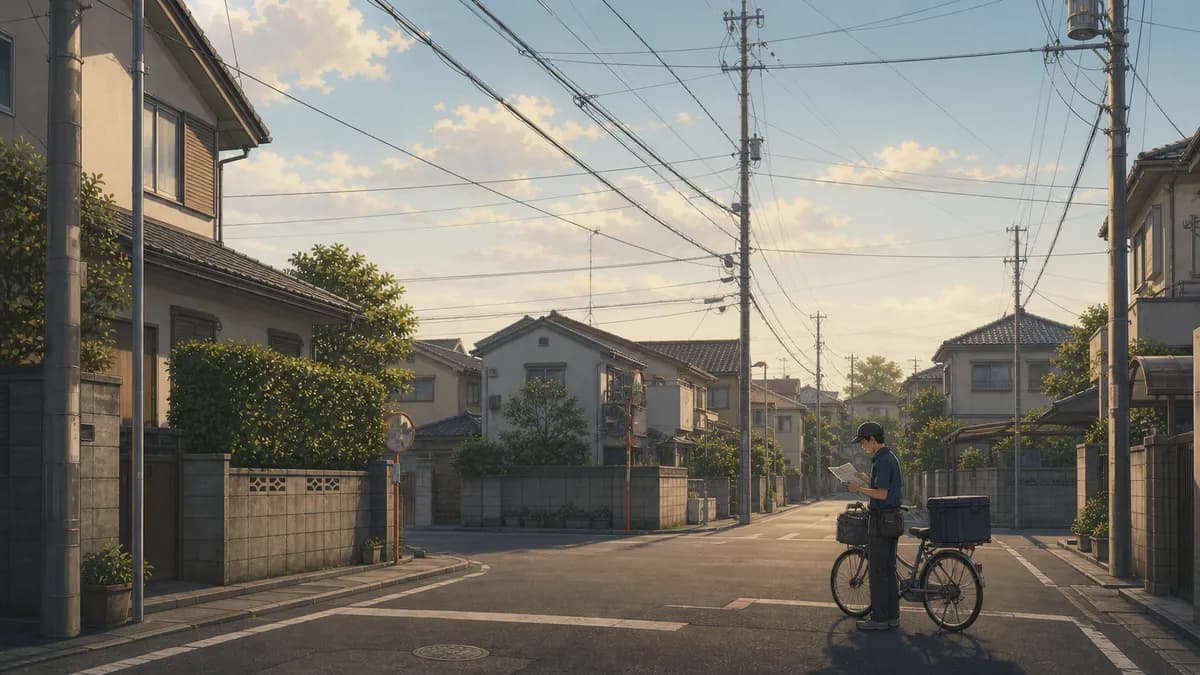
Quick answer: Japan still has so many utility poles and overhead power lines because burying cables costs roughly five to ten times more per kilometer than stringing them above ground, above-ground lines can be visually located and repaired within hours after an earthquake, and postwar reconstruction in the 1940s–50s prioritized speed over long-term aesthetics — a choice later generations never fully unwound. Here's how that logic actually held together, and what it costs.
Contents (7)
- The Speed of Postwar Electrification
- The Disaster Logic
- The Cost Nobody Wants to Talk About
- A Contested Landscape
- The Other Side of the Wires
- Where to Feel This
- One Question I Keep Coming Back To
You step out of a train station in a quiet Tokyo suburb — or a mid-sized city in the Kansai, or a small town anywhere — and look up. The sky above the narrow street is split by a lattice of black cables: power lines, telephone lines, fiber-optic bundles, all strung between wooden poles that lean at slightly different angles. A crow sits on one. Two plastic bags have lodged themselves in the wires above the convenience store. It is, honestly, a mess.
If you've come from London, Paris, or Seoul, where cables live underground and the sky above a city block is just sky, the question is immediate: how does a country this technically sophisticated still look like this?
The answer is less about neglect than about a very specific set of overlapping choices — some made in a hurry seventy years ago, some still being argued over today.
The Speed of Postwar Electrification
After World War II, Japan's infrastructure was devastated. Cities had been bombed flat, and the need to restore electricity was urgent. Through the late 1940s and into the 1950s, workers raced to string lines across the country. Wooden utility poles were the fastest, cheapest way to get power to homes and factories: plant a pole in a day, string a line, move on.
Running cables underground required excavation, conduit, waterproofing — weeks of work per block, at costs that were several times higher. A country that needed to rebuild its economy as fast as possible couldn't afford to go slow. Speed was the rational choice.
This isn't unique to Japan. Many countries electrified fast and above-ground in the postwar decades. The difference is what happened next. In much of Western Europe, cities undertook large-scale undergrounding programs through the 1970s, 80s, and 90s, often bundled into urban renewal or road-widening projects. Japan, where streets in older residential neighborhoods are famously narrow, faced a different set of constraints — widening roads to accommodate underground cable conduit sometimes meant demolishing buildings that had barely been rebuilt.
So the poles stayed. And as Japan's economy accelerated through the 1960s and 70s, more cables were added to the existing poles: first telephone, then cable TV, then internet fiber. What started as a power infrastructure became a stacked tangle of services sharing the same wooden poles, because that was always cheaper and faster than digging new conduit.
The Disaster Logic
Here is something that surprises many people: after a major earthquake, above-ground power lines can often be restored in days. Sometimes hours. A crew with a bucket truck can see exactly where the break is, and fix it on the spot.
Underground cables are different. After the 2016 Kumamoto earthquakes, which caused significant ground displacement in some areas, certain underground cable sections required considerably longer to locate and repair — because the damage isn't visible. Finding the break requires diagnostic equipment; then it requires excavation.
Japan sits on one of the most seismically active zones on Earth. The country experiences thousands of small earthquakes every year and major destructive ones every generation. Emergency power restoration isn't an abstract concern — it's a core function of the grid. The visibility and accessibility of above-ground lines is a genuine operational advantage in a country where the question isn't whether there will be a major quake, but when.
I won't say this settles the debate — it doesn't. There are engineers who argue that modern underground systems, properly designed, can be more resilient to earthquake damage than above-ground lines. The evidence is genuinely contested. But the disaster-recovery logic is one real reason why Japan's infrastructure planners have historically been cautious about committing to undergrounding at scale.
The Cost Nobody Wants to Talk About
The other reason — maybe the most straightforward — is money.
Undergrounding utility cables in a dense urban environment costs, by most estimates, somewhere between five and ten times more per kilometer than maintaining above-ground poles. Japan's Ministry of Land, Infrastructure, Transport and Tourism has been pushing a national undergrounding initiative for years, but even their targets are modest: focus on major arterial roads and disaster-risk zones first, not the residential back-streets where most of the poles actually live.
As of recent government surveys, Japan's underground cable rate in major urban areas — even in central Tokyo — remains significantly lower than European capitals. London and Paris are near 100%; Japan's residential neighborhoods are largely untouched. The gap is widely acknowledged domestically and, in some circles, a source of genuine national embarrassment.
The 無電柱化推進法 — the Utility Pole Elimination Promotion Act — was passed in December 2016, giving the government a legal framework to accelerate undergrounding. Progress has been made along major roads in central Tokyo and Osaka. But the narrow residential lanes, where the poles lean at their photogenic angles, are a different matter entirely.
A Contested Landscape
This is where things get genuinely interesting to me, and where I want to be careful not to land too cleanly.
Some Japanese people find the poles genuinely ugly — an embarrassment compared to the clean sightlines of European or East Asian cities. Urban planners, architects, and tourism advocates have argued for years that the tangle of cables makes Japan look less sophisticated than it is. There have been campaigns, municipal incentives, architectural prizes for underground infrastructure.
And then there's the other side.
The 電柱 (denchū) has become a visual signature of everyday Japan that carries, for many people, a certain warmth. You see it in anime constantly: the evening shot of wires silhouetted against an orange sky, a crow on the line, a child walking home below. It appears in Anohana, in Karakai Jōzu no Takagi-san, in Yotsuba&!, in countless other works set in ordinary Japanese neighborhoods. It is, unmistakably, a shorthand for this specific texture of daily life.
That aesthetic didn't emerge because someone chose it. It emerged because the poles are actually there — in every residential street, in every town, in the background of every memory of coming home as a kid. The anime frame is a direct copy of the real landscape.
Of course, not everyone finds this charming. The romanticization of utility poles would probably strike anyone who grew up wishing the streets looked different as a bit tone-deaf. Both reactions are valid. The poles are not secretly beautiful; they are simply present, and presence over decades accumulates a weight that is hard to entirely dismiss.
The Other Side of the Wires
It's worth naming this clearly: the slow progress on undergrounding has real costs, not just aesthetic ones.
Utility poles are a documented hazard in earthquakes and typhoons. When a pole topples — and they do — it can take out power to hundreds of homes, block roads for emergency vehicles, and create electrical hazards at ground level. In the 2018 Osaka earthquake, fallen utility poles caused significant road disruption. The case for undergrounding is not just a matter of how a city looks.
There is also the question of who pays. The current framework puts much of the financial burden on local governments and landowners, which slows progress in areas where budgets are tight and priorities compete. The slow pace isn't only about technical caution or engineering philosophy — it's about funding structures that don't make undergrounding easy to execute at scale.
The poles' advantage in fast recovery after a quake, and their risk when they fall during one, are two sides of the same fact. Neither cancels the other out.
Where to Feel This
If you want to see the poles in their most visually striking form, walk a quiet residential neighborhood in late afternoon — Shimokitazawa in Tokyo, the backstreets of Nara, or the older quarters of any mid-sized Japanese city. The low sun catches the wires; crows settle on the lines; a cat sits on a wall below. It's the scene anime has borrowed so many times it has almost become a cliché — except it's real, and it's real everywhere.
If you want to follow the ongoing debate, search for NHK or major news coverage of 無電柱化. The tension between cost, safety, nostalgia, and international comparison is argued there with genuine seriousness.
Anime to watch with this in mind: Ano Hi Mita Hana (Anohana), Karakai Jōzu no Takagi-san, or any slice-of-life series set in an ordinary Japanese neighborhood. The poles appear in background frames as a matter of fact — because they are a matter of fact.
One Question I Keep Coming Back To
Here is what I find myself sitting with: the poles aren't going away quickly. The undergrounding targets are ambitious on paper and slow in practice. The cost is real, the earthquake logic is real, the narrow streets are real. None of these are excuses, exactly — they're just the actual conditions.
What has changed is that a certain generation grew up with these poles as part of the visual language of home. And that is now being exported, frame by frame, through anime, to people who have never been to Japan but immediately recognize the feeling of a crow on a wire at dusk.
Whether that's a beautiful accident or simply a thing that happened, I honestly can't say. How does the sky look above the streets where you grew up?
Sources & References
- 国土交通省「無電柱化の推進」 (Ministry of Land, Infrastructure, Transport and Tourism — Utility Pole Elimination Initiative)
- 無電柱化推進法(平成28年法律第112号)— Utility Pole Elimination Promotion Act, enacted December 2016
- Comparative underground cable rate data cited from publicly available government comparative surveys; specific residential-area percentages vary by measurement method and are presented here as approximate ranges, not precise figures
- Personal observation; the nostalgia and landscape readings are a personal interpretation, not a claim about universal Japanese feeling
A Geek in Japan (Revised & Expanded)
A wide-angle introduction to the 'why' of Japanese culture — manga, anime, Zen, the tea ceremony and more. A natural companion to the topics Naze explores.
The Japanese Mind: Understanding Contemporary Japanese Culture
Chapters on aimai (ambiguity), amae, giri, wa and more — the values beneath the gestures and words. For readers who want to go deeper into the 'why.'
Share this article
Read Next
- Everyday JapanWhy Are Japanese Train Bento (Ekiben) So Special?Ekiben turn the train journey into a curated regional food tour. Here's the quiet logic behind Japan…
- Everyday JapanWhy Are There So Many Signs and Notices in Japan?Japan's streets and stations are layered with notices. Here's what the density reveals about preempt…
- Everyday JapanWhy Do Japanese People Care So Much About Seken?Seken — Japan's unnamed collective gaze — shapes everything from garbage etiquette to career choices…
- Everyday JapanWhy Do Japanese Households Still Keep a Handwritten Kakeibo? — The 1904 Method Behind the NotebookKakeibo — Japan's household account book — traces back to 1904, when journalist Hani Motoko proposed…
- Everyday JapanWhy Are Japanese 100-Yen Shops So Surprisingly Good? — The Daiso Model ExplainedJapan's 100-yen shops aren't just cheap stores — they run a specific model built on massive order vo…
Related Articles
Articles in the same category: