Why Don't Japanese Addresses Have Street Names? — The Block Number System
Everyday Japan · 2026-06-18 · ~1,700 words · ~6 min read
Contents (8)
- Living Inside the Block, Not on the Street
- Why No Street Names?
- Before GPS: Hand-Drawn Maps and the Landmark Art
- The Delivery Driver Who Knows Every Corner
- Here's How I See It
- The Real Friction
- Where to Feel This
- The Part That Stays With Me
You've copied the address from a website and opened it in Maps. Your phone says you're standing right outside the building. But there are three identical-looking entrances in front of you, and not one of them has a visible number. Or you're on a corner in Osaka trying to find a friend's apartment, and you notice: there is no street sign anywhere. The streets clearly exist. They just don't have names — at least not ones that appear in anyone's address.
This isn't an infrastructure gap. It's a different logic entirely — one that has been quietly organizing Japanese daily life for well over a century.
Living Inside the Block, Not on the Street
A Japanese address works through nested areas, not named roads. After the city and ward, three elements narrow the location:
- 丁目 (chōme) — a named sub-district within a neighborhood (e.g., Shinjuku 3-chōme)
- 番 (ban) — a numbered block within that sub-district
- 号 (gō) — the specific building within that block
So an address like 新宿区新宿3丁目5番7号 means: "In Shinjuku, Shinjuku district, third sub-district, block five, building seven." No road is named.
A Japanese address doesn't say "on this street" — it says "inside this block."
The system was formally standardized by the Residential Address Display Act (住居表示に関する法律), passed in 1962. But its roots go further back, to the Meiji-era land surveys of the late 19th century. When the government formalized land ownership, plots were recorded and numbered in the order they were surveyed — not in the order they physically sat on the ground.
That last point explains the confusion. Building numbers within a block are not sequential by physical position. They follow the order in which plots were registered. House number 3 may sit next to house number 17. There is logic in the archive; there is no logic visible from the street.
Why No Street Names?
In most Western countries, cities developed along named roads — Roman roads, medieval market streets, colonial grids — and buildings were numbered along those roads as they appeared. The street came first; the buildings followed it.
In Japan, especially in cities that grew without a formal plan (which is most of them, outside Kyoto and Sapporo), land was registered parcel by parcel. As the Meiji government formalized property ownership, it numbered plots in the order they were surveyed. That registration number became the address. The road the plot happened to face wasn't part of the record.
Streets did acquire names over time — especially major thoroughfares in large cities — but those names never became the organizing principle of the address system. The address belonged to the land record, not to the road. Whether that felt like a gap at the time is hard to say; it was simply how land was tracked.
Before GPS: Hand-Drawn Maps and the Landmark Art
If you've watched older Japanese films or anime set in the 1980s and 90s, you'll recognize the ritual of the hand-drawn map (手書きの地図). Someone hosting a gathering would fax or mail a small sketch ahead of time: "Turn left at the convenience store, past the barber, the house with the red gate." Company invitation letters came with printed diagrams showing the nearest station exit, the main corners, the building.
This wasn't charming set dressing. It was practical necessity. The address existed on the envelope, but you often couldn't find the door from it alone. The sketch bridged the gap.
Without named streets as waypoints, Japanese navigation defaulted to landmarks. "The second traffic light past the shrine," "the parking lot next to the family restaurant," "the building with the green awning." Streets were almost invisible in direction-giving — they were gaps between places, not places themselves.
You can still feel this today, smartphone in hand. Casual directions in Japanese lean heavily on what you can see and recognize. "Turn at the convenience store" is the native phrase. Giving a street name as a waypoint isn't a pattern that comes naturally in cities where streets go unnamed.
I caught myself doing it recently. Asked how to reach a place I know well, I produced — without thinking — something like: "Keep the convenience store on your left and go about fifty meters. When you see the sign, turn right. Up the slope, and at the crossroads turn right again. Follow the road and it comes up on your left." Only afterwards did I notice: an entire route, delivered turn by turn, and not one street name in it. I wasn't avoiding them. They simply never came to mind.
The Delivery Driver Who Knows Every Corner
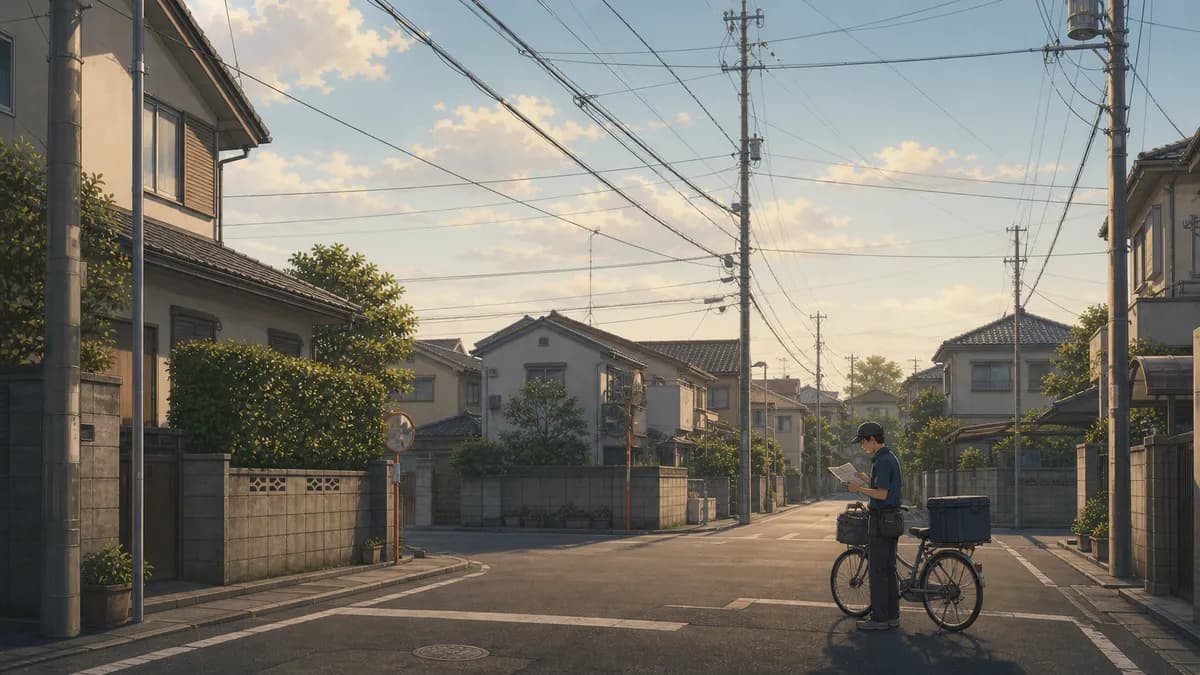
Japan's postal and courier networks run against this backdrop with notable effectiveness. Japan Post and courier companies like Yamato Transport (クロネコヤマト) and Sagawa are known for the local expertise of their drivers — entire delivery districts memorized, down to which building sits in which corner of which block, which entrance is around the back.
Veteran drivers describe their routes the way craftspeople describe their tools. That's because the system asks something a street-name address never would: know the neighborhood, not just the number.
The fact that Japanese deliveries work as well as they do is partly a tribute to that expertise, and partly a reminder that navigability was never what the system was optimized for.
Here's How I See It
I won't claim this reflects some deep Japanese sense of place or neighborhood belonging — that feels like a reach. It's mostly a bureaucratic legacy of how land was recorded.
But I do notice something in how it plays out day to day. When you navigate by block rather than by street, your mental map of a neighborhood becomes about what and who is there rather than which roads run through it. Directions become relational — described in terms of other visible things, not abstract lines on a grid.
Perhaps, in places where streets don't have names, people learn to know an area by its contents rather than its geometry. The shrine, the old tofu shop, the sento that's been there forty years. I won't say that's a deeper way of knowing a place. But it is a different one.
Of course, not everyone experiences it this way — and many Japanese people find the system just as frustrating as anyone else when they're somewhere unfamiliar.
The Real Friction
It should be said plainly: this system causes genuine confusion, and not only for tourists.
Deliveries go to the wrong entrance. First-time visitors circle the same block twice. Japanese people navigating an unfamiliar neighborhood can't reliably find an address from the numbers alone — they call ahead, ask at the nearest convenience store, stand outside saying "I see a blue sign, is that you?"
I've done the circling myself — in Kyoto, of all places, the one Japanese city famous for having street names. The house I was looking for was an old machiya set back from the road on a flag-shaped plot: the address was right, the map insisted I had arrived, but the building sat behind the row that faced the street, up an entrance path too narrow for a car. I drove the same loop again and again before giving up, parking nearby, and walking the last stretch. The address had been correct the entire time. It pointed at the zone. It never promised the door.
And the difficulty isn't only structural — the reading is hard too. Many Japanese place names are nandoku: names almost no one but a local can pronounce on sight. The same kanji can read differently from one place to the next; some addresses even mix in katakana; and cities like Kyoto stack up long, complex street-name addresses. Even Japanese people frequently can't read an unfamiliar place name correctly. On top of the jumping numbers, that unreadability is part of what keeps an address feeling faintly like a stranger.
The address points to a block. It doesn't always point to the door.
The system functions in modern Japan largely because GPS now handles what the address doesn't — and because of the dense local knowledge that delivery drivers, longtime residents, and neighborhood shopkeepers carry. The elegance lives in the land registry, not in the street experience.
For visitors, this disorientation is real. The practical insight: once you understand that a Japanese address points to a zone rather than a road, you can stop looking for a street sign that isn't coming, and start using Maps plus a landmark description for the final approach.
Where to Feel This
Try filling out a Japanese shipping slip. The address fields break down into exactly the nested structure — prefecture, city or ward, chōme, ban, gō. Fill it out once, and the zone-within-zone logic clicks into place.
Then walk through Kyoto. Kyoto was built in 794 as the imperial capital Heian-kyō, modeled on the Tang Dynasty Chinese grid plan. Named thoroughfares — 四条通 (Shijō-dōri), 烏丸通 (Karasuma-dōri), 御池通 (Oike-dōri) — appear on signs, in addresses, and in everyday speech. You can arrange to meet at "the corner of Shijō and Karasuma." That works in Kyoto. Try the equivalent in Tokyo and you'll get a blank look.
Sapporo offers another version: planned on a Meiji-era grid, it uses directional coordinates (North 3, West 5) that give an immediate physical bearing. Both cities are exceptions that make the rule visible.
For a lived sense of the pre-GPS era, pay attention in older anime or live-action dramas when characters exchange meeting details. The hand-drawn map, the "turn at the tofu shop, look for the blue gate" — that was real social infrastructure, not set dressing.
The Part That Stays With Me
If someone gives you their address in Japan, you'll find the block. But not always the door.
So you add: "Near the X station exit, behind the Y supermarket, the building with the Z sign." You triangulate with visible things.
What that suggests to me is that in a system without street names, what actually communicates where someone lives isn't the address — it's the description of the neighborhood they add around it. The numbers locate the block. The story locates the person.
Whether that's a feature or a workaround probably depends on which side of the address slip you're standing on.
Sources & References
- 住居表示に関する法律(昭和37年法律第119号)— e-Gov法令検索
- 総務省「住居表示制度」 — Ministry of Internal Affairs and Communications
- Kyoto's Heian-kyō street grid: historical documentation via Kyoto City official site
- Personal observation; no statistical claims made about navigational behavior
A Geek in Japan (Revised & Expanded)
A wide-angle introduction to the 'why' of Japanese culture — manga, anime, Zen, the tea ceremony and more. A natural companion to the topics Naze explores.
The Japanese Mind: Understanding Contemporary Japanese Culture
Chapters on aimai (ambiguity), amae, giri, wa and more — the values beneath the gestures and words. For readers who want to go deeper into the 'why.'
Share this article
Read Next
- Everyday JapanWhy Are Japanese Train Bento (Ekiben) So Special?Ekiben turn the train journey into a curated regional food tour. Here's the quiet logic behind Japan…
- Everyday JapanWhy Are There So Many Signs and Notices in Japan?Japan's streets and stations are layered with notices. Here's what the density reveals about preempt…
- Everyday JapanWhy Do Japanese People Care So Much About Seken?Seken — Japan's unnamed collective gaze — shapes everything from garbage etiquette to career choices…
- Everyday JapanWhy Do Japanese Households Still Keep a Handwritten Kakeibo? — The 1904 Method Behind the NotebookKakeibo — Japan's household account book — traces back to 1904, when journalist Hani Motoko proposed…
- Everyday JapanWhy Are Japanese 100-Yen Shops So Surprisingly Good? — The Daiso Model ExplainedJapan's 100-yen shops aren't just cheap stores — they run a specific model built on massive order vo…
Related Articles
Articles in the same category:
- Why Does Japan Still Have So Many Utility Poles?
- Why Does Japan Still Use So Much Cash? — The Quiet Logic Behind Every 'Cash Only' Sign
- Why Do Japanese Children Walk to School Alone? — The Hidden System Behind the Independence
- Why Is Japanese Curry So Different from Indian Curry — and How Did It Become Japan's National Dish?