What Is Otentosama? Why Japanese People Behave as if Someone Is Always Watching
Words & Feelings · 2026-06-20 · ~1,500 words · ~6 min read
Contents (7)
- The Sun as a Witness
- One Thread, Two Surprising Places
- Not Conquering Nature, but Living Under It
- Here's How I See It — One Reading Only
- Maybe It Was Never an Eye
- Not Everyone, and the Shadow
- Where to Feel This Most Clearly
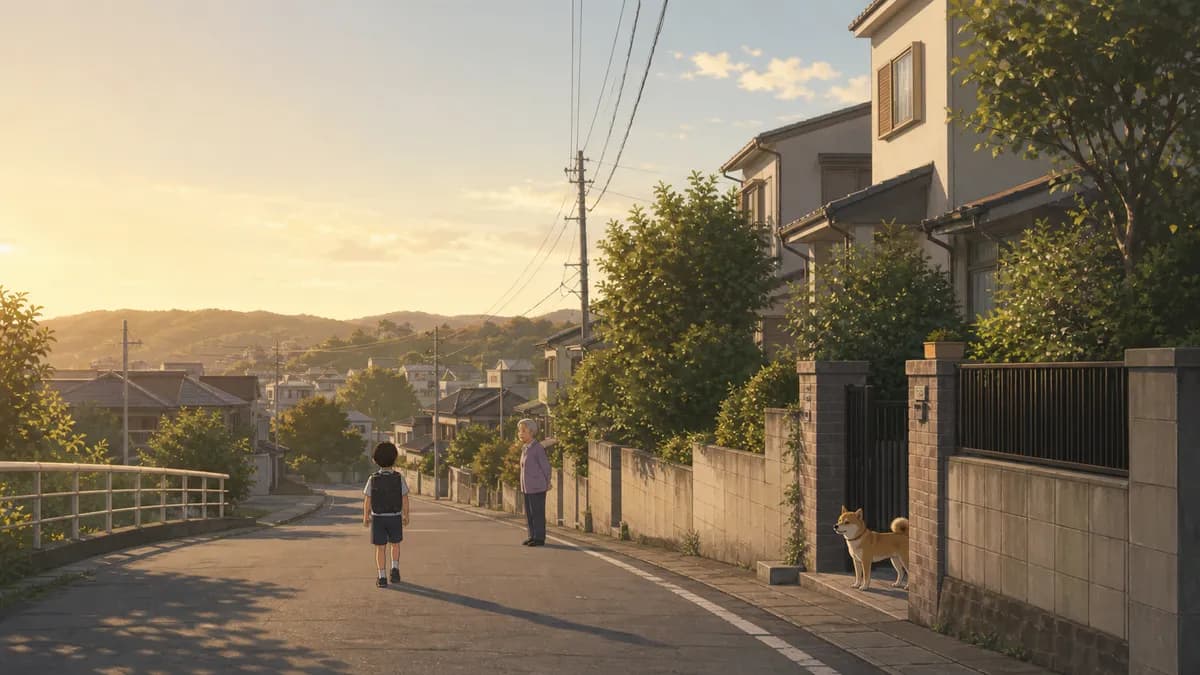
A child reaches for a coin that isn't theirs, and an adult says, quietly, not angrily: Otentosama ga miteru yo. — "Otentosama is watching."
There's no one else in the room. No camera, no teacher, no parent's eye on the moment. And yet the sentence lands. The child puts the coin down.
If you've spent time in Japan and found yourself surprised by small things — a lost wallet handed back intact, an unattended roadside stand with a cash tin and no lock, the way people behave on an empty late-night street — you may have brushed against the same underground idea without knowing its name. A lot of it can be traced, at least partly, to one quiet word.
The Sun as a Witness
Otentosama (お天道様) is an old, affectionate, respectful word for the sun. The o- and -sama are markers of warmth and reverence; tendō (天道) means something like "the way of heaven." So the whole word is closer to "the honorable way of heaven made visible as the sun" than to a flat astronomical "the sun."
What makes it interesting isn't the sun as an object. It's the sun as a witness.
The phrase you hear is Otentosama ga miteiru — "Otentosama is watching." It's said to children, but adults carry it too, half-jokingly and half not. The meaning is direct: even when no person can see what you do, something can. So don't do the thing you'd be ashamed of. Behave as if the sky is keeping account.
This is not exactly religion. People who would never call themselves believers still use the phrase. It's not a named god you pray to for favors. It sits in a vaguer, older space — a folk sense that there is an order to things, and that honesty isn't only a transaction between you and whoever might catch you. It's something closer to: the daylight itself has seen.
One Thread, Two Surprising Places
Here's what I find genuinely striking about otentosama: the same idea seems to surface in two everyday places that, at first glance, have nothing to do with each other.
The honesty things. Japan's reputation for safety and returned property gets explained in a lot of ways — and the concrete explanations matter most. There is real lost-property infrastructure: koban, station staff, a return system that makes handing something in easier than keeping it. There are dense community systems. I've written elsewhere about why Japan feels so safe, and almost none of that is mystical. But underneath the systems, there's also this quiet internal sense that being unseen by people doesn't mean being unseen. The unmanned vegetable stand works partly because of small-community reputation — and partly because of a feeling that someone has seen anyway.
The gratitude things. Now look at the words said over food. Itadakimasu before a meal and gochisousama after it are both directed outward — toward the food, the lives it took, the people who grew and carried and cooked it, even when no one is at the table to thank. You say gochisousama over a convenience store bento eaten alone. The recipient isn't present. The phrase still faces outward, toward an unseen network of effort.
Do you see the shared shape? In both cases, behavior is organized around an absent-but-felt witness. Honesty when no one watches. Thanks when no one receives it. The phrasing differs, but the underlying posture — act as if it is seen, say it as if it is heard — rhymes.
I want to be careful here. I'm not claiming a single word causes a whole society's honesty; that would be exactly the kind of tidy story this site exists to resist. But as a thread — a way the same intuition shows up in unrelated corners of daily life — otentosama is hard to unsee once you've noticed it.
Not Conquering Nature, but Living Under It
There's a second face to otentosama worth naming, because curious readers often arrive at it from a different door — wondering whether Japan has a distinctive relationship with nature.
The sun in otentosama isn't a resource to be managed or a force to be subdued. It's above you. You live under it. The grammar of the word itself — heaven's way, honored — places the human below, not in command.
That fits a wider pattern I've tried to describe in why people here speak of living with nature rather than mastering it. The summer sun, the rainy season, the heat and the cold are things you adjust to, not things you defeat. Otentosama is the small, daily, personal version of that posture: the sky is not yours to outsmart, and it has, in some quiet sense, already seen.
I'd stop short of turning this into a grand civilizational claim. Plenty of cultures speak of the heavens watching. But the everydayness of it in Japan — that an ordinary parent reaches for the sun, not a courtroom or a god of judgment, to teach a child honesty — is the part that stays with me.
Here's How I See It — One Reading Only
I'll be honest: I don't think otentosama is "the secret of Japan." I distrust any sentence shaped like that.
What I'd offer instead is smaller. A society needs ways to make honesty hold in the gaps where no one is looking — and those gaps are where most behavior actually happens. Some cultures fill the gap with law, some with God, some with shame before a community. Japan's folk answer, repeated quietly to children for generations, was to point at the sky and say: it has seen.
Perhaps. That's one way to frame it. The concrete systems — return infrastructure, community watch, dense streets — probably do most of the heavy lifting. But the interior habit of feeling watched by the daylight is, I suspect, part of what makes those systems feel natural rather than imposed.
I can't prove the weight of any one factor. They're tangled. I just notice that the wallet comes back, the gochisousama gets said to an empty room — and the same small idea is sitting under both.
Maybe It Was Never an Eye
There's one more turn worth taking before the shadow.
Is it really the feeling of being watched that walks a stranger's wallet to the police box? Framed only as a watching eye, otentosama starts to sound cold — honesty out of fear of being caught.
But what actually moves the hand may be warmer than that. It's the imagining: if I had dropped this, how lost would I feel? You can't see the owner, yet you picture their panic and their relief as your own — and your feet start toward the koban. If that's true, then otentosama may not be a watching eye at all, but the most familiar name we gave to that act of imagining.
Why did the language of being watched survive, then, rather than the language of imagining? Probably because imagining is invisible and the sky is not. Give the unseen act of empathy a face — vast, ordinary, above everyone alike — and it becomes something you can point a child toward. Otentosama may simply be the old, workable shorthand for that.
For me, too, the ones who said this were almost always parents or older people. And of course, both the person saying it and the person hearing it know, somewhere, that no sun is literally keeping watch from above. In the end it's a matter of your own heart, I think. Even with no one watching, can you stand tall behind what you did? Will you regret it later? It's a device for asking yourself exactly that. You could call it a kind of extremely high-performance radar, built into the Japanese heart — not a lookout posted outside, but a single eye set inside yourself, always quietly running.
Not Everyone, and the Shadow
Of course, not everyone feels this, and plenty of people would laugh at the phrase as something their grandmother said.
And there's a shadow worth naming honestly. A felt, invisible witness can be gentle — be good, even alone — but it can also tip into a heavier sense of always being watched, of never quite being off-stage. The same intuition that returns a wallet can, in another mood, become the pressure of imagined eyes: what would people think. I've written about the exhausting side of that elsewhere, in reading the air. The sun that reassures and the sun that surveils are, sometimes, the same sun. Both are true.
Where to Feel This Most Clearly
If you want to feel otentosama rather than just read about it:
Find an unmanned roadside stand — a box of vegetables, a price card, a cash tin. Buy something. Notice the small, real pause where you decide to pay although nothing would stop you from not paying. That pause is the word at work.
Sit through a quiet family meal and listen for itadakimasu and gochisousama — said outward, into the air, whether or not anyone "deserves" the thanks in that moment.
And, simply, step outside on a clear morning. The thing the phrase points to is right there, ordinary and enormous, and — the old line goes — already watching.
That's not a verdict I'd defend as fact. But the next time a small honest choice is yours alone to make, you might catch yourself glancing, just slightly, upward. Where does your sense of "someone is watching" come from?
Sources & References
- Standard Japanese dictionaries (国語辞典) — entries for お天道様 / 天道, etymology and usage
- Tokyo Metropolitan Police Department — Lost Property Annual Report
- Kanji and word-origin references for 頂く (itadaku) and 馳走 (chisou)
- A personal reading drawn from everyday observation; the link between a single phrase and social behavior is offered as one thread, not a proven cause.
The Japanese Mind: Understanding Contemporary Japanese Culture
Chapters on aimai (ambiguity), amae, giri, wa and more — the values beneath the gestures and words. For readers who want to go deeper into the 'why.'
A Geek in Japan (Revised & Expanded)
A wide-angle introduction to the 'why' of Japanese culture — manga, anime, Zen, the tea ceremony and more. A natural companion to the topics Naze explores.
Share this article
Read Next
- Words & FeelingsPILLARWhy Is Silence Not Awkward in Japan? — The Concept of MaIn many cultures, silence in conversation signals something's wrong. In Japan, silence can mean the …
- Words & FeelingsWhy Are Japanese Shops So Loud If Japan Is 'Quiet'?Japanese trains are near-silent; shops hit you with a full 'Irasshaimase!' the moment you enter. One…
- Words & FeelingsWhy Do Japanese People Find It Hard to Say No?Japan's indirect 'no' — chotto, muzukashii, 'I'll think about it' — isn't evasion. It's a system for…
- Words & FeelingsWhy Does 'Daijoubu' Mean Both Yes and No in Japanese?'Daijoubu desu' works as a polite refusal one moment and a reassurance the next — same word, opposit…
- Words & FeelingsWhy Does "Mottainai" Mean More Than Just "Wasteful"?"Mottainai" translates as wasteful, but the word carries something English lacks — the grief of disc…
Related Articles
Articles in the same category: