
Why Do Japanese People Say Gochisousama After Eating? — The Word for a Finished Meal
Words & Feelings · 2026-06-08 · ~1,300 words · ~4 min read
Contents (5)
- The Word That Closes a Meal
- What the Kanji Actually Shows
- Who It's Directed At
- Itadakimasu and Gochisousama as a Pair
- A Note on the Habit
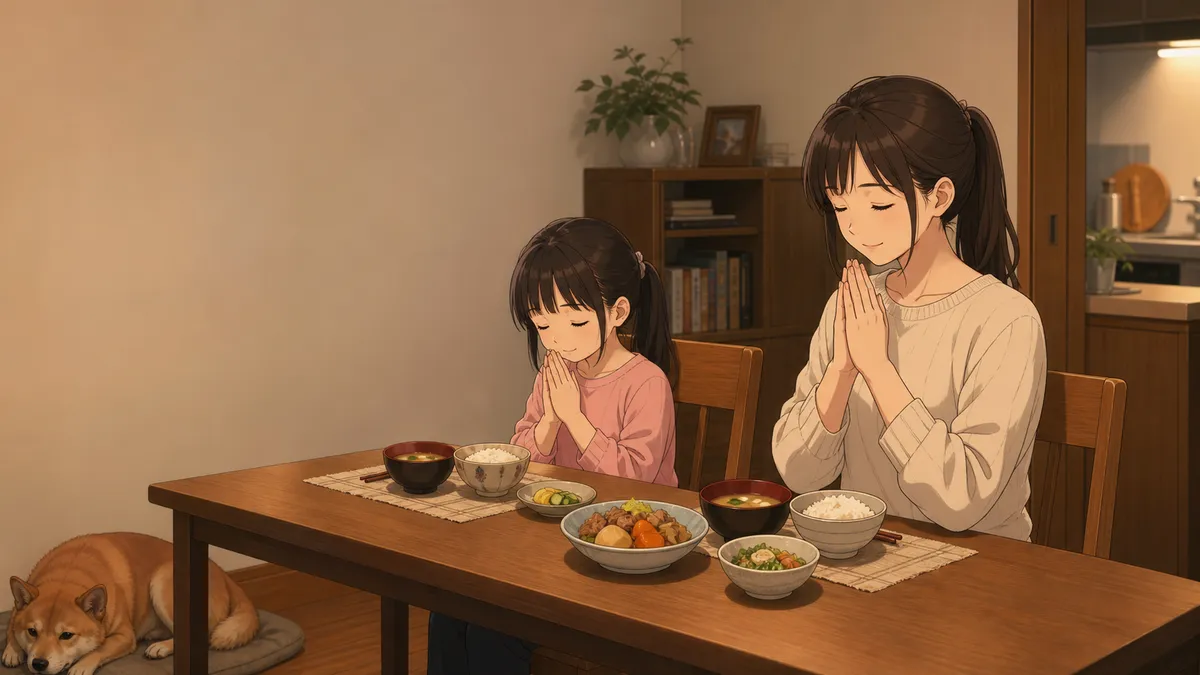
The meal is finished. Chopsticks are set down. Gochisousama deshita.
If you eat with Japanese people, you'll hear this at the end of every meal — at home, at a restaurant, over a convenience store lunch at a work desk. It's automatic. And yet folded inside the word is an image that goes back centuries.
(The word appears in romaji as gochisousama, gochisosama, or occasionally gouchisosama — all refer to the same phrase: ごちそうさまでした.)
The Word That Closes a Meal
In Japan, meals have a formal opening and closing. Before eating: itadakimasu — a statement of posture, a declaration that you are about to receive what's in front of you with a particular kind of attention. After eating: gochisousama (deshita) — the closing, the acknowledgment that the meal is complete.
The two words work as a pair. Itadakimasu opens the frame; gochisousama closes it. Together they give a meal something that "eating" alone doesn't quite have: a beginning that carries weight, and an ending that says, that mattered.
What the Kanji Actually Shows
Gochisousama is built on the word chisou (馳走), and the kanji inside it are worth a look.
The first character, chi (馳), contains the radical for horse (馬) and means "to rush on horseback." The second, sou (走), means "to run." Together, chisou originally described the act of riding out on horseback to gather ingredients — someone physically rushing about to procure and prepare a feast.
The honorific prefix go (御) and the respectful suffix sama (様) frame it as a formal acknowledgment of that effort. Gochisousama, literally rendered, is something like: "You ran around on my behalf, and I see that."
According to CoCoRo's research on Japanese mealtime expressions, the phrase began to be used as a post-meal greeting in the latter half of the Edo period. It was originally reserved for situations where you'd been treated to a meal outside your own home. After World War II, it gradually moved into everyday family meals and became universal.
Who It's Directed At
In a restaurant, the word feels natural — there's a kitchen, a staff, someone who made this happen. But what about eating a convenience store bento alone at your desk? Or a self-made meal, eaten by yourself?
Gochisousama still gets said. Automatically, often without reflection.
This is similar to the structure of itadakimasu: the word doesn't require a specific recipient to function. It seems to work as a gesture directed at the whole situation of the meal — the invisible labor embedded in the food: the farmers, the logistics chain, the person who cooked it, or the network of effort that made a meal possible at all.
The image of someone "running on horseback" is folded into the word, even when no one ran anywhere.
Personally, I've come to feel the question of who it's directed at doesn't matter much. For me, neither gochisousama nor itadakimasu depends on whether anyone else is in the room. The gratitude goes to the people who grew and made the ingredients — and, even more, to the life of the food itself: the fish, the vegetables, the meat on the plate were all, once, alive. So even eating a convenience store bento alone, the words come out with the same weight. There may be no one in front of me to receive them, but the thing the gratitude is pointed at is still very much there.
Itadakimasu and Gochisousama as a Pair
The pairing of these two phrases gives a meal a structure that "eating" by itself doesn't have.
Before: a posture of humble receipt. After: an acknowledgment that the effort was seen. The meal becomes, at least formally, something that was received and then completed — not just consumed.
Whether anyone experiences this consciously in daily life is a separate question. Most people say both phrases the way English speakers say "cheers" — habitually, without active reflection. The meaning, if it's present at all, runs below the surface.
But there's something in the structure worth noting: a culture that marks both the beginning and the end of something as simple as eating is, at minimum, one that treats the act of eating as worth framing.
A Note on the Habit
It's worth mentioning that not everyone follows this perfectly. In casual settings, among close friends, the phrase can be shortened, mumbled, skipped entirely. Young children sometimes need reminding. Families have different norms.
The point isn't that the custom is universally observed with precision — it's that the structure exists at all, and that it persists, even in abbreviated form, across contexts where most other cultures have nothing comparable.
Sources & References
- CoCoRo, "Itadakimasu & Gochisousama: Meaning and History" — historical spread and etymology
- Linguajunkie, "Itadakimasu and Gochisousama" — kanji breakdown and usage notes
- Kanji analysis from standard Japanese language references
The Japanese Mind: Understanding Contemporary Japanese Culture
Chapters on aimai (ambiguity), amae, giri, wa and more — the values beneath the gestures and words. For readers who want to go deeper into the 'why.'
A Geek in Japan (Revised & Expanded)
A wide-angle introduction to the 'why' of Japanese culture — manga, anime, Zen, the tea ceremony and more. A natural companion to the topics Naze explores.
Share this article
Read Next
- Words & FeelingsPILLARWhy Is Silence Not Awkward in Japan? — The Concept of MaIn many cultures, silence in conversation signals something's wrong. In Japan, silence can mean the …
- Words & FeelingsWhy Are Japanese Shops So Loud If Japan Is 'Quiet'?Japanese trains are near-silent; shops hit you with a full 'Irasshaimase!' the moment you enter. One…
- Words & FeelingsWhy Do Japanese People Find It Hard to Say No?Japan's indirect 'no' — chotto, muzukashii, 'I'll think about it' — isn't evasion. It's a system for…
- Words & FeelingsWhy Does 'Daijoubu' Mean Both Yes and No in Japanese?'Daijoubu desu' works as a polite refusal one moment and a reassurance the next — same word, opposit…
- Words & FeelingsWhy Does "Mottainai" Mean More Than Just "Wasteful"?"Mottainai" translates as wasteful, but the word carries something English lacks — the grief of disc…
Related Articles
Articles in the same category: