Ittekimasu and Itterasshai: What They Really Mean
Words & Feelings · 2026-06-19 · ~1,700 words · ~6 min read
Contents (6)
- The Return Is Already Inside the Departure
- The Genkan, the Threshold, Every Morning
- Why Does the Staying Person Get a Line?
- When There's No One to Say It To
- Where to Feel This More Deliberately
- A Question, Not a Conclusion
If you've watched any anime set in an ordinary Japanese home, you've heard it: someone grabs their bag at the door, calls something back into the house, and the person staying answers. The word going first is ittekimasu (行ってきます). The reply coming back is itterasshai (行ってらっしゃい). Most subtitles render these as "I'm off!" and "Take care!" — serviceable, but they quietly erase what's actually happening. Because this isn't a farewell in the usual sense. It's closer to a two-part contract, and the terms are specific.
The Return Is Already Inside the Departure
Ittekimasu breaks down as 行って (going) + 来ます (coming back). Not "I'm leaving," but "I'm going and I'll be back." The return is folded into the departure from the very start — and itterasshai, from 行っていらっしゃい, a gentle imperative — is the reply that accepts that: "go, and come back." The person staying isn't just wishing you well. They're holding the expectation of return.
Ittekimasu isn't a farewell — it's a promise to return. Itterasshai is the answer that accepts the promise.
One sentence. That's the spine of the whole exchange. Once you hear it framed that way, the pair sounds different.
The Genkan, the Threshold, Every Morning
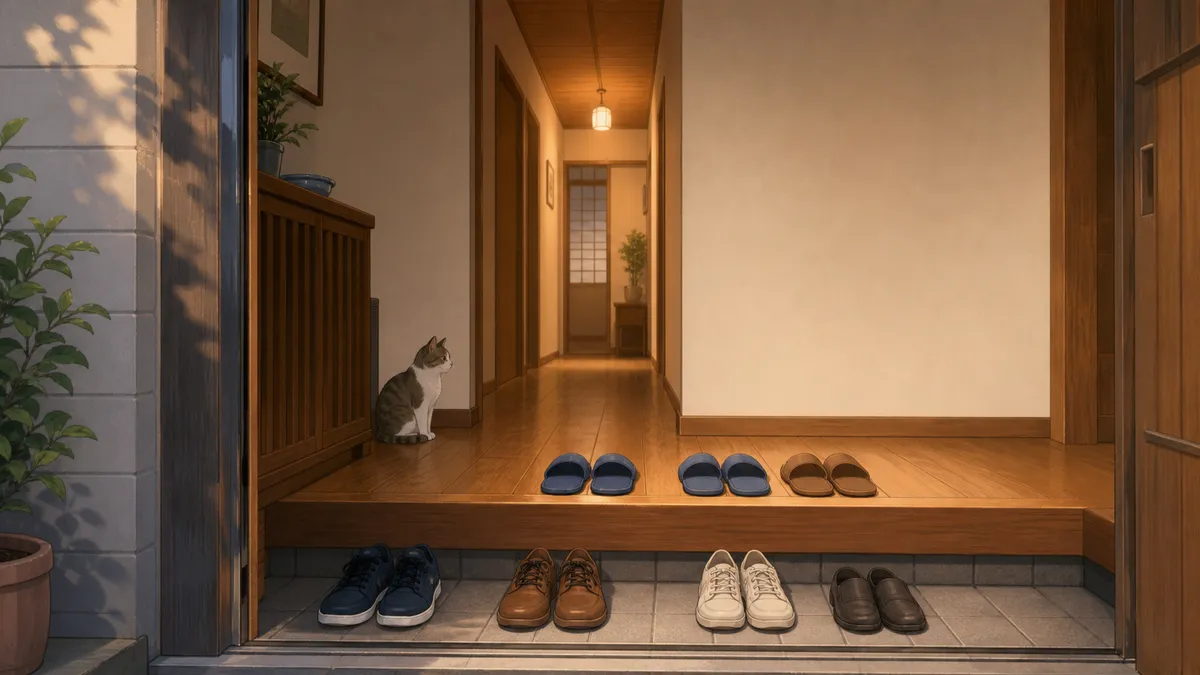
The exchange happens at the genkan — Japan's entryway, the threshold zone between inside and outside. Architecturally, it's a border: you step down here, put on shoes, cross over. Neither fully interior nor fully exterior. And it's on this threshold, every morning, that the contract is made.
A child heading for school. A partner leaving first for work. Someone still half-asleep at the kitchen table calling back itterasshai without quite looking up. The word comes before thought, nearly automatic. But the automaticity works because both sides of the exchange are expected — the departing person's line and the staying person's reply.
If you're learning Japanese, you've probably paused at this pair early on. Why does the person staying get a speaking part? In English — and in many other languages — the farewell belongs to the person leaving. "Bye," "see you," "take care" — all coming from the one going out the door. The other side can respond if they like, but there's no fixed form waiting for them.
Here there is. The staying person's line isn't optional the way a wave might be; it's the second half of the exchange. Without itterasshai, ittekimasu hangs in the air with its promise unacknowledged. Most people don't experience this consciously — the reply just comes — but its absence is felt.
The anime versions of this scene aren't stylized or exaggerated. Walk through a residential neighborhood on any weekday morning just before school hours, and you can hear the real thing — front doors opening, that brief two-part exchange, doors closing. It's texture, not drama.
How to use it
| Situation | Leaving | Staying |
|---|---|---|
| Home (everyday) | ittekimasu 行ってきます | itterasshai いってらっしゃい |
| Formal / workplace | itte mairimasu 行ってまいります | itterasshai (same) |
| On return | tadaima ただいま | okaeri おかえり |
Itte mairimasu is the polite form, appropriate when speaking to superiors at work or in any formal context. Itterasshai works as the reply in either case. The return pair — tadaima and okaeri — closes the loop that ittekimasu opened.
Why Does the Staying Person Get a Line?
Here's how I see it — not as a definitive reading, just one angle worth sitting with.
A departure is, in a small way, a disappearance. You step through the door and you're gone. Ittekimasu is the leaving person saying: I haven't vanished; I'll be back. And itterasshai is someone at home saying: I heard you, I hold that, come back. Perhaps what the exchange does — and I'm hedging this carefully, because language habits accumulate over centuries for all kinds of tangled reasons — is make the return expected rather than merely hoped for. You've said it aloud. Someone has held the other end. The going has been witnessed.
There's also the grammatical direction worth noticing. Itterasshai is imperative in structure — "go, and come back." Not a wish, but a gentle instruction. The staying person isn't passive; they send the leaving one off with an expectation attached. That's a specific kind of care: not "I hope you'll be okay" but "I expect you back."
I won't claim this is why the exchange developed historically, or that speakers consciously carry this meaning. Most people saying ittekimasu in the morning are thinking about whether they grabbed their commuter pass, not about the philosophy of departure. The structure doesn't need to be felt to do its work. There are many ways to read a pair of words used millions of times a day, and this is one of them. Of course, not everyone experiences the exchange as warm or significant — language worn smooth by repetition often just moves through people without leaving a mark.
When There's No One to Say It To
That's fine. But there's a shadow the exchange quietly reveals, and it's worth acknowledging honestly.
Japan's single-person household rate has been rising for decades. According to the Ministry of Internal Affairs and Communications' Housing and Land Survey, more than a third of all households in Japan are now single-occupant. A growing number of people leave their apartments in the morning with no one to say ittekimasu to — or say it out of habit to an empty room — and come home to silence where tadaima should prompt okaeri.
The warmth inside the pair only works when someone's on the other side. For many people now, there isn't. I'm not making a judgment — single-person living exists for all kinds of reasons, and not all of them are lonely. But when a ritual has this much structure around return and acknowledgment, the missing half has a particular shape. You know exactly what isn't being said.
Personally, I've come to think there may be nothing luckier than this near-unconscious exchange we trade every morning. Someone to send you off. Someone waiting for you to come home. A voice that says itterasshai as a matter of course; an okaeri that comes back as a matter of course — that, I think, is the kind of good fortune you only fully grasp once it's gone. Inside that ordinary-looking round trip, the most important thing is quietly tucked away.
For some people, the exchange has never felt warm — it can register as pressure, as a reminder of an obligation or a loss. Both are true. It isn't only one thing. That's worth saying plainly rather than smoothing over.
This isn't a uniquely Japanese story, either. Single-person households are rising across most wealthy countries. But when the language has a specific word for "I'm going and I'll be back" and a specific reply for "I receive that promise," the absence of the reply is very specific too.
Where to Feel This More Deliberately
For language learners: Practice the full four-word cycle — ittekimasu → itterasshai → tadaima → okaeri. Departure and return, bracketed by language. Running through these shows you how ittekimasu is structurally designed to close: it's not complete until you're back. The cycle is also one of the first things you'll naturally say if you live in Japan, and getting both ends of it right signals that you understand how a household works.
For anime and film: The household morning scenes in My Neighbor Totoro (1988, Studio Ghibli) show the pair without emphasis or commentary — woven into how the family moves through their days. That's the right register: unremarkable, just there. If you've seen it, go back and notice how quietly the exchange happens. That quietness is the point.
If you're in Japan: Staying somewhere with shared spaces — a host family, a guesthouse, a share house — and offering ittekimasu when you head out, or returning someone else's ittekimasu with itterasshai, slots naturally into the household rhythm. It doesn't require explanation. It's participation, not performance.
A Question, Not a Conclusion
I won't say this exchange reveals something essential or uniquely Japanese. What I can say is that it does something precise: it puts the return inside the leaving, and gives the staying person a specific role in holding that expectation. Whether that lands as warmth, habit, pressure, or background noise probably depends on who's home.
How does it work where you live? Is there a word — in any language you know — for the person who stays?
Sources & References
- 行ってきます / いってらっしゃい — 大辞泉 (Shogakukan, via goo辞書): standard dictionary entry; compound structure 行って + 来ます
- Ministry of Internal Affairs and Communications — Housing and Land Survey (住宅・土地統計調査): single-person household statistics
- My Neighbor Totoro (dir. Miyazaki Hayao, Studio Ghibli, 1988): household scene reference — public release
- This piece reflects personal observation; no claims about cultural essence or universality are made
The Japanese Mind: Understanding Contemporary Japanese Culture
Chapters on aimai (ambiguity), amae, giri, wa and more — the values beneath the gestures and words. For readers who want to go deeper into the 'why.'
A Geek in Japan (Revised & Expanded)
A wide-angle introduction to the 'why' of Japanese culture — manga, anime, Zen, the tea ceremony and more. A natural companion to the topics Naze explores.
Share this article
Read Next
- Words & FeelingsPILLARWhy Is Silence Not Awkward in Japan? — The Concept of MaIn many cultures, silence in conversation signals something's wrong. In Japan, silence can mean the …
- Words & FeelingsWhy Are Japanese Shops So Loud If Japan Is 'Quiet'?Japanese trains are near-silent; shops hit you with a full 'Irasshaimase!' the moment you enter. One…
- Words & FeelingsWhy Do Japanese People Find It Hard to Say No?Japan's indirect 'no' — chotto, muzukashii, 'I'll think about it' — isn't evasion. It's a system for…
- Words & FeelingsWhy Does 'Daijoubu' Mean Both Yes and No in Japanese?'Daijoubu desu' works as a polite refusal one moment and a reassurance the next — same word, opposit…
- Words & FeelingsWhy Does "Mottainai" Mean More Than Just "Wasteful"?"Mottainai" translates as wasteful, but the word carries something English lacks — the grief of disc…
Related Articles
Articles in the same category: