Why Are Studio Ghibli Films So Universally Beloved?
Stories & Characters · 2026-06-06 · ~1,600 words · ~5 min read
Contents (6)
- The Simple Truth About the Food and the Wind
- The Textures Are Real
- One Way to Read the Feeling
- The Shadow Worth Naming
- To Feel It More Directly
- A Question I Can't Fully Answer
A pot of curry left on the stove. A girl cycling past a rice field in the rain. The exact sound of a wooden floor settling at 2 a.m. None of these are plot points. No one's fate turns on the curry.
And yet — you can't look away.
This is the question I keep coming back to when I watch Studio Ghibli films with people who have never been to Japan, have never seen a farmhouse kitchen, have never heard cicadas through a screen door. They feel it too. The food. The wind. The walking. Something in those details crosses whatever border should, logically, keep the feeling out.
The Simple Truth About the Food and the Wind
Here's what I notice, just at the level of watching: Ghibli films animate the world around the characters with the same care they give to the characters themselves.
The rice has steam. Not symbolic steam — actual visible plumes that rise and drift. The bread in Kiki's Delivery Service has weight; you can almost feel the resistance of the crust. In My Neighbor Totoro, the wind doesn't just move — it moves each blade of grass on its own schedule. These are costly details in animation. Nobody was obligated to include them.
That is the core thesis, as I see it: Ghibli's world is too busy living to be a backdrop.
The food steams because someone cooked it. The floor creaks because the house has age. The path has mud because it rained last week. This isn't magic realism — it's just realism, applied to animated frames with unusual seriousness.
The Textures Are Real
If you've spent time in rural Japan, you'll recognize these details as something more than artistic style — they're observation carried forward from specific places.
The farmhouse kitchen in Totoro is based on a recognizable era of Japanese domestic life: low tables, early gas stoves, wooden storage, light coming through shoji screens. The narrow streets in Spirited Away compress the architecture of old Japanese hot-spring towns (onsen-gai) — the kind you can still walk through in places like Kinosaki Onsen in Hyogo or Dogo Onsen in Ehime. The hillside textures in Nausicaä carry the specific green of Japanese rural slopes after rain.
Miyazaki Hayao has spoken in interviews about drawing from things he actually saw: the countryside near Tokorozawa in Saitama, postwar kitchens, the way afternoon light falls through particular windows. Whether or not he articulated all of that in words, the frames carry the observation.
And here, I think, is where the universality might come from — not from any specifically Japanese feeling, but from the fact that careful observation of any real place tends to resonate beyond it. A specific place, rendered with total attention, becomes somewhere everyone recognizes as real.
One Way to Read the Feeling
Here's how I see it — and I want to be clear this is a reading, not a verdict.
There's a word in Japanese: furusato (ふるさと). It means "hometown," but it carries something broader — a feeling of home that exists before or beyond any specific address. People who grew up in cities carry it. People who have never visited Japan seem, somehow, to encounter something like it in a Ghibli film.
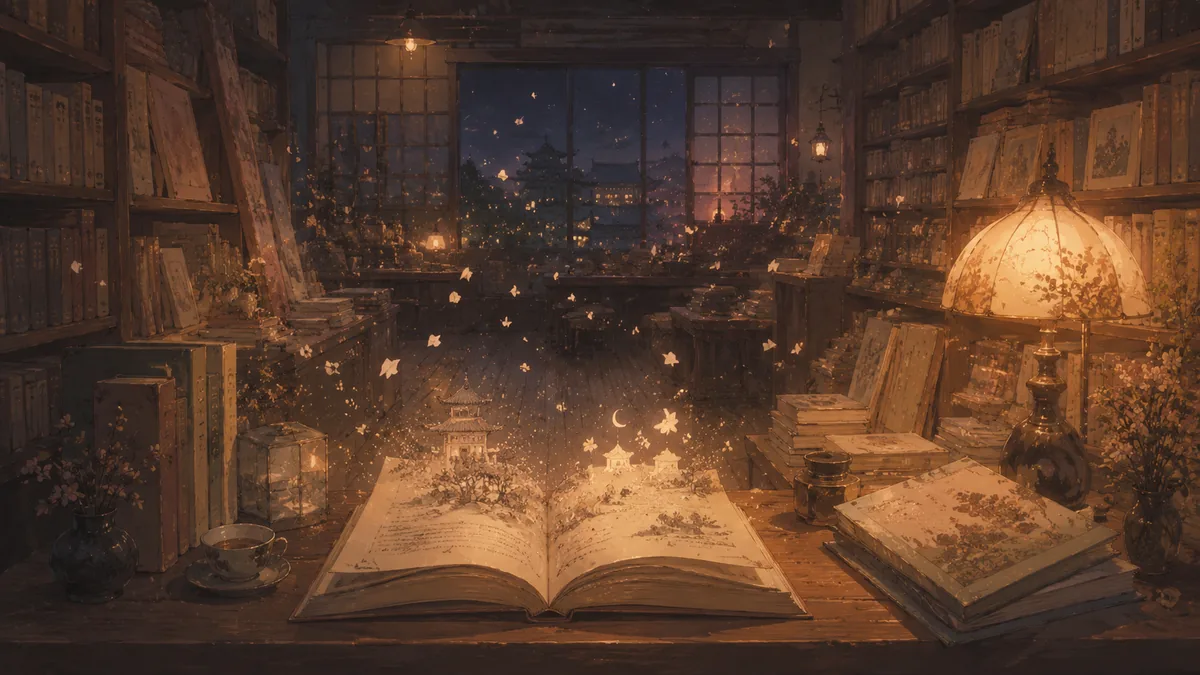
Perhaps — I'm offering this gently — what Ghibli captures is not specifically Japanese life, but the universal experience of ordinary life taken seriously. The meal that someone made for you. The house that had its own sounds at night. The particular quality of afternoon light in a place you can't fully return to.
Every culture has its version of that feeling. Ghibli just happened to animate theirs with unusual care.
Of course, not everyone feels this the same way. Some viewers respond to the environmental themes; some to the female protagonists who act without waiting to be saved. Some people, honestly, just love the visual style without it hitting them at any deeper level. All of those are legitimate ways in. I won't pretend there's one explanation that covers everyone.
The Shadow Worth Naming
I want to say this directly, because skipping it would be dishonest.
"Ghibli-esque" has become an aesthetic genre of its own — a visual template that can be imitated, packaged, and sold without any of the original's substance. The warm afternoon light, the overgrown garden, the wide-eyed child: these have been copied so thoroughly that some viewers arrive at the actual films already inside the aesthetic, rather than encountering it fresh.
There's a version of Ghibli fandom that is essentially consuming a vibe — purchasing Totoro merchandise, decorating in the visual language of the films, engaging with AI-generated "Ghibli-style" images without watching the films themselves. That isn't wrong, exactly.
But the films are stranger, more ambivalent, and less comfortable than the aesthetic they've generated. Nausicaä of the Valley of the Wind ends without a clean resolution. Princess Mononoke refuses to give you a villain. The Wind Rises is a meditation on beauty and destruction that left many viewers genuinely unsettled. These aren't warm-light-through-the-window feelings. The vibe and the films are not the same thing.
My own first encounter with this world was a mobile screening — a travelling projection — of Nausicaä of the Valley of the Wind. Honestly, I went in expecting a children's cartoon and was caught off guard. It pulled me in as sheer entertainment, and underneath that sat a critique of society that kept me thinking long after it ended. And the raw power of the artwork simply floored me. That one film is why I later spent a while working at a movie theater. Before I could explain in words why Ghibli "reaches the world," my body already seemed to know.
To Feel It More Directly
If you want to go beyond watching:
The Ghibli Museum in Mitaka, Tokyo, is a small, deliberately maze-like building that takes the films' domestic textures into three dimensions — the lighting, the materials, the sense that a room has been lived in. Advance reservations are required and limited, but the visit is genuinely different from other animation exhibitions.
For the food: the tonkatsu in Spirited Away, the herring pot pie in Kiki's Delivery Service, the ramen in Ponyo — all are real Japanese dishes you can find and eat. There's something small and good about sitting with a bowl of that ramen after watching the film.
For the landscapes: Yakushima Island (the ancient cedar forest in Princess Mononoke), the rural Saitama countryside near Tokorozawa (Totoro), and the old hot-spring districts of western Japan (Spirited Away) are all real places. They are not the films. But spending time in them, I think, helps you understand why someone might draw them the way Miyazaki did.
A Question I Can't Fully Answer
Why does this work on people who have no connection to Japan?
My honest read: it isn't ultimately about Japan. It's about what happens when an artist observes ordinary life without rushing past it — when they animate the steam, the wind, the creak of the floor, because they believe those details are worth seeing.
Miyazaki has said, in various ways, that he makes films for children but not films that condescend to them — because children notice when a world isn't real. I suspect adults notice too. We just stop expecting to be given the real world.
Ghibli gave it back. That's my reading. I could be wrong.
How does it land for you — is there a specific scene, a specific detail, that made it feel like something?
Sources & References
- Studio Ghibli Museum (三鷹の森ジブリ美術館) official site — visitor information and exhibition details
- The Kingdom of Dreams and Madness (dir. Mami Sunada, 2013) — documentary record of Miyazaki's production process
- This article is a personal reading from everyday observation; claims about viewer response are not supported by cited survey data.
A Geek in Japan (Manga, Anime, Zen & Tea)
Why anime and manga took such deep root in Japan, explained from the cultural soil up — broad context for the stories-and-characters 'why.'
The Art of Spirited Away
A large-format art book of concept sketches, background paintings and storyboards from Miyazaki's Spirited Away — the craft behind the frames.
The Art of My Neighbor Totoro
Character art, background paintings and staff commentary from My Neighbor Totoro — how that nostalgic look was actually built.
Share this article
Read Next
- Stories & CharactersPILLARWhy Do Small Details Carry So Much Weight in Japan?In Japanese anime and daily life, small things — a half-finished cup of tea, shoes lined up facing t…
- Stories & CharactersWhy Are There So Many Cats in Japanese Anime?From the Catbus to Nyanko-sensei, anime is full of cats — Japan has long placed them at the border b…
- Stories & CharactersWhy Are Anime Openings So Incredibly Well-Made?Anime OPs are 90-second emotional blueprints — here's what studios pack into each cut, and why the b…
- Stories & CharactersWhy Do Anime Characters Have Such Big Eyes?Anime eyes aren't just a style quirk — they're a visual grammar. Here's how highlights, tear lines, …
- Stories & CharactersWhy Do Mundane Moments in Anime Look So Alive?Anime lingers on steam rising from rice and shoes lined at the door — not as decoration, but as proo…
Related Articles
Articles in the same category: