
Why Do Japanese People Say Tadaima When They Come Home — Even When No One's There?
Words & Feelings · 2026-06-08 · ~1,900 words · ~5 min read
Contents (6)
- The Word at the Door
- What the Phrase Originally Meant
- Who It's Directed At When Nobody's Home
- The House That Might Not Be Empty
- The Response That Completes It
- A Note on the Habit
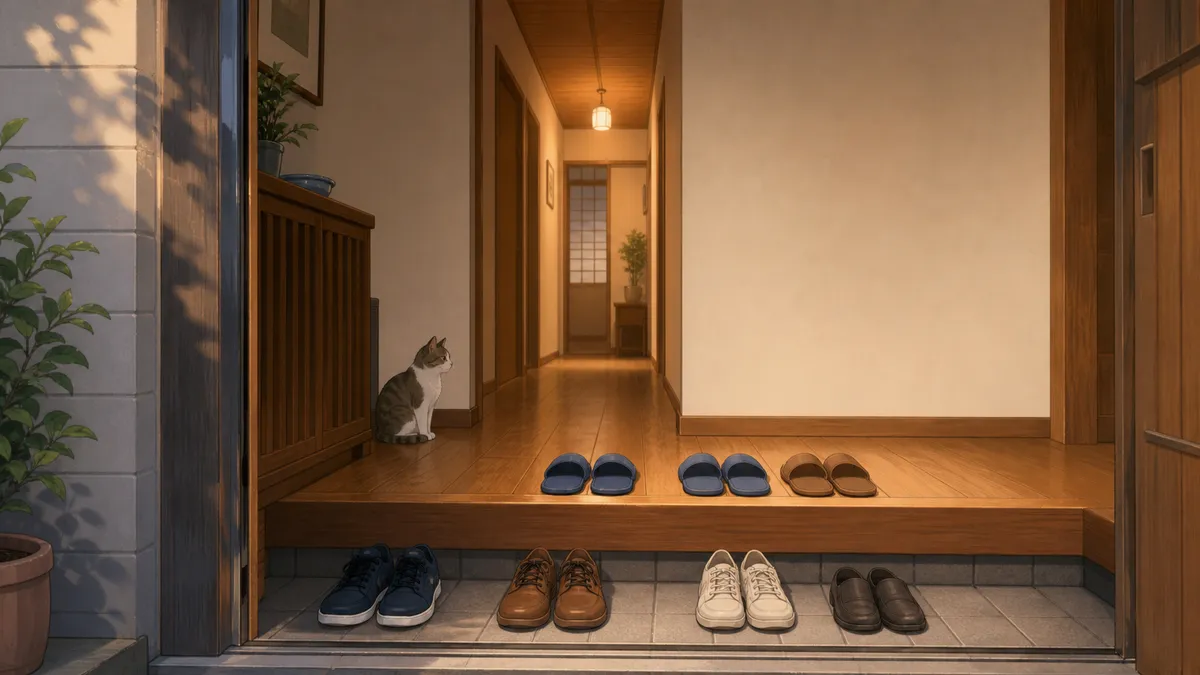
You unlock the door. Step inside. Tadaima.
No answer. You're alone. You knew that. And yet the word came out.
If you live with Japanese people — or have seen this in a film or anime — you've noticed that tadaima doesn't wait for conditions to be right. It arrives with the person, automatic, directed at whatever is there.
The Word at the Door
Tadaima (ただいま) is used when returning to a place — most commonly home, but also an office, a team, a familiar group. It signals arrival. The person already there responds with okaerinasai (お帰りなさい), or the shorter okaeri.
This exchange — tadaima / okaeri — is one of the most fundamental in Japanese daily life. It marks the moment a person crosses back from the outside world into the inside one.
What the Phrase Originally Meant
Tadaima is a compressed form of tadaima kaerimashita (只今帰りました) — "I have returned just now."
Tada (只) means "just" or "merely"; ima (今) means "now." The original phrase was a factual report: the action of returning has just been completed. Somewhere in the history of the word, that full sentence compressed into a single expression used as a greeting.
According to sources including fun-japan.jp and thisis-japan.com, the word's core meaning is still present in its abbreviated form — it isn't just announcing presence, it's marking the completion of a movement from out there to in here.
The English "I'm home" is close in function, but it emphasizes location — I am (here, at home). Tadaima emphasizes timing — I have just now arrived. A subtle difference, but one that puts the focus on the transition itself rather than the resulting state.
Who It's Directed At When Nobody's Home
Many people who live alone say tadaima anyway.
To a cat, perhaps. To the room. To themselves. To nothing in particular.
One reading: the word is completing the transition, regardless of whether anyone receives it. Saying tadaima closes the outside chapter of the day and opens the inside one. It's less an announcement and more a private ritual — a way of marking that the shift has happened.
Another reading: the habit is so deeply ingrained that the absence of a listener doesn't register strongly enough to stop the word from coming out. It arrives before the thought does.
Personally, I suspect the empty-room tadaima points in more directions than one. There's the loose, ambient Japanese sense that things and places can hold something — not a god exactly, but a presence — so the entryway, the room itself, feels like it's worth speaking to. There's a more modern and slightly lonelier version, too: people saying tadaima to a stuffed animal, to a poster of the idol they love on the wall, to a little acrylic stand on the desk. No reply comes, but a "someone who welcomes me back" has been placed there. As more people live alone, the word of homecoming quietly turns personal, and you can feel the texture of that shift. And — half as a joke — saying tadaima into a dark apartment can also be a small precaution: a way of signaling I know you're there on the off chance that someone actually is.
Both might be true. Language habits often outlive the social conditions that created them, taking on new functions in the gap.
The House That Might Not Be Empty
I want to follow that "loose sense of presence" back to an older story, because it gives the feeling a specific shape.
In Tōhoku folklore, particularly in Iwate Prefecture, there's a spirit called zashiki-warashi (座敷童子) — a child-like presence said to live in the inner rooms of old houses. Its behavior is mostly indirect: footprints in ash, small sounds, a fleeting impression rather than a clear sighting. Tradition holds that a house where it resides will prosper, and a house it leaves will decline. The folklorist Kunio Yanagita recorded and popularized these stories nationally in his 1910 collection Tōno Monogatari (Tales of Tōno), and the belief remains specifically associated with the Tōno region of Iwate to this day.
What I find useful about zashiki-warashi isn't the specific spirit — it's the structure of the belief. It's a folk tradition built entirely around the idea that a house might not be as empty as it looks, that presence can be inferred rather than seen. Nobody walking into an empty apartment and saying tadaima is thinking about a Tōhoku house spirit. But the underlying sense — that a place you live in for long enough accumulates something, that speaking into it isn't quite speaking into a total void — is the same sense that this century-old folklore quietly formalizes.
I want to be clear that this is my own reading, not a documented connection. But the two things — an old regional belief that houses can hold something unseen, and a modern habit of greeting an empty room as if it might hear you — seem to be drawing on the same well.
The Response That Completes It
Okaerinasai — "you have returned" — is the other half of the exchange.
The word acknowledges the person's return as a fact. It says: I see that you've come back. The fact of your return is received. Without it, the tadaima hangs unresolved in the air.
Otsukaresama, the phrase used to acknowledge effort, works similarly — it recognizes that something happened, that someone was present and did something that deserves acknowledgment. Okaeri does the same for the act of returning: your absence was real, your return is real, and I see it.
The person who comes home to an empty room and says tadaima is, in some sense, performing the first half of a script that will go unanswered. Which might be why the empty-room tadaima has a particular quality — neither quite the same word as the one that gets answered, nor quite different.
A Note on the Habit
Not everyone says tadaima every time. Some skip it in casual or distracted moments. Some feel it matters more on certain days. Young children sometimes forget; parents sometimes remind.
The point isn't that the custom is universally precise — it's that the structure exists, that there's a word at all for this moment, and that it has companions: ittekimasu (I'm leaving now), itterasshai (go safely), tadaima (I'm back), okaerinasai (welcome back).
Together they form a set of words that frame departure and return as events worth marking — small occasions in a day that might otherwise go entirely unspoken.
Sources & References
- fun-japan.jp, "What Does 'Tadaima' Mean in Japanese?" — etymology and usage
- thisis-japan.com, "Tadaima Meaning: 'I'm Home' in Japanese" — cultural context
- Coto Academy, "Ittekimasu, Itterasshai, Tadaima, Okaerinasai" — set of four phrases
- Kunio Yanagita, Tōno Monogatari (1910) — source of the zashiki-warashi folklore; the connection drawn to tadaima is a personal reading, not an established finding.
The Japanese Mind: Understanding Contemporary Japanese Culture
Chapters on aimai (ambiguity), amae, giri, wa and more — the values beneath the gestures and words. For readers who want to go deeper into the 'why.'
A Geek in Japan (Revised & Expanded)
A wide-angle introduction to the 'why' of Japanese culture — manga, anime, Zen, the tea ceremony and more. A natural companion to the topics Naze explores.
Share this article
Read Next
- Words & FeelingsWhy Do Japanese People Say "Moshi Moshi" When They Answer the Phone?"Moshi moshi" — the phrase every Japanese phone call begins with — traces back to Meiji-era telephon…
- Words & FeelingsWhy Do Japanese People Always Say "Ganbatte"? — The Word That Does Everything at Once"Ganbatte" is the Swiss Army knife of Japanese encouragement — it works before exams, during illness…
- Words & FeelingsShōganai Meaning — Why Japanese People Say a Word That's More Than "It Can't Be Helped"Shōganai meaning, honestly: shōganai (しょうがない) is usually translated as "it can't be helped," but the…
- Words & FeelingsPILLARWhy Is Silence Not Awkward in Japan? — The Concept of MaIn many cultures, silence in conversation signals something's wrong. In Japan, silence can mean the …
- Words & FeelingsWhy Are Japanese Shops So Loud If Japan Is 'Quiet'?Japanese trains are near-silent; shops hit you with a full 'Irasshaimase!' the moment you enter. One…
Related Articles
Articles in the same category: