Why Do Japanese Schools and Workplaces Have Senpai and Kōhai? — The Logic of Japan's Senior-Junior System
Words & Feelings · 2026-06-26 · ~1,550 words · ~5 min read
Contents (7)
- The Mechanic Is Almost Embarrassingly Simple
- The Place It Gets Into Your Body: Bukatsu
- The Language Connection
- Here's How I See It
- The Shadow
- Where the Word Has Traveled
- A Last Question
If you've watched more than a handful of anime, you've already heard the word. "Senpai!" — called across a kendo dojo, a baseball dugout, a clubroom doorway. Subtitles usually give you "senior" or "upperclassman," but that never quite lands. The word carries more weight than either translation suggests, and a different kind of weight.
So what is the senpai-kōhai system, exactly, and why does it run so deep in Japanese life?
The Mechanic Is Almost Embarrassingly Simple
Senpai (先輩) means someone who entered a group before you. Kōhai (後輩) is someone who entered after. The criteria is not age, not ability, not social rank. It is arrival order.
Join a club in April; the students who joined last April are your senpai. Join a company in spring; colleagues hired one year earlier hold that position relative to you — sometimes for decades, sometimes for life. In many contexts — workplaces, martial arts dojos, alumni networks — the relationship doesn't dissolve when you graduate or change roles. You remain kōhai to your senpai even if you've long since outpaced them professionally.
That "even if you've outpaced them" is the part worth sitting with.
The Place It Gets Into Your Body: Bukatsu
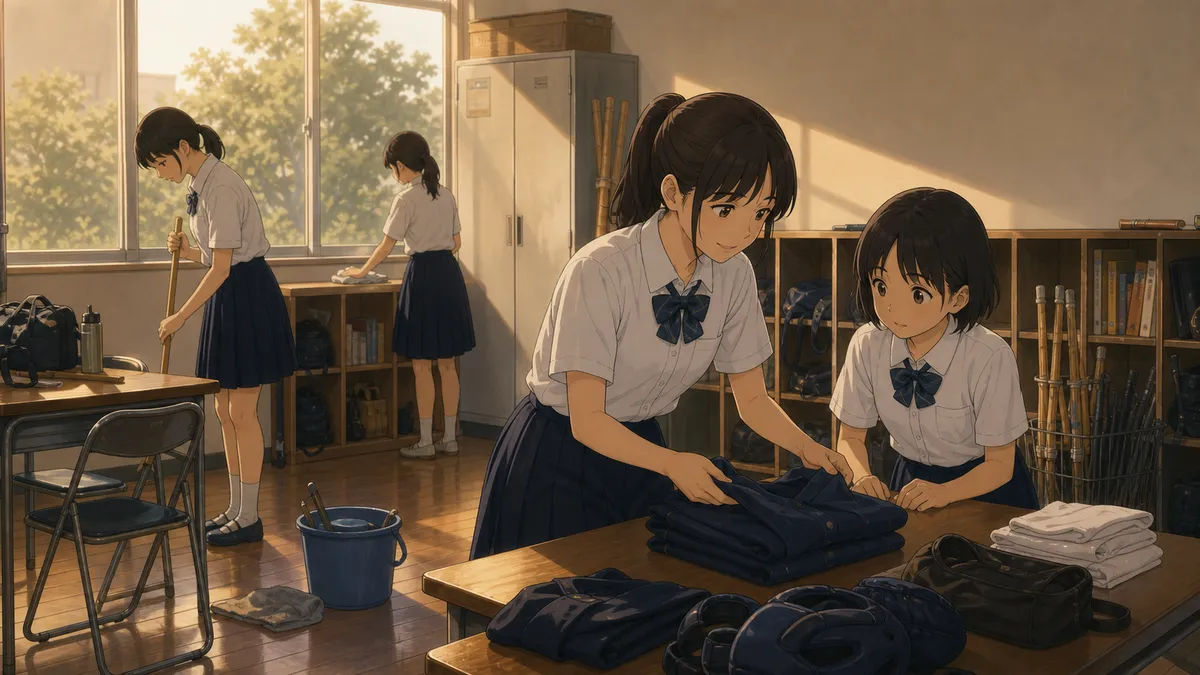
For most Japanese people, the senpai-kōhai relationship isn't just a concept — it's something they first felt physically during bukatsu (部活), the after-school club. Whether it was soccer, brass band, tea ceremony, or the art club, the structure arrived on day one.
The kōhai carries equipment. The kōhai arrives early to clean the space. The kōhai uses different language to a third-year than to a classmate from the same year — not always consciously, but correctly. Mistakes get corrected by the senpai in front of the group, and you accept that without argument. You watch how your senpai moves — in the sport, in the social geography of the clubroom — and you calibrate accordingly.
This isn't inherently cruel, though it can be. Many people carry genuinely warm memories of a good senpai: someone who taught without being asked, who shielded younger members from the hardest early moments, who became a kind of model for what to grow into. The obligation runs both ways. The kōhai owes deference; the senpai owes guidance. When it works, it functions as a real apprenticeship model.
Bukatsu is where this ethic gets into the body. By the time most Japanese people graduate high school, they don't need to think about it anymore — the posture, the speech register, the spatial awareness of who is senior to whom — it's already automatic.
The Language Connection
Here's something worth connecting: the senpai-kōhai structure and keigo (敬語), Japan's system of formal and polite speech, run on exactly the same underlying logic.
Japanese grammar requires you, before you speak, to locate your social position relative to the person you're addressing. Are they above you? Below you? Same level? The verb ending, the vocabulary choice, whether you use a subject pronoun at all — all of this shifts depending on the answer. Keigo isn't stylistic ornamentation. It's load-bearing structure.
The senpai-kōhai relationship provides one clear axis for answering that "where am I relative to you?" question: arrival order. Once arrival order is known, the speech register follows. The physical posture follows. The social map resolves. In a language that requires you to encode social position before you complete a sentence, having clear coordinates isn't just polite — it's linguistically functional.
I won't say this is the origin of the system. It almost certainly has multiple roots — Confucian social philosophy that entered Japan over centuries, the practical logic of skill transmission from senior to junior, the way group cohesion was prioritized over individual advancement in certain historical contexts. But the fit between keigo and the senpai-kōhai structure is striking. They feel like two expressions of the same underlying operating system.
Here's How I See It
One reading I keep returning to: the senpai-kōhai system is a way of making the social map legible before anyone has to negotiate it.
In groups where everyone's relative standing is ambiguous, status has to be continuously renegotiated — sometimes through low-level conflict, often through exhausting implicit competition. The senpai-kōhai system offloads that negotiation to a single external fact: when did you arrive? Once that's settled, people can stop jostling and get on with the actual work of the group.
That's one reading, not a verdict. Whether the efficiency gained is worth the costs is a genuinely open question — and the costs are real.
The Shadow
The system assumes that more time in the group equals more wisdom, more authority. That assumption fails constantly. A kōhai who has practiced twice as hard as their senpai still has to defer. A new hire who genuinely understands the job better than a five-year veteran still has to navigate that gap with considerable care. The structure doesn't adapt well to meritocracy, and it doesn't pretend to.
More seriously: the hierarchy creates cover for behavior that would otherwise be named plainly. The expectation that kōhai absorb unreasonable demands, harsh criticism, or even physical mistreatment because "that's just how it works" is not hypothetical. Japanese schools and sports clubs have faced serious public scrutiny over abuse embedded in senior-junior dynamics. The same structural channel that enables mentorship can enable harm. Both are real. Both are true.
Of course, not everyone experiences the senpai-kōhai relationship as oppressive, or even particularly formal — in many contexts it's warm, flexible, and feels more like friendship across a small age gap than a hierarchy. But honesty requires saying that the structure contains both possibilities, and which one surfaces depends largely on who happens to be at the top.
Speaking from my own sense of it: back when hierarchy was absolute, manners were solid — for better and for worse. These days the senpai-kōhai line runs closer to friendship, and more people will quit over a single scolding, which has made mentoring genuinely harder. But there's one thing I want to put plainly: being seriously told off by someone is not something that happens much once you're an adult. So if you have someone who will honestly get angry at you, that's worth treasuring. The same goes for being honestly praised. The stiffness of the hierarchy is real. And yet there are things you can only receive from inside that kind of relationship.
Where the Word Has Traveled
Something interesting happened around the 2010s: "senpai" crossed into English-speaking internet culture, mostly through anime fandom. "Notice me, senpai" became a meme — earnest and ironic at once — about wanting acknowledgment from someone admired. The word traveled the world while still meaning something quite specific: a Japanese school or club dynamic.
That it resonated internationally suggests the underlying human need isn't uniquely Japanese. The desire for a person who is a little further along, who might acknowledge you, who you look up to without entirely knowing why — that exists everywhere. Japan named it, formalized it, and built social architecture around it. Whether that formalization is a feature or a bug probably depends on where you happen to sit in it.
If you want to feel the senpai-kōhai dynamic through story, the volleyball anime Haikyuu!! (2012–) renders both its warmth and its tension with particular honesty. My Hero Academia also plays with it explicitly. For something more adult and morally ambiguous, Natsume Sōseki's Kokoro (1914) circles a mentor-disciple relationship whose shadow still feels current.
A Last Question
The word I keep coming back to when I think about this system: obligation. The senpai-kōhai relationship is mutual obligation across an asymmetry — and that is precisely where most of the interesting, and most of the difficult, human situations live.
If you've been part of a system like this — as a senpai, as a kōhai, as an outsider watching from the edge — I'm curious how the obligation felt. Like structure? Like care? Like weight you didn't ask for?
Sources & References
- Agency for Cultural Affairs — "Keigo no shishin" (Guidelines on Honorific Language), 2007
- Kokoro by Natsume Sōseki (1914) — senpai-kōhai dynamics in a literary, adult register
- Haikyuu!! (manga/anime, 2012–) — bukatsu and senpai-kōhai rendered with genuine honesty
- A personal reading from everyday observation; no statistical claims made.
The Japanese Mind: Understanding Contemporary Japanese Culture
Chapters on aimai (ambiguity), amae, giri, wa and more — the values beneath the gestures and words. For readers who want to go deeper into the 'why.'
A Geek in Japan (Revised & Expanded)
A wide-angle introduction to the 'why' of Japanese culture — manga, anime, Zen, the tea ceremony and more. A natural companion to the topics Naze explores.
Share this article
Read Next
- Words & FeelingsPILLARWhy Is Silence Not Awkward in Japan? — The Concept of MaIn many cultures, silence in conversation signals something's wrong. In Japan, silence can mean the …
- Words & FeelingsWhy Are Japanese Shops So Loud If Japan Is 'Quiet'?Japanese trains are near-silent; shops hit you with a full 'Irasshaimase!' the moment you enter. One…
- Words & FeelingsWhy Do Japanese People Find It Hard to Say No?Japan's indirect 'no' — chotto, muzukashii, 'I'll think about it' — isn't evasion. It's a system for…
- Words & FeelingsWhy Does 'Daijoubu' Mean Both Yes and No in Japanese?'Daijoubu desu' works as a polite refusal one moment and a reassurance the next — same word, opposit…
- Words & FeelingsWhy Does "Mottainai" Mean More Than Just "Wasteful"?"Mottainai" translates as wasteful, but the word carries something English lacks — the grief of disc…
Related Articles
Articles in the same category: