
Why Do Japanese People Call Food Kawaii? — What the Word Means Beyond Cute
Words & Feelings · 2026-06-08 · ~1,300 words · ~4 min read
Contents (5)
- The Moment Before You Eat It
- Where the Word Came From
- Why Kawaii Isn't Just "Cute"
- When Kawaii Meets Food
- A Question to Leave With
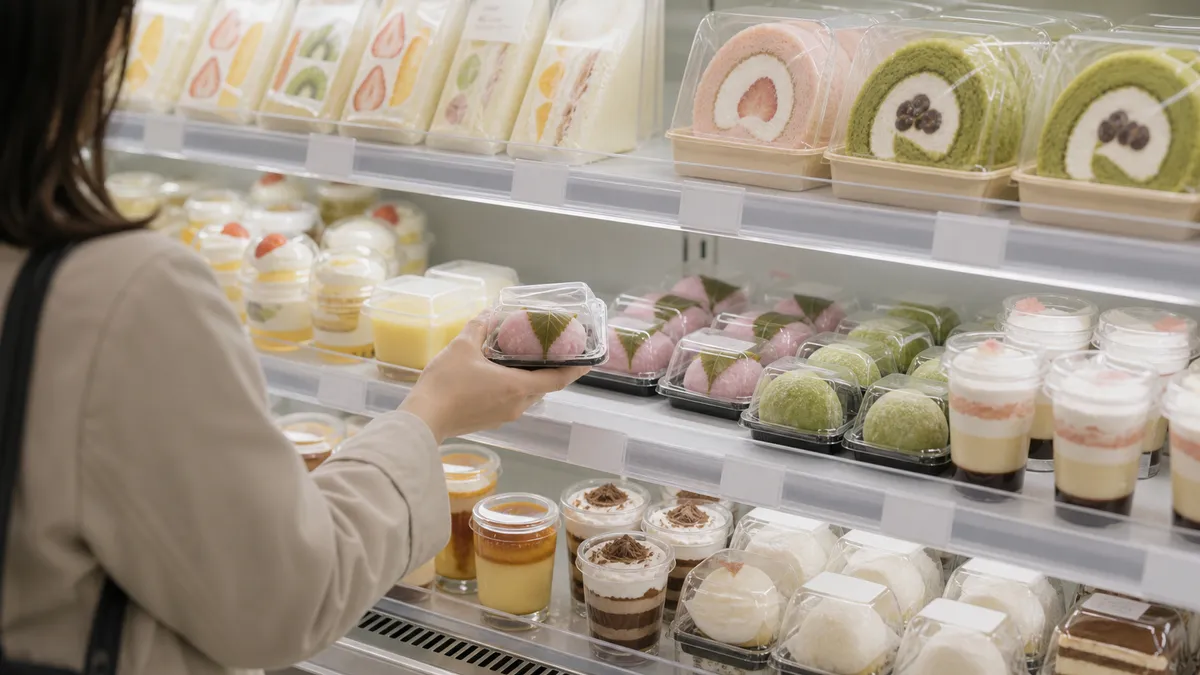
A wagashi is placed in front of you — a small, seasonal Japanese sweet, shaped like a maple leaf in autumn colors, made of bean paste that took someone time to form.
You say it's kawaii.
Not delicious, not beautiful — kawaii. And there might follow a moment's hesitation before you eat it, because eating means destroying the form.
That hesitation is part of the point.
The Moment Before You Eat It
There's a phrase in Japanese: taberu no ga mottainai — "it would be a waste to eat it." The word mottainai usually refers to physical waste — throwing things away before they're used up. But applied to food that's been called kawaii, it means something slightly different: the form is so considered, so carefully made, that consuming it feels like a small destruction.
This response — aesthetic appreciation combined with reluctance — is, I think, part of what kawaii is doing when it's applied to food. It's not just noting that the thing is pretty. It's expressing a kind of attachment to it.
Where the Word Came From
The etymology of kawaii is debated, but one well-documented theory traces it to the phrase kao hayushi (顔映ゆし) — something like "face-flushing," meaning a feeling of helpless tenderness in the face of something pitiable or fragile (Wikipedia).
In this earlier usage, kawaii was directed at things that were vulnerable, small, or in need of protection — evoking a caretaking impulse rather than simply an aesthetic one. Sei Shōnagon, a Heian-period court lady whose Pillow Book dates to around 1000 CE, wrote that small things are kawaii — a sensibility that connects the small, the fragile, and the endearing in ways that have persisted for a thousand years.
The modern expansions of kawaii — through manga, anime, Sanrio characters, youth fashion — developed mainly from the 1970s onward. According to Britannica and Japan House LA, the contemporary word carries: visual cuteness, yes, but also smallness, approachability, incompleteness, and the wish to protect something fragile. Its roots in vulnerability and tenderness are still present, even in its most casual modern uses.
Why Kawaii Isn't Just "Cute"
"Cute" in English is primarily a visual judgment. Something is cute the way something is tall — an attribute you observe.
Kawaii tends to include emotional involvement. The classic descriptions of kawaii objects note not just what they look like but how they make the viewer feel: a wish to take care of them, a sense that they shouldn't be carelessly damaged, an awareness of their smallness relative to the world.
Konrad Lorenz's concept of Kindchenschema — baby schema — is sometimes invoked here: certain features (large eyes, round face, small size) trigger an innate nurturing response across cultures. Kawaii may work partly through this biological channel. But the cultural history of the word suggests it also carries something more specific: an attention to effort, to smallness, to things that are fragile not because they're weak but because they've been made carefully.
When Kawaii Meets Food
Food is usually described in Japanese by taste (oishii — delicious), appearance (kirei — beautiful, utsukushii — beautiful in a more elevated register), or texture. Kawaii is a different register.
When food is called kawaii, the response seems to be triggered by specific conditions: small size, careful shaping, a sense that someone invested effort in making it look the way it does, and often the awareness that eating it means undoing that.
Character bento boxes (kyara-ben), where rice is shaped into faces and vegetables are cut into animals, are a vivid example: the labor involved in their creation is part of what's being acknowledged. Seasonal wagashi in flower or leaf shapes. Mini desserts plated to look like tiny landscapes.
The phrase "food too cute to eat" has equivalents in many cultures, but the Japanese version seems to sit in a long tradition of treating the carefully-made small thing as something that deserves a moment of appreciation before being consumed.
Personally, it's almost always in front of sweets that I say kawaii. There are confections shaped like characters, and small, neatly plated desserts. Japanese has an expression, me de taberu — "to eat with your eyes" — the sense that a dish's appearance matters as much as its taste. So calling food kawaii is, I suspect, partly proof that you're actually looking as you eat: savoring the shape with your eyes first, then bringing it to your mouth with a little reluctance.
A Question to Leave With
Have you ever paused before eating something because it seemed too considered to destroy?
That pause — wherever you encountered it — might be touching something that kawaii has names for, and that other languages reach for less precisely.
Sources & References
- Wikipedia, "Kawaii" — etymology, Heian-period uses, modern cultural development
- Britannica, "Kawaii culture" — aesthetic dimensions and global spread
- Japan House Los Angeles, "Beyond Cuteness: Japan's Kawaii Culture" — philosophical dimensions
The Japanese Mind: Understanding Contemporary Japanese Culture
Chapters on aimai (ambiguity), amae, giri, wa and more — the values beneath the gestures and words. For readers who want to go deeper into the 'why.'
A Geek in Japan (Revised & Expanded)
A wide-angle introduction to the 'why' of Japanese culture — manga, anime, Zen, the tea ceremony and more. A natural companion to the topics Naze explores.
Share this article
Read Next
- Words & FeelingsPILLARWhy Is Silence Not Awkward in Japan? — The Concept of MaIn many cultures, silence in conversation signals something's wrong. In Japan, silence can mean the …
- Words & FeelingsWhy Are Japanese Shops So Loud If Japan Is 'Quiet'?Japanese trains are near-silent; shops hit you with a full 'Irasshaimase!' the moment you enter. One…
- Words & FeelingsWhy Do Japanese People Find It Hard to Say No?Japan's indirect 'no' — chotto, muzukashii, 'I'll think about it' — isn't evasion. It's a system for…
- Words & FeelingsWhy Does 'Daijoubu' Mean Both Yes and No in Japanese?'Daijoubu desu' works as a polite refusal one moment and a reassurance the next — same word, opposit…
- Words & FeelingsWhy Does "Mottainai" Mean More Than Just "Wasteful"?"Mottainai" translates as wasteful, but the word carries something English lacks — the grief of disc…
Related Articles
Articles in the same category: