
Why Do Japanese People Say "Yoroshiku Onegaishimasu" So Often?
Words & Feelings · 2026-06-08 · ~1,750 words · ~6 min read
Contents (5)
- One Phrase in Many Places
- The Request Before Anything Has Happened
- A Pattern Across Japanese Courtesy Words
- The One Phrase I Still Can't Translate
- How to Use It
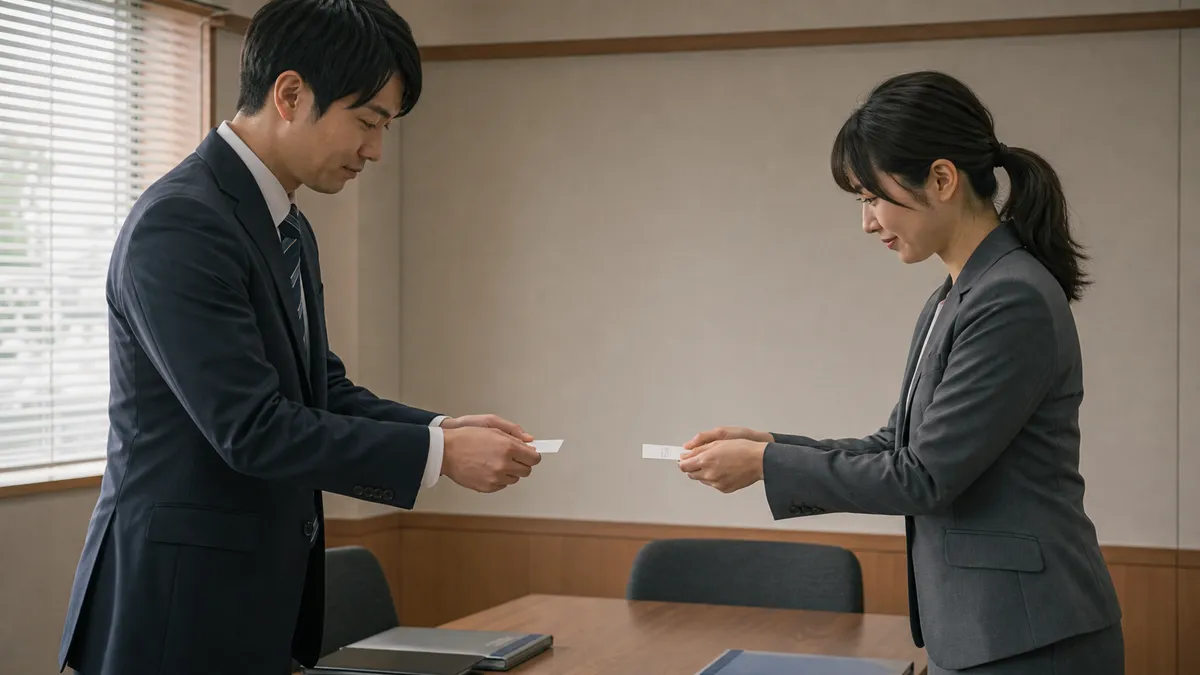
After exchanging business cards and bowing, you say yoroshiku onegaishimasu. At the end of a work email, you type yoroshiku onegaishimasu. Before a sports practice begins, the team shouts it together. After an apology, it sometimes closes the conversation.
The same phrase, in completely different situations. What is it doing?
One Phrase in Many Places
Yoroshiku onegaishimasu (よろしくお願いします) doesn't have a clean English translation, which is the first clue that it's doing something structurally different from "nice to meet you" or "please" or "thank you."
The word yoroshiku comes from yoroshii — meaning "appropriate," "fitting," "as it should be." The whole phrase is roughly: "please handle things as is appropriate" or "please be good to me/this situation." What it requests is not a specific action but a general goodwill applied to whatever comes next.
At a first meeting, yoroshiku onegaishimasu is not thanking the person for anything they've done. It is asking them, in advance, to extend favorable attention to the relationship that is about to begin.
The Request Before Anything Has Happened
This preemptive structure is what makes the phrase interesting.
In English, pleasantries around introductions tend to be retrospective or declarative: "Nice to meet you" (responding to meeting), "I look forward to working with you" (stating a future feeling). The courtesy is timed to what is happening.
Yoroshiku onegaishimasu does something slightly different: it makes a request about the future, before the future has happened. It's closer to: "I am placing the success of what comes next, to some small degree, in your care."
One way to read it: the phrase is a small act of trust extended before any trust has been earned. You are naming the relationship as something to be tended, and naming the other person as someone who will do the tending.
This connects to a broader orientation in Japanese social language — sumimasen covers apology, thanks, and greeting because all three share the sense of having caused, or being about to cause, someone some consideration. Itadakimasu marks the receipt of food before you eat it. Yoroshiku onegaishimasu marks the receipt of a relationship before it begins.
A Pattern Across Japanese Courtesy Words
There may be a pattern here worth naming, though I want to be careful about overstating it.
Japanese courtesy language seems to have a recurring structure of marking transitions before they fully occur — of placing the polite acknowledgment before the thing, rather than after. The bow before speaking rather than after. The apology sign before the inconvenience. Yoroshiku before the relationship.
Whether this reflects something deliberate about Japanese communication norms or is simply the accumulated form of many small linguistic habits over centuries, I can't say.
The One Phrase I Still Can't Translate
In my own work, I deal with overseas business contacts fairly regularly. And there's a specific moment where I still get stuck, every time.
A Japanese email ends with yoroshiku onegaishimasu, no question about it. But in an English email, in that same closing spot — honestly, I still don't know what to put. I've tried "Best regards," I've tried "Thank you," and something always feels missing. That particular forward-leaning feeling — may things keep going well between us, not just this time but from here on — seems to leak out a little no matter which English phrase I substitute it with.
I don't think this is really a language-skill problem. I think the structure yoroshiku onegaishimasu carries — placing courtesy on a relationship before that relationship has actually happened yet — just doesn't have a slot that fits neatly inside English greeting conventions. After years of doing this, this is still the one phrase I've never felt like I fully handed across intact.
This is probably what an untranslatable phrase actually is. You can explain the meaning. What you can't hand over is the ma — the spacing, the timing, the exact distance it's meant to hold — that the word is carrying along with it.
How to Use It
In practice, yoroshiku onegaishimasu appears in three main situations:
-
First meetings — after your own name and any brief self-introduction, you close with it. It marks the end of the introduction and an invitation for the relationship to begin.
-
Emails and letters — it closes correspondence the way "regards" or "best" does in English, but warmer. In formal business Japanese it's almost mandatory at the end of emails.
-
Before joint activity — before a meeting, a practice, a task undertaken together. "Yoroshiku" alone often works here. It's a rallying word as much as a courtesy.
Not every yoroshiku is empty content, either. Buried in the daily, almost reflexive use, there's a version of this phrase that suddenly turns "genuine" — specifically toward someone I want to keep working with well into the future, not just for the task in front of us. It's more obvious with a big project, sure. But even without one, the yoroshiku onegaishimasu that comes out the moment I realize I want this relationship to keep going seems to carry a different weight than the rest, at least to me.
Speaking for myself, I use this phrase every single day, almost like breathing. Some of my yoroshiku are genuine requests. But a lot of them come out with no definite content at all — something closer to "well, please just sort the various things out nicely." I couldn't even tell you exactly what I'm asking to be handled. And yet, just having those words there softens the doorway into a relationship. Precisely because it carries so little fixed content, it fits any situation at all — yoroshiku onegaishimasu is, I think, a kind of convenient blank space of a phrase.
Sources & References
- Etymology: standard Japanese dictionaries and etymology references for yoroshii (宜し)
- The section on translating yoroshiku for overseas correspondence is based on personal work experience and observation
- This article is observation-based; no single institutional source for pragmatic usage patterns
The Japanese Mind: Understanding Contemporary Japanese Culture
Chapters on aimai (ambiguity), amae, giri, wa and more — the values beneath the gestures and words. For readers who want to go deeper into the 'why.'
A Geek in Japan (Revised & Expanded)
A wide-angle introduction to the 'why' of Japanese culture — manga, anime, Zen, the tea ceremony and more. A natural companion to the topics Naze explores.
Share this article
Read Next
- Words & FeelingsPILLARWhy Is Silence Not Awkward in Japan? — The Concept of MaIn many cultures, silence in conversation signals something's wrong. In Japan, silence can mean the …
- Words & FeelingsWhy Are Japanese Shops So Loud If Japan Is 'Quiet'?Japanese trains are near-silent; shops hit you with a full 'Irasshaimase!' the moment you enter. One…
- Words & FeelingsWhy Do Japanese People Find It Hard to Say No?Japan's indirect 'no' — chotto, muzukashii, 'I'll think about it' — isn't evasion. It's a system for…
- Words & FeelingsWhy Does 'Daijoubu' Mean Both Yes and No in Japanese?'Daijoubu desu' works as a polite refusal one moment and a reassurance the next — same word, opposit…
- Words & FeelingsWhy Does "Mottainai" Mean More Than Just "Wasteful"?"Mottainai" translates as wasteful, but the word carries something English lacks — the grief of disc…
Related Articles
Articles in the same category: