Why Do Japanese People Bow — and Does the Angle Actually Mean Something?
Gestures & Manners · 2026-06-03 · ~1,500 words · ~6 min read
Contents (7)
- The Grammar of the Angle
- A Scene You Already Know
- The Asymmetry Worth Watching
- One Way to Read the Deeper Logic
- Not Everyone Feels It the Same Way
- Where to Feel It Most Clearly
- A Question to Leave With
You're at a convenience store in Japan. The clerk bows as you leave. You bow back — a little awkward, because you've never quite worked out how deep to go. You step outside. Then you glance back through the glass door. The clerk is already bowing to the next customer, smooth and automatic. The angle: roughly thirty degrees. No hesitation at all.
If you've spent any time in Japan — or watched enough anime set in everyday life — that bow has probably caught your attention. It feels meaningful. But it also happens so often, with such apparent ease, that you start to wonder: is it meaningful? Or is it just a social reflex, like saying "fine" when someone asks how you're doing?
Here's what I can say with some confidence: the angle is real. It isn't decoration.
The Grammar of the Angle
Depending on the situation, a bow lands at a different depth. A rough guide — not a strict rulebook, just a working map of what you'll actually see:
| Angle | Typical situation |
|---|---|
| ~15° | A casual greeting, a quick acknowledgment — "oh, hey" |
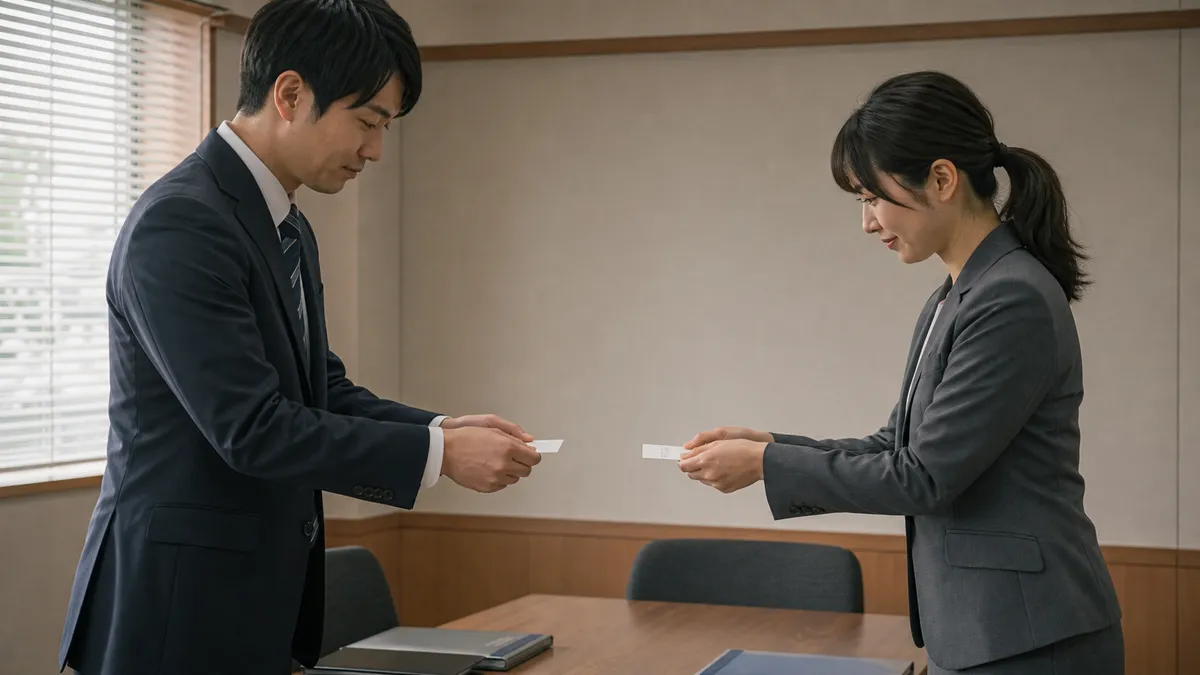
| ~30° | A standard thank-you, a polite greeting, a normal business introduction |
| ~45° | A deep apology, a formal thank-you, meeting someone very senior for the first time |
These aren't official measurements. You won't find them in a government document or an etiquette law. But if you watch carefully at a hotel lobby, a train station, or a business meeting, the pattern holds. The body is doing something consistent — something specific.
The core observation is this: a bow is a measurement, expressed physically, of how much the other person matters in this moment. The angle encodes the relationship before a single word is spoken.
Put another way — if a handshake confirms a relationship through physical contact, a bow maps it through geometry. One variable, and the social structure of the moment is already on the table.
But before any of that analysis, one plainer truth — and for me it's the center of the whole thing: the bow sits in the same slot as "hello." When I meet someone, the greeting simply comes out — the only question is whether it exits as a word or as a motion. That's the entire difference. Before it's etiquette, before it's geometry, it's a greeting, worn into the body. Which is exactly why you see it everywhere, all day, from everyone.
A Scene You Already Know
If you've watched anime — especially school dramas or slice-of-life series — you've seen this play out. The homeroom teacher bowing to the principal. The student bowing deeply to apologize. The old shopkeeper inclining his head when a loyal customer leaves. The first-year who hasn't quite calibrated her angle yet, and the senpai who notices.
It looks stylized on screen, but it comes directly from ordinary life. Walk into a department store in Japan and watch the floor staff near the escalators. Check into a traditional inn. Sit in on a formal business meeting between two companies meeting for the first time. The angles shift with context the way verb endings shift with formality in Japanese — the bow is a kind of conjugation.
What makes it feel different from, say, a handshake is that it's almost entirely non-verbal. A handshake involves eye contact, grip strength, duration — it's a negotiation in real time, with multiple signals running simultaneously. A bow is one clean variable. The depth alone carries the message. The body says what the mouth hasn't yet — and sometimes what the mouth never will.
The Asymmetry Worth Watching
One thing that stands out once you start noticing: bows are rarely perfectly mirrored.
A junior employee bows at forty-five degrees to a senior executive who returns a fifteen-degree nod. A young sales rep bows deeply to the client who bows back, comfortably, at thirty. A student bowing to a teacher who gives a gentle, measured return.
The gap in angle is the gap in status, expressed physically. You can read the social map of a room — who is senior, who is the guest of honor, who is asking a favor — just by watching where the heads go. No words needed, no titles announced.
This asymmetry can feel unsettling to newcomers, particularly from cultures where equality is performed through sameness of gesture. There's no discomfort intended — but the bow doesn't pretend everyone is equal in every context. It says something precise about the situation, and it says it plainly.
One Way to Read the Deeper Logic
Here's how I see it — not as a verdict, just one reading.
The bow is a gesture where you lower your head — the most vulnerable, most guarded part of the body — below the level of the other person's. That physical act, if you think about it symbolically, says something like: I am making myself open to you. You matter more than my guard does, right now.
Is that consciously felt? Probably not, most of the time. I suspect the majority of people performing a thirty-degree bow in a business meeting are not thinking "I am symbolically lowering my defenses." The body just moves. That's perhaps the point — the meaning is in the motion, not in the analysis. It became habitual because it worked, and it works because the body communicates something real.
There are many ways to read this, and I won't claim to know what any particular person feels in the moment. These kinds of gestures tend to live below the level of conscious thought. But I do think — and this is just a personal reading — that part of why the bow feels so legible to outsiders is that it's unusually transparent as social signaling. You can watch, and read, and understand something true. The angle does not lie.
Not Everyone Feels It the Same Way
Of course, not everyone approaches a bow with the same awareness. And here the shadow side is worth naming honestly.
The bow can become form without feeling — the quick, reflexive nod that says nothing except I know this is expected of me here. Sales clerks bowing toward empty elevator doors because a camera might be watching. Staff at fast-food counters delivering a perfectly calibrated bow that has, through ten thousand repetitions, become pure muscle memory. The form survives; the measurement doesn't necessarily follow.
This isn't a criticism — it's a natural fate of any repeated gesture. "Have a nice day." The Christmas card. The handshake in the arrivals hall. When a ritual is performed thousands of times, meaning becomes optional.
For some people who grew up in service environments here, the relentless bowing — before the customer arrives, while they leave, in case someone is watching — can accumulate into something heavier. A performance that never stops. The warmth of the gesture and the weight of its obligation can coexist, and both are real.
Personally, though, I find myself wanting to read it the other way too. Even within "lowering your head," some of it is the body acting entirely on its own — like bowing during a phone call — and some of it carries real feeling. When I see someone off, I bow deeply without deciding to. And the service bow, which from outside might look like pure form, can turn into something else if you hold ichigo ichie in mind — the idea that this meeting, with this person, may be the only one you'll ever have. Seen that way, the bow becomes gratitude for the encounter itself. Same angle, but a head lowered with that thought behind it feels, to me, like a different thing.
Where to Feel It Most Clearly
A few situations worth watching closely:
A business introduction between unfamiliar companies. This is where the angle calibration is most conscious and most legible. Watch how the depths shift in the first exchange, and you'll see the social map being drawn in real time.
A shinkansen platform farewell. Someone seeing off a family member or close friend, holding the bow until the train is completely out of sight. The gesture carries what the voice couldn't quite hold.
Anime that takes everyday life seriously — March Comes In Like a Lion, or almost any Ghibli film, or the quieter moments of Your Name — uses the bow as a living, contextual beat rather than a stylized formality. It's worth watching for.
A Question to Leave With
I won't say the bow is the essence of Japanese culture, or that it captures something outsiders can never understand. It's a gesture — a remarkably precise one, but still a gesture. Whether someone is feeling what the angle says, or running on motor memory, you cannot know from the outside.
But that might be true of most social forms. A handshake, a card with "with deepest condolences," a smile held a second past the moment — we're always reading the angle and hoping the meaning is still there.
If any of this stays with you, you'll catch the same body-language elsewhere — for instance in the call-and-answer of "ittekimasu" and "itterasshai".
Sources & References
- General knowledge of Japanese business etiquette conventions; rough angle guidelines referenced from standard Japanese business-manner publications (general etiquette guides widely available in Japanese bookstores).
- This article is primarily a personal, observational reading. Interpretations of inner meaning are offered as one view, not a definitive account.
The Japanese Mind: Understanding Contemporary Japanese Culture
Chapters on aimai (ambiguity), amae, giri, wa and more — the values beneath the gestures and words. For readers who want to go deeper into the 'why.'
A Geek in Japan (Revised & Expanded)
A wide-angle introduction to the 'why' of Japanese culture — manga, anime, Zen, the tea ceremony and more. A natural companion to the topics Naze explores.
Share this article
Read Next
- Gestures & MannersPILLARWhat Is Omotenashi — And Why Does Japanese Hospitality Feel Different?Omotenashi is Japanese hospitality that anticipates what you need before you think to ask — and make…
- Gestures & MannersWhy Don't Japanese People Linger After Eating?Japanese diners tend to leave fairly soon after finishing, especially when it's busy. Here's the qui…
- Gestures & MannersWhy Do Japanese Restaurants Give Free Water and Oshibori?Sit down at almost any Japanese restaurant and cold water, tea, and an oshibori appear before you've…
- Gestures & MannersWhy Does Japan's School Year Start in April?Japan's school year opens in April because its fiscal year does — a calendar fixed in the Meiji era,…
- Gestures & MannersWhy Do Japanese Train Workers Point and Call? — The Science Behind Shisa KankoStation workers who point firmly at signals and call out their status aren't performing a ritual — t…
Related Articles
Articles in the same category:
- Why Japanese Culture Values Ongoing Care Over Finished Products — A Different Idea of 'Done'
- Why Do Japanese People Take Off Their Shoes Indoors?
- Why Do Japanese People Slurp Noodles? — The Sound, the Reason, and "Noodle Harassment"
- Why Japanese Temple Gardens Feel So Calming — Impermanence & the Art of Tended Nature