Why Is Japanese Gift Wrapping So Elaborate? — The Greeting Before the Gift
Gestures & Manners · 2026-06-03 · ~1,700 words · ~7 min read
Contents (7)
- The Wrapping Is Already Part of the Gift
- What You'll See in Ordinary Life
- One Way to See It
- The Wrapping Gets There First
- The Other Side
- Where to Feel It
- A Thought to Leave With
You've probably seen it — in a department store, or maybe first in an anime: a shop assistant folds paper around a box with a precision that looks almost architectural. Tuck, crease, tuck again. A ribbon. A small wax seal in the shop's color. The whole process takes two quiet minutes. The gift itself might be a box of cookies.
So why the ceremony? What is all that wrapping actually doing?
The Wrapping Is Already Part of the Gift
Here's the plain answer, at the observable level: in Japan, the wrapping is not packaging. It is a greeting.
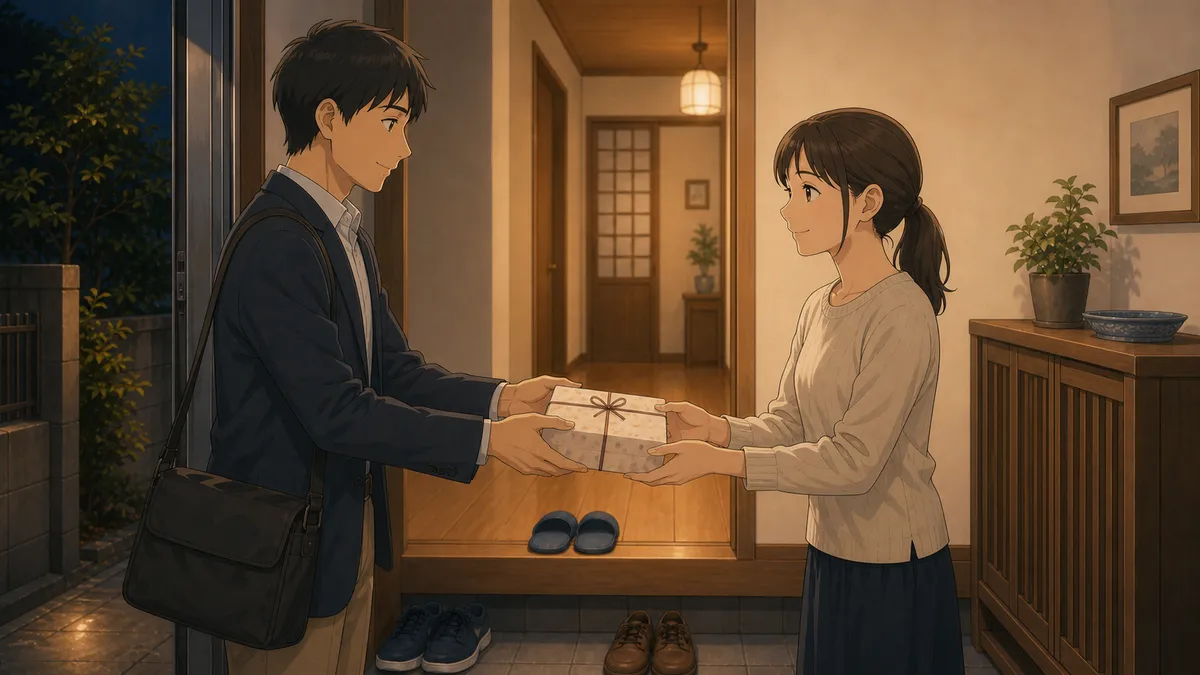
The moment a gift passes from your hands to another person's, the wrapping speaks first. Before anyone sees what's inside, the care of the exterior has already said something. A precisely folded paper corner, a piece of washi in the shop's seasonal pattern, a cloth furoshiki tied just so — each signals that someone took time. Not time to buy, but time to prepare.
That distinction seems small. I think it isn't.
The wrapping is the first sentence of the gift — it speaks before you open it.
What You'll See in Ordinary Life
Walk into a depāto — one of Japan's traditional department stores — and you'll find a wrapping counter staffed by people whose entire job is to wrap. Not with tape-and-scissors speed, but methodically. There is a specific fold called hyakkaten-maki (department-store wrap), in which the paper meets at a diagonal rather than straight across, creating a clean, angled seam. Seasonal paper for summer gifts (ochūgen), different paper for year-end ones (oseibo). Getting the paper right for the occasion is part of the gift's grammar.
If you're learning Japanese, you've probably encountered kimochi o komeru — "to put feeling into something." It comes up in cooking, in letters, in the way a senior colleague corrects your work. I suspect the same logic applies to wrapping.
Outside the depāto, furoshiki — square cloth wrapping — is the older tradition. It dates at least to the Nara period (8th century), when it was used to bundle goods at public bathhouses. Today it wraps wine bottles, melons, stacked lacquerware. And here is the detail that tends to genuinely surprise people who encounter it for the first time: the cloth is often part of the gift itself. The recipient keeps it and uses it. The wrapping doesn't get thrown away. It travels forward.
Even convenience-store gifts — and Japanese convenience stores stock some genuinely considered packaged sweets — tend to come with a small bag, a ribbon loop, a card slot. The impulse to wrap runs deeper than luxury goods alone.
One Way to See It
Here's how I see it — not as a verdict, just one reading:
The wrapping seems to function as a prologue. Before the gift is opened, the recipient is already receiving something — evidence of attention. The minutes spent folding are not invisible. They are, in a quiet sense, part of what is being offered.
There are other views. Some people would tell you it's simply good manners, no deeper logic needed. Others would point to aesthetic tradition — a love of katachi, of form for its own sake. I can't rank these, and I won't try. But when I watch someone carefully match the corner of a piece of washi, I find it hard to believe the process is purely functional.
What I do notice is that the act of wrapping creates a small delay — a pause between the decision to give and the moment of giving. And in Japan, pauses tend to carry weight.
For my part, every time I watch those hands at work I think: this is a genuine skill. The quick folds, the corners lined up, the finish arrived at without hesitation. And the result is often so beautiful that I honestly feel it would be a shame to open it. I want to see what's inside, and at the same time I don't want to be the one who wrecks this lovely surface. That flicker of hesitation may be the clearest proof that the wrapper's effort has actually reached me.
And I'll confess the beauty has a trap in it. Try to check what's inside by undoing the wrapping once, and it never goes back. Your eyes remember every fold; your hands can't reproduce a single one. A perfect wrapping job is, from the opening side, a puzzle with no reverse gear.
I also know this from the sending side. I work in a job that ships cloth. For domestic shipments, a single layer of vinyl wrapping is the standard. But when something ships overseas, we wrap it again, over the vinyl, in a heavier reinforced paper. The journey is longer, the handling may be rougher — so the parcel gets one more layer. Which is to say: the thickness of wrapping isn't decoration. It's a function of distance and worry. The department-store magician and the roll of paper on our workbench speak the same language — the farther something travels, the more carefully it's wrapped.
The Wrapping Gets There First
There's something in the act of wrapping that arrives ahead of the recipient. The box isn't open yet. No one has said "thank you" yet. And already the giver's hands are working toward a moment that won't happen for another thirty seconds — the moment the paper comes loose.
At the core of what Japan has long called omotenashi — hospitality — is, I think, this same running ahead. Choosing summer-patterned paper for an ochūgen gift means picturing, ahead of time, the season in which it will be opened. Adding that extra layer of paper to our overseas parcels means worrying, ahead of time, about a long journey that hasn't begun. Not responding once asked, but quietly attending to a moment that hasn't arrived — the fingertips lining up the corners of the paper are preparing, before the gift is even handed over, the instant its opener thinks this is beautiful.
Not everyone wrapping a box is thinking any of this, of course. Most are simply being careful because that's how it's done. I can't state it as fact. But at some wrapping counter today, a sheet of paper is being folded, quietly, for somebody's thirty seconds from now.
The Other Side
I want to be honest here, because it isn't only beautiful.
Japan's wrapping culture has a real shadow: the sheer volume of packaging it generates. Multi-layered plastic trays, individual cellophane sleeves over each sweet, a paper bag around a box around more paper — Japanese product packaging is among the most elaborate in the world, and the environmental cost is not nothing. Conversations about this are happening; the Ministry of the Environment has actually run campaigns promoting furoshiki as a low-waste alternative to disposable paper wrapping. That a government ministry promotes cloth wrapping as eco-policy while the country simultaneously produces some of the world's most layered single-use packaging is its own kind of contradiction. A very human one.
There is also a quieter pressure on the recipient. When a gift arrives wrapped this carefully, unwrapping it clumsily feels like a small failure. Some people fold the paper as they go, saving it. Others feel the slight weight of "opening correctly." The same gesture that feels like warmth can also feel, on the wrong day or in the wrong relationship, like an instruction.
Of course, not everyone experiences it as pressure. But both things are true.
Where to Feel It
If you want to notice this more deliberately:
Watch Whisper of the Heart or nearly any Studio Ghibli film that involves a gift being exchanged — the wrapping is drawn with the same care as the food. It isn't decoration; it's characterization. The effort put into a wrapped object in those films tells you something about the person giving it.
If you're visiting Japan, spend five minutes at a depāto wrapping counter and just watch. You don't need to buy anything. The folding itself is worth seeing as a small performance of intention.
If you want to try furoshiki wrapping yourself, the basic otsukai-tsutsumi fold for a rectangular box is learnable in an afternoon — the Ministry of the Environment's free online guides (in both Japanese and English) are a reliable starting point. There is something satisfying about the moment the knot settles and the object holds its shape inside the cloth.
A Thought to Leave With
A wrapped gift makes a small ask of the recipient before it is opened: a moment of attention. You receive the effort before you receive the thing.
Whether that feels like warmth or like obligation probably depends on the relationship, the occasion, and honestly, the day. I don't think there is a single answer — and I would be wary of anyone who offered one.
What I keep coming back to is this: in Japan, the preparation for giving seems to be considered part of giving. The wrapping is already speaking. It has been, since before you walked through the door.
Have you ever felt that a gift was in the wrapping itself — before you even opened it?
Sources & References
- Ministry of the Environment (Japan), Furoshiki Promotion Materials — public guidance on cloth wrapping as waste-reduction policy (env.go.jp)
- Nihon Fūzoku-shi Jiten 『日本風俗史事典』(Kōbundō) — reference for furoshiki historical use and origins
- A personal reading from everyday observation; claims about inner meaning and feeling are offered as one perspective, not a conclusion.
The Japanese Mind: Understanding Contemporary Japanese Culture
Chapters on aimai (ambiguity), amae, giri, wa and more — the values beneath the gestures and words. For readers who want to go deeper into the 'why.'
A Geek in Japan (Revised & Expanded)
A wide-angle introduction to the 'why' of Japanese culture — manga, anime, Zen, the tea ceremony and more. A natural companion to the topics Naze explores.
Share this article
Read Next
- Gestures & MannersPILLARWhat Is Omotenashi — And Why Does Japanese Hospitality Feel Different?Omotenashi is Japanese hospitality that anticipates what you need before you think to ask — and make…
- Gestures & MannersWhy Don't Japanese People Linger After Eating?Japanese diners tend to leave fairly soon after finishing, especially when it's busy. Here's the qui…
- Gestures & MannersWhy Do Japanese Restaurants Give Free Water and Oshibori?Sit down at almost any Japanese restaurant and cold water, tea, and an oshibori appear before you've…
- Gestures & MannersWhy Does Japan's School Year Start in April?Japan's school year opens in April because its fiscal year does — a calendar fixed in the Meiji era,…
- Gestures & MannersWhy Do Japanese Train Workers Point and Call? — The Science Behind Shisa KankoStation workers who point firmly at signals and call out their status aren't performing a ritual — t…
Related Articles
Articles in the same category: