
Why Wrapping Things So Carefully Matters in Japan — Furoshiki, Gifts & the Art of Consideration
Gestures & Manners · 2026-06-08 · ~1,800 words
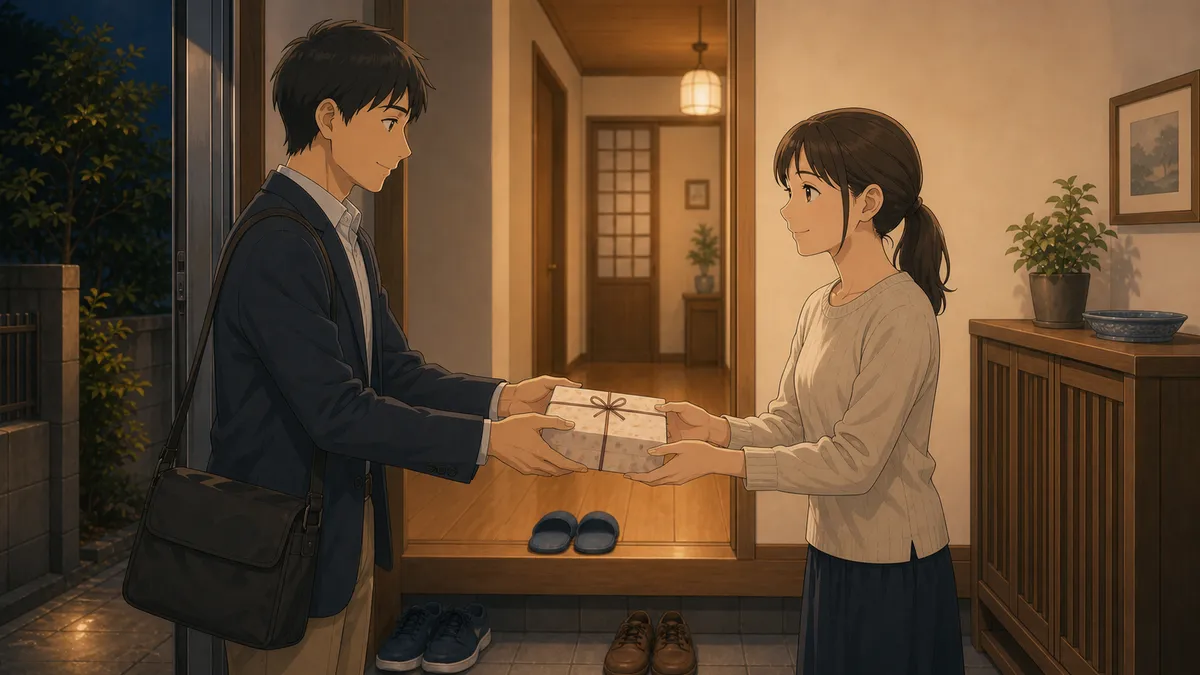
Every time I buy a box of confectionery at a Japanese department store, the same ritual unfolds. The staff member takes the paper box, wraps it briskly in patterned paper, attaches a decorative noshi (a folded paper ornament), slides the whole thing into a handled paper bag, and hands it to me with both hands and a small bow. Before I even reach the actual sweets, I'll need to open at least three separate layers.
The first time this happened to me, my instinct was: why? It's just a gift. The cookies are the same cookies regardless of how many times they get wrapped. But after years of noticing this — in shops, at family occasions, in the quiet gesture of a colleague leaving a carefully wrapped thank-you on a desk — I've started to think the wrapping is the point, not just packaging around it.
What We're Actually Talking About
Japan has a deep cultural investment in the act of wrapping — the process itself, not just the result.
This shows up in a lot of places: the elaborate packaging of department store gift sets, the furoshiki cloth used to bundle a bento box or wine bottle, the two or three layers of wrapping paper on a wedding gift, the tiny decorative envelope (pochibukuro) used to give crisp bills at New Year's, the bamboo-leaf wrap on certain traditional sweets. In each case, the wrapping isn't just protecting the contents — it's doing something extra.
The most iconic example is the furoshiki: a single square of cloth that can be folded and knotted into a carrier for almost any shape — a bottle, a watermelon, a stack of books, a delicate ceramic bowl. It's essentially origami logic applied to fabric. And it's been in continuous use for centuries.
What Looks Distinctly Japanese About This
Compared to gift-giving customs I've encountered elsewhere, a few things stand out.
The wrapping has rules. Not suggestions — actual rules, with meaningful distinctions. The direction you fold the paper matters: one orientation signals a celebratory gift, the opposite is reserved for condolence offerings. The placement of the decorative noshi (a small folded paper that once represented a dried abalone strip, now mostly symbolic) conveys whether something is a celebration or a formal apology. The color and knot style of the mizuhiki — the twisted decorative cord tied around gift envelopes — signals the occasion. Get it wrong and you've accidentally handed someone a sympathy gift at their birthday.
For visitors or newcomers to Japan, this can feel bewildering. There's a whole vocabulary here that takes time to read.
The cloth tradition. A furoshiki is a reusable square of fabric, typically around 70–90cm, and a skilled user can wrap just about anything with one. There are specific folding techniques for bottles, for round objects, for multiple items at once. The cloth then unfolds and becomes a cloth again — no waste, no single-use plastic. In a world increasingly anxious about packaging waste, this aspect has attracted renewed attention internationally.
The social density of gift-giving. Japanese social life has a lot of formalized gifting occasions: omiyage (souvenirs brought back from travel), ochugen and oseibo (mid-year and year-end gifts to people you're indebted to), お見舞い (hospital visits), 内祝い (return gifts after receiving a celebration present), formal thank-yous for introductions or recommendations. Each occasion has its own conventions — and in many of them, the wrapping itself signals that you know the rules, that you took the time, that you care.
The Idea Behind It: Wrapping as Visible Care
This is my reading, not a definitive cultural statement — but I think the logic runs something like this.
In a lot of Japanese social practice, how you handle something communicates your feelings toward a person. Business cards are offered and received with two hands, a small bow, and a moment of attention. Food is plated seasonally, even when the dish itself is humble. The angle of a bow conveys degrees of respect. The tea ceremony, at its core, is an elaborate demonstration that every movement made while serving a guest has been considered.
Wrapping seems to belong to the same family of thinking. The contents of the gift are the same whether you hand them over in a plastic bag or spend twenty minutes at a gift-wrapping counter. But the effort of the wrapping — the layering, the careful folding, the correct noshi — makes visible something that would otherwise stay invisible: I thought about this. I took time for you specifically.
Where this tradition comes from exactly is genuinely complicated. Scholars point to overlapping influences: the aesthetic practices of samurai households, the meticulous gift customs of merchant culture (especially in Kyoto and Osaka), formal court tradition, and even the way offerings to shrines and temples were wrapped and presented. There's no single clean origin. The culture we have now is a layered accumulation.
How It Shows Up in Daily Life Today
This isn't just a museum-piece tradition. I see it in ordinary life all the time.
The triangle-folded wrapper on a convenience store onigiri (rice ball) is a small engineering achievement — designed so you can peel away the plastic in a specific sequence to keep the nori (seaweed) crisp until the moment you eat it. Traditional wagashi (Japanese confectionery) shops often wrap individual sweets in bamboo leaves or washi paper. High-end sushi restaurants pack takeout in wooden containers wrapped in special paper.
In homes, parents often wrap a child's bento box in a cloth square instead of using a bag. Gifts of money — for weddings, graduations, New Year's — go into specialized envelopes whose design and quality communicate the size and seriousness of the occasion. A thoughtful person adds a handwritten note on a small slip of traditional paper.
Furoshiki, meanwhile, has been experiencing a quiet revival. Younger people are picking it up partly for aesthetic reasons, partly because of sustainability concerns. You can now find furoshiki with contemporary graphic designs, and several Kyoto manufacturers have produced English-language folding guides aimed at international visitors. I've seen furoshiki workshops at cultural centers outside Japan — they tend to fill up quickly.
What Visitors Often Notice
People visiting Japan from elsewhere often describe a version of this experience: buying something small and inexpensive — a single pastry, a packet of cookies — and having it wrapped with a care that seems disproportionate to the price. The reaction tends to split.
Some people find it genuinely touching. The feeling, as one person described it to me, is that the object was treated as if it mattered, and so were you. For cultures where retail transactions are purely transactional, this can feel unexpectedly warm.
Others find it excessive. All that paper, all that plastic, for a 200-yen snack. That reaction is also reasonable.
Both responses can be true at once, and that tension is actually worth sitting with rather than resolving quickly in either direction.
A Note on Kyoto and Furoshiki Production
Most high-quality furoshiki are still produced in Kyoto, which has long been a center of Japanese textile craft — silk dyeing, Nishijin weaving, Tango chirimen (a particular type of crepe silk from the northern Kyoto peninsula). Several long-established manufacturers in Kyoto specialize in furoshiki, producing everything from simple everyday cotton versions to elaborate dyed silk pieces meant to be given as gifts in their own right.
The craftsmanship layered into a well-made furoshiki — the dye work, the fabric weight, the hand-feel — is part of why the cloth itself can be the present, not just the packaging.
The Problem That Can't Be Ignored
I want to be direct about this because it matters.
The same cultural logic that produces beautiful furoshiki and thoughtfully layered gift presentation also produces a staggering amount of packaging waste. Japan has one of the highest packaging-to-product ratios in the world. Individual chocolates wrapped in foil, then placed in a paper tray, then boxed, then wrapped in department store paper, then placed in a branded bag. Hotel toiletries individually wrapped in plastic. Fruit — single perfect peaches — nestled in foam nets inside gift boxes.
This is not lost on people in Japan. The criticism comes from within, regularly and pointedly. Consumer advocates, environmental groups, and ordinary people increasingly push back on what gets called 過剰包装 — excess packaging. Some major retailers have begun offering simplified wrapping options, and convenience stores have reduced certain types of single-use packaging. The younger generation, in my observation, is more likely to decline bags and ask for simple wrapping.
It would be easy to frame the wrapping culture as pure elegance and leave it there, but that would be dishonest. The same impulse that makes a gift feel considered has, at scale, contributed to a real environmental problem. Both things are true.
And it's also worth saying: not everyone in Japan relates to this culture the same way. The intensity of wrapping customs tends to vary by generation, region, and context. Many people think the formal gift-wrapping conventions are excessive. Many skip them entirely for casual occasions. The picture is not uniform.
But there's something that persists — some version of the idea that the care you put into handing something to another person is itself a kind of message. The last time you wrapped something carefully before giving it to someone: what were you trying to say?
Sources & References
- Furoshiki Shinkōkai (風呂敷振興会) public materials on furoshiki history and technique
- General reference works on Japanese gift-giving etiquette and noshi/mizuhiki conventions
- Kyoto textile industry association public documentation on regional furoshiki production
- Personal observation and reporting; historical attributions represent commonly cited accounts and should not be taken as settled scholarly consensus
The furoshiki from this article. A single cloth can wrap, carry and gift, again and again.
The Japanese Mind: Understanding Contemporary Japanese Culture
Chapters on aimai (ambiguity), amae, giri, wa and more — the values beneath the gestures and words. For readers who want to go deeper into the 'why.'
A Geek in Japan (Revised & Expanded)
A wide-angle introduction to the 'why' of Japanese culture — manga, anime, Zen, the tea ceremony and more. A natural companion to the topics Naze explores.
Share this article
Read Next
- Gestures & MannersPILLARWhat Is Omotenashi — And Why Does Japanese Hospitality Feel Different?Omotenashi is Japanese hospitality that anticipates what you need before you think to ask — and make…
- Gestures & MannersWhy Don't Japanese People Linger After Eating?Japanese diners tend to leave fairly soon after finishing, especially when it's busy. Here's the qui…
- Gestures & MannersWhy Do Japanese Restaurants Give Free Water and Oshibori?Sit down at almost any Japanese restaurant and cold water, tea, and an oshibori appear before you've…
- Gestures & MannersWhy Does Japan's School Year Start in April?Japan's school year opens in April because its fiscal year does — a calendar fixed in the Meiji era,…
- Gestures & MannersWhy Do Japanese Train Workers Point and Call? — The Science Behind Shisa KankoStation workers who point firmly at signals and call out their status aren't performing a ritual — t…
Related Articles
Articles in the same category:
- Why Is Japanese Gift Wrapping So Elaborate? — The Greeting Before the Gift
- Why Bonsai Takes a Lifetime — Japan's Culture of Tending What Never Quite Finishes
- Why Do Japanese People Bow — and Does the Angle Actually Mean Something?
- Why Japanese Culture Values Ongoing Care Over Finished Products — A Different Idea of 'Done'