Why Do Japanese People Exchange Business Cards with Both Hands? — The Logic of Meishi Etiquette
Gestures & Manners · 2026-06-03 · ~1,600 words · ~6 min read
Contents (6)
- The Card Is Treated as the Person
- What Actually Happens — and What Doesn't
- A Deeper Reading — One Interpretation, Not a Verdict
- The Other Side: When Ceremony Raises the Stakes
- How to Feel This More Directly
- A Lingering Thought
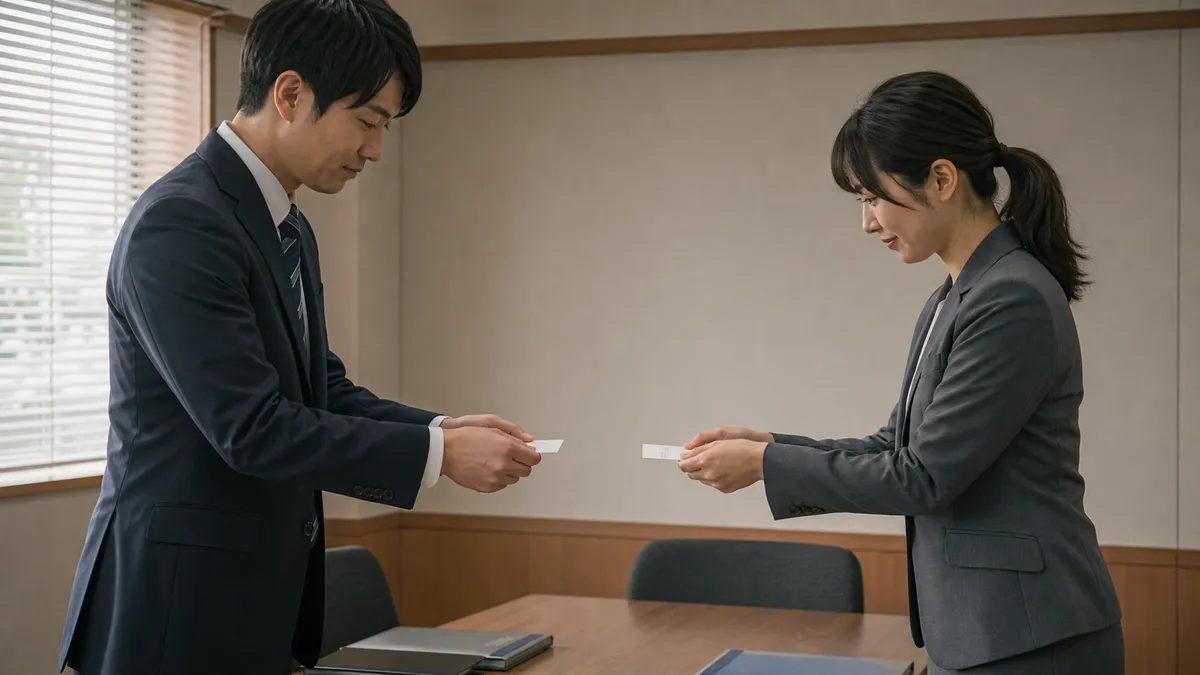
The scene plays out in a particular order, almost like choreography. Two people meet for the first time. Before anyone sits down, they reach into a card holder, produce a business card, and then — with both hands, a slight bow, the card rotated to face the recipient — they offer it. The other person receives it the same way. For a few seconds, both people's hands are fully occupied.
If you've seen this in a Japanese drama, caught it in an anime, or watched it happen in real life, you may have paused. Why both hands? Why the deliberate care? It's just a piece of paper with a name on it.
The Card Is Treated as the Person
Here's the short answer, and I think it's worth landing early: in the meishi exchange, the card is not contact information. It is treated as a stand-in for the person handing it over.
Both hands say: I'm not taking you lightly.
That's the core of it. One hand would be casual — the way you might pass someone a receipt, or a flyer. Two hands, with attention and a small bow, signal that this moment of introduction is being taken seriously. You're not just receiving data. You're receiving a person.
This isn't a rule that was written down by a committee somewhere. It evolved out of older conventions around gift-giving and the respectful handling of objects — a pattern in Japanese social life where both hands and a slight incline of the head indicate care and attention rather than haste or casualness. The meishi exchange formalized that instinct into a shared ritual.
What Actually Happens — and What Doesn't
In a formal first meeting, the exchange typically happens standing, before anyone sits. You offer your card with both hands, name and logo oriented toward the recipient so they can read it without turning it. You receive the other person's card with both hands and a brief bow. You look at it. You don't immediately shove it in your pocket.
During the meeting itself, the card stays on the table in front of you. If there are multiple people, the cards are often arranged in rough order of seniority — a small geography of respect.
A few things generally considered bad form: writing on someone's card in front of them, setting something on top of it, bending or folding it, or pocketing it the moment it's handed over. Each of these would, in effect, treat the card as just a piece of paper — which would suggest, in turn, that you're treating the person that way.
This level of care isn't universal across every Japanese social context. Casual introductions between friends, informal settings, younger-generation exchanges — the ceremony varies. But in professional or semi-formal first meetings, the ritual tends to persist, even among people who couldn't fully explain why.
Let me add one report from the field. I sometimes sit in meetings with overseas partners, and most visitors from abroad don't carry business cards at all. I'm also, frankly, terrible at remembering names. In a meeting with many people and no cards on the table, I genuinely struggle. Which taught me what the meishi actually is, underneath the ceremony: a seating chart and a memory aid, working the whole meeting — who is who, holding which title, sitting where. That small piece of paper is on the clock the entire time.
A Deeper Reading — One Interpretation, Not a Verdict
Here's how I see it, offered carefully as one reading.
There's something in Japanese everyday life about the way care for objects reflects care for people. The wrapping of a gift. The plating of food before it's brought to the table. The way something is handed over with two hands rather than one. These feel connected — as if the object becomes a proxy for the person behind it, and how you handle the proxy signals how you're thinking about that person.
The meishi exchange may be a formalized version of that instinct. Whether its roots are deeply cultural, historically contingent, or just a professional norm that stuck and became self-reinforcing — I honestly don't know. Perhaps all three. But the effect, when the exchange is done sincerely, is that the gesture itself speaks before any words do. I prepared for this meeting. I'm entering this with attention.
Of course, not everyone experiences it that way. For some Japanese professionals, especially younger ones, the ritual can feel more like a checklist — something you do because not doing it would be noticed, rather than because it means something to you. The form stays even as the feeling varies person to person. Both things can be true at once.
The Other Side: When Ceremony Raises the Stakes
It's worth saying plainly, because it's real: the precision of Japanese manners can make first meetings harder, not easier.
If you're a foreigner or a newcomer to professional Japan, the meishi ritual can feel like a minefield. Did I turn the card the right way? Am I holding it correctly? Did I bow at the right depth before I extended it or after? The ceremony that's designed to signal "I take you seriously" can, for someone unfamiliar with the choreography, accidentally signal "I don't know the rules here" — which in some professional contexts creates its own quiet awkwardness before the meeting has even started.
I won't pretend that's a minor thing. Detailed etiquette can function as an invisible filter for outsiders — a grammar that's assumed rather than taught. And on the Japanese side, there's sometimes a corresponding anxiety: if the other person doesn't know the sequence, the opening feels clunky rather than smooth, which is the opposite of what the ritual is trying to achieve.
The exchange works best when both people share the grammar. When they don't, goodwill tends to fill the gap. In my experience, most people are considerably more forgiving of a foreigner fumbling the exchange than the formal rules might suggest — sincerity reads across the gap, even if the choreography is imperfect.
What I keep coming back to is just how many of these rules there are — in Japanese business manners and etiquette generally. Honestly, even Japanese people don't have all of them memorized precisely; it's genuinely hard. But even when you don't know the fine points of the form, you try, in the moment, to read the situation as best you can so as not to be rude, not to make the other person uncomfortable — and that effort might be the most Japanese thing about it. More than tracing the correct shape exactly, the intent to treat the other person well is, I suspect, the real substance underneath.
How to Feel This More Directly
If you want to understand meishi culture through something concrete:
- Watch the opening scenes of almost any Japanese workplace drama — Hanzawa Naoki, for instance, or any office-set anime. The card exchange often appears early because it's the first legible signal of a character's professional bearing and social position. Directors use it because audiences read it immediately.
- If you're visiting Japan for any semi-formal meeting — a language partner, a business contact, a community introduction — bring a card. Even a simple one printed at home works. Try the two-handed exchange. The other person's reaction will tell you more about what it means to them than any explanation.
- During the meeting, notice where the cards go. On the table, in front of you, in some rough order. A small, quiet arrangement that says: these people are present here, and I haven't forgotten them.
A Lingering Thought
What I keep returning to is this: the meishi exchange is efficient, in its own way. It compresses a lot of social signal — "I prepared," "I'm paying attention," "I'm entering this meeting with both hands" — into a gesture that takes maybe fifteen seconds.
Whether that efficiency is worth the pressure it can create for those outside the ritual is a question I can't answer for anyone else. But the underlying logic seems sound to me: the way you handle a small piece of paper becomes a declaration about how you intend to handle the relationship it represents.
And this ceremonial layer will keep changing, I suspect. Digital business cards are slowly spreading, and the form will move with the times — what remains, I'd bet, is only the core: I'm not taking you lightly. Some visitors, meanwhile, might find the whole thing delightful for a different reason — grown-up trading cards. Honestly? Fair. A card with a name and a title, exchanged with both hands and laid out on the table in formation. It is a little like that.
How does that look from where you are?
Sources & References
- A personal reading from everyday observation and general familiarity with Japanese professional contexts; no external academic sources are cited.
- Standard Japanese business etiquette guidance (widely circulated professional manuals and etiquette books in Japanese corporate settings).
The Japanese Mind: Understanding Contemporary Japanese Culture
Chapters on aimai (ambiguity), amae, giri, wa and more — the values beneath the gestures and words. For readers who want to go deeper into the 'why.'
A Geek in Japan (Revised & Expanded)
A wide-angle introduction to the 'why' of Japanese culture — manga, anime, Zen, the tea ceremony and more. A natural companion to the topics Naze explores.
Share this article
Read Next
- Gestures & MannersPILLARWhat Is Omotenashi — And Why Does Japanese Hospitality Feel Different?Omotenashi is Japanese hospitality that anticipates what you need before you think to ask — and make…
- Gestures & MannersWhy Don't Japanese People Linger After Eating?Japanese diners tend to leave fairly soon after finishing, especially when it's busy. Here's the qui…
- Gestures & MannersWhy Do Japanese Restaurants Give Free Water and Oshibori?Sit down at almost any Japanese restaurant and cold water, tea, and an oshibori appear before you've…
- Gestures & MannersWhy Does Japan's School Year Start in April?Japan's school year opens in April because its fiscal year does — a calendar fixed in the Meiji era,…
- Gestures & MannersWhy Do Japanese Train Workers Point and Call? — The Science Behind Shisa KankoStation workers who point firmly at signals and call out their status aren't performing a ritual — t…
Related Articles
Articles in the same category: