Why Do Japanese People Take Off Their Shoes Indoors?
Gestures & Manners · 2026-06-03 · ~1,800 words · ~8 min read
Contents (7)
- The Floor Is the Living Room
- The Genkan: A Threshold Built Into the House
- Uchi and Soto: Inside and Outside
- Leaving the Outside at the Step
- The Other Side: Small Frictions
- Where You'll Feel the Logic Most Clearly
- A Line You Step Over Every Day
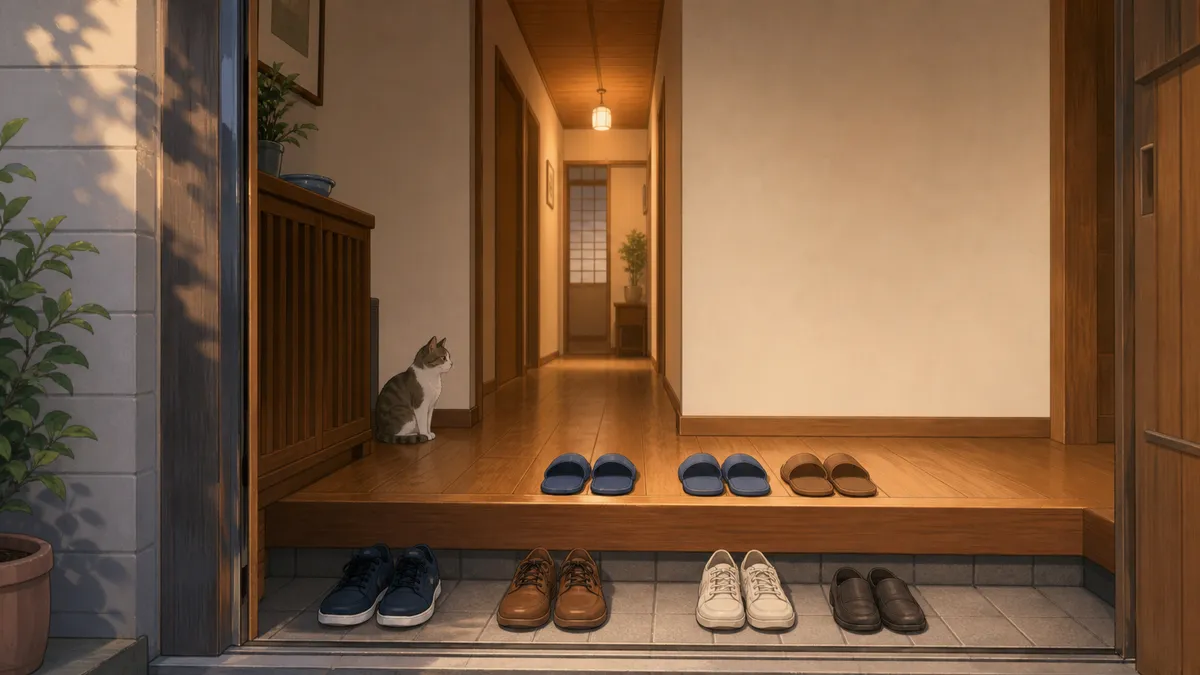
You step up to the front door of a Japanese home, and the first thing you notice is a row of shoes. They're lined up on the lower concrete step — the outdoor side — pointing outward, like they're ready to leave without you. One step above them, the wooden floor or tatami begins. A pair of slippers, sometimes two pairs, faces you from just inside.
If you grew up somewhere shoes stay on all day, this small scene carries a quiet instruction nobody explained. You sense it: something changes here. The question is what, exactly, and why this particular line exists in the first place.
The Floor Is the Living Room
The most direct answer starts with the floor itself.
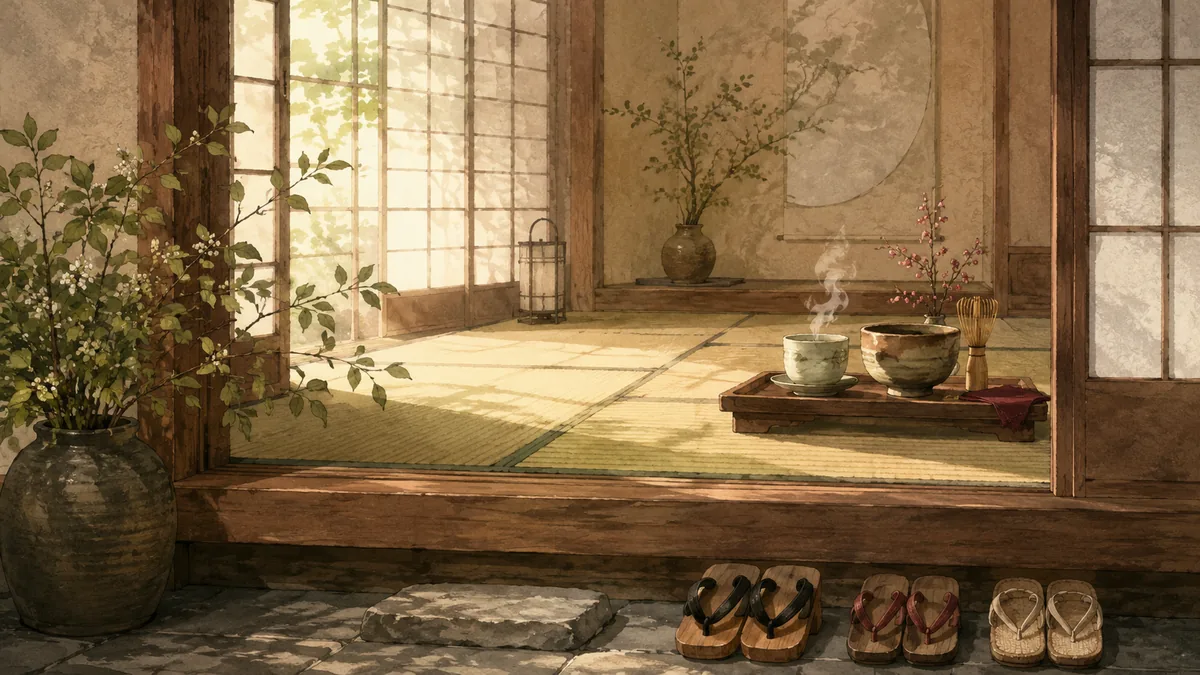
For much of Japanese history — and still in many homes today — daily life happened close to the ground. Chairs weren't the default; people sat on tatami matting, cross-legged or kneeling. Sleep didn't happen in a raised bed frame; a futon was unrolled directly onto the floor each night and folded away each morning. Meals came at low tables, paperwork spread across the same tatami, guests were received sitting down on cushions. The floor was simultaneously the bedroom, the dining room, the living room, and the workspace.
When the floor is all of those things at once, what you track in from outside stops being a minor inconvenience. It's the surface you're going to sleep on tonight. The habit of removing shoes isn't a cultural ritual in the first instance — it's practical arithmetic. Keep the floor clean because the floor is where you live.
To put it even more bluntly — I sometimes think the question runs backwards. Walk into a house with mud on your shoes, and the person cleaning up that mud is you. Taking your shoes off costs a few seconds; wiping the floor costs many times that. So the real question isn't "why take them off?" but "isn't keeping them on the inefficient choice?" The way I see it, the genkan habit is plain rationality before it's culture.
And rationality has one quiet advantage: it travels. Explain the logic once — people here sat on the floor, and slept on the floor — and most first-time visitors get it immediately. It isn't a prohibition to memorize; it's a reason that makes sense the moment you hear it. That's why it rarely feels like an imposition.
Tatami, in particular, reinforces this logic. Woven from rush grass pressed onto a rice-straw base, it's warm and pleasant underfoot — but it absorbs what it catches and doesn't release it easily. A floor you sit and sleep on, made of material that holds what it touches: the logic of shoes-off becomes almost obvious from there.
This is the core of it, and I think it's worth staying with before reaching for anything more abstract. The floor was used differently. So it was treated differently. That's where this starts.
The Genkan: A Threshold Built Into the House
That practical logic eventually became architecture.
The genkan (玄関) is the entry area set just inside a Japanese front door, built one step lower than the rest of the living space. That step — roughly ten to fifteen centimeters in most homes — creates a physical threshold. The outdoor level ends at the step; the indoor floor begins above it. Shoes stay on the lower level. You continue upward.
It's a small design detail, but it carries weight in its shape. The genkan isn't a mudroom in the European sense — a place to shed wet gear before moving on. It's more deliberately a transition zone: a built-in pause between the world outside and the home inside. The architecture itself makes the change of state visible and unavoidable.
If you've spent time with anime or Japanese film — My Neighbor Totoro, Anohana, A Silent Voice, or almost any slice-of-life story set in a family home — you've seen this scene dozens of times without perhaps noticing. A character arrives home. Steps into the genkan. Takes off their shoes. Possibly lines them up. Steps up into the house. The story continues. Nobody explains it. Nobody needs to. The camera catches it in passing because it's always there.
That invisibility is exactly what makes it interesting when you start to look: the behavior is so consistent, so unremarkable within the world of the story, that it reads as pure observation rather than set dressing. The genkan is just what coming home looks like.
Uchi and Soto: Inside and Outside
Here's where I want to be careful, because this is where interpretation tends to outpace the evidence.
One framework that comes up in writing about Japanese social life is the distinction between uchi (内, roughly "inside" or "home") and soto (外, roughly "outside" or "the world"). These aren't just spatial categories; they carry some sense of what belongs within a particular circle and what remains beyond it. In that reading, the genkan becomes one of this distinction's most literal expressions: outside stays outside, left at the step in the form of two shoes pointing toward the door.
I find that reading genuinely useful — as one way to see it. But I want to be honest that I can't tell you it's the reason people remove their shoes, and I doubt any single framing covers it. Habits like this accumulate across time: a practical necessity becomes an architectural convention, becomes an unexamined routine, becomes part of what "home" feels like. At some point, the feeling outlasts the original reason.
Here's how I see it personally, for what that's worth: a home where people sleep on the floor needs a clean floor. That practical need, held across generations and built into the structure of the house, becomes part of what home means — not consciously reasoned out, just in the feel of crossing that threshold. Many modern Japanese homes have beds now. Chairs are common. But the shoes still come off. Maybe because the genkan remains, and the genkan trains the habit. Maybe because stepping "inside" still feels like something, even when the floor no longer needs to be slept on.
Of course, not everyone experiences this the same way, and I'd be cautious about claiming any single, unified feeling here. Some people who grew up with this say they've genuinely never thought about it — it's just what you do. Others say there's something real about crossing that line, a distinct sense of arriving somewhere separate from the outside world. Both are probably true for different people, at different moments.
Leaving the Outside at the Step
There's a faint thread that runs through a lot of Japanese life: the sense that crossing a boundary calls for a small act of cleansing. You rinse your hands and mouth at a shrine gate. You wash your body before getting into the onsen water. Some households scatter a pinch of salt at the entrance. Each looks like a variation on one idea — don't carry the outside, as it is, into a clean place.
Taking your shoes off at the door may brush against the low edge of that same feeling. Shoes that have walked outside carry more than dust; they carry the outside world itself. Leaving them below the step is less about knocking off dirt than about marking, with the body, that the air is different from here in. It's why, even somewhere shoes are perfectly fine, a floor that's too clean can make you want to slip them off anyway. I won't pretend to know exactly what that hesitation is. But in that instant, what the sole of your foot is checking probably isn't the dirt on the floor — it's the boundary.
None of this is done consciously. It's a few seconds at a doorway. And yet, every day, we repeat that small changeover — shedding the outside world by one layer before stepping up into the inside — mostly without noticing we do it.
The Other Side: Small Frictions
It's worth being honest about the parts of this that don't work as smoothly as the idea might suggest.
The first trap for travelers, by the way, isn't in a home at all — it's in restaurants. Without knowing, it's easy to step up onto an izakaya's zashiki — the raised tatami seating area — with your shoes still on. In a house, the genkan announces itself at the front door; in a restaurant, the boundary appears mid-room, halfway to your table. The cue is the same, though: a floor raised one step up, and shoes lined up at its edge. That's a small genkan. When in doubt, look at everyone else's feet.
For guests — especially visitors from cultures where shoes stay on — the shoes-off moment can carry a low-grade anxiety. Are my socks presentable? Is there a hole I forgot about? Should I ask for slippers, or would that be presumptuous? Japanese hosts, for their part, sometimes find themselves worrying in the other direction: Have I prepared enough slippers? Are they clean enough? Will our guest feel at ease?
There's a small but real burden in both directions. The transition that feels effortless after ten thousand repetitions can feel like a social test when you haven't done it before. Most people find their footing quickly — Japanese visitors to homes often ease the moment by saying ojama shimasu ("I'm intruding," said on entering), a small verbal acknowledgment of the crossing — but the friction is there, and it's honest to name it.
I'll confess my own version of this. At home, I'm fairly careless about how I take my shoes off — often just kicking them off and stepping up, leaving them in a heap. But the moment I'm at someone else's house, or a ryokan, I line them up neatly without thinking. I suspect a lot of people are the same: the exact same act, but a switch flips between uchi and someone else's space. And then — purely practical, this one — boot days are genuinely a struggle. You fumble at the entryway, quietly anxious about whether you're holding up the person behind you.
There's also a practical issue that rarely gets discussed in writing about this habit: the step between genkan and living space can be a genuine barrier for elderly people, or anyone with limited mobility. What reads as a meaningful threshold for one body can be a literal obstacle for another. Some families lower the step entirely, add grab rails, or redesign the entry to be level. The architecture that grew from one pattern of living doesn't automatically fit every body, every age, every need.
And in contemporary urban apartments, the genkan has often been compressed to almost nothing — barely enough floor space for two pairs of shoes and a small mat. The custom persists in its abbreviated form. Sometimes it functions fine; sometimes it's just an awkward shuffle by the door before the living room begins.
The habit has good reasons and real friction. That's the honest description of most customs that have lasted a long time.
Where You'll Feel the Logic Most Clearly
A few places where this becomes tangible, not just legible:
A traditional ryokan. Stepping out of your shoes at the entrance and into a world of tatami, low ceilings, and yukata, the shift in atmosphere is immediate and complete. The same logic that governs a residential genkan operates here at a larger scale — and because everything inside is designed around floor-level living, the transition feels unusually sharp and clear.
Older anime and Japanese film. Watch My Neighbor Totoro or Only Yesterday with the genkan in mind. It appears naturally, consistently, unremarkably — never framed as interesting. That's the point. The consistency is what makes these films feel observed rather than invented.
Your own front door, if you're curious. A number of people who've stayed in Japanese homes have mentioned coming back and quietly starting to leave their shoes at the door — not as imitation, but because they noticed something about the feeling of a floor that stays clean. Whether that experiment holds is its own question. But it costs almost nothing to try.
A Line You Step Over Every Day
Most homes have a threshold — a point where outside becomes inside. Many don't make it visible. The Japanese genkan makes it visible, tactile, and daily: you step out of the world and into the home in a physical act that takes a few seconds and leaves two shoes behind as evidence.
Whether that carries meaning beyond the practical, I genuinely don't know. There are many ways to read it. What I find striking is simply how consistently one small habit — shoes off at the step, slippers on, floor begins — maintains a line that, once you notice it, you start to see everywhere.
Every home draws the line somewhere. In Japan, you can see exactly where it falls.
One last observation from the inside: the instinct moves even where the rule doesn't. In places where shoes are explicitly fine — a shop with beautifully polished floors, a friend's brand-new room — many Japanese people (I'm one of them) feel a flicker of hesitation: should I take these off? The written rule says there's no need. The body votes anyway. That's how deep this habit lives — not in the head, but somewhere below it.
How does that line feel where you live?
Sources & References
- This article is based on everyday observation and general knowledge of Japanese residential architecture and domestic customs. No statistical claims are made; no external figures or organizations are cited.
The Japanese Mind: Understanding Contemporary Japanese Culture
Chapters on aimai (ambiguity), amae, giri, wa and more — the values beneath the gestures and words. For readers who want to go deeper into the 'why.'
A Geek in Japan (Revised & Expanded)
A wide-angle introduction to the 'why' of Japanese culture — manga, anime, Zen, the tea ceremony and more. A natural companion to the topics Naze explores.
Share this article
Read Next
- Gestures & MannersPILLARWhat Is Omotenashi — And Why Does Japanese Hospitality Feel Different?Omotenashi is Japanese hospitality that anticipates what you need before you think to ask — and make…
- Gestures & MannersWhy Don't Japanese People Linger After Eating?Japanese diners tend to leave fairly soon after finishing, especially when it's busy. Here's the qui…
- Gestures & MannersWhy Do Japanese Restaurants Give Free Water and Oshibori?Sit down at almost any Japanese restaurant and cold water, tea, and an oshibori appear before you've…
- Gestures & MannersWhy Does Japan's School Year Start in April?Japan's school year opens in April because its fiscal year does — a calendar fixed in the Meiji era,…
- Gestures & MannersWhy Do Japanese Train Workers Point and Call? — The Science Behind Shisa KankoStation workers who point firmly at signals and call out their status aren't performing a ritual — t…
Related Articles
Articles in the same category: