
Itadakimasu Meaning: Why Japanese Say It Before Eating
Words & Feelings · 2026-06-08 · ~1,800 words
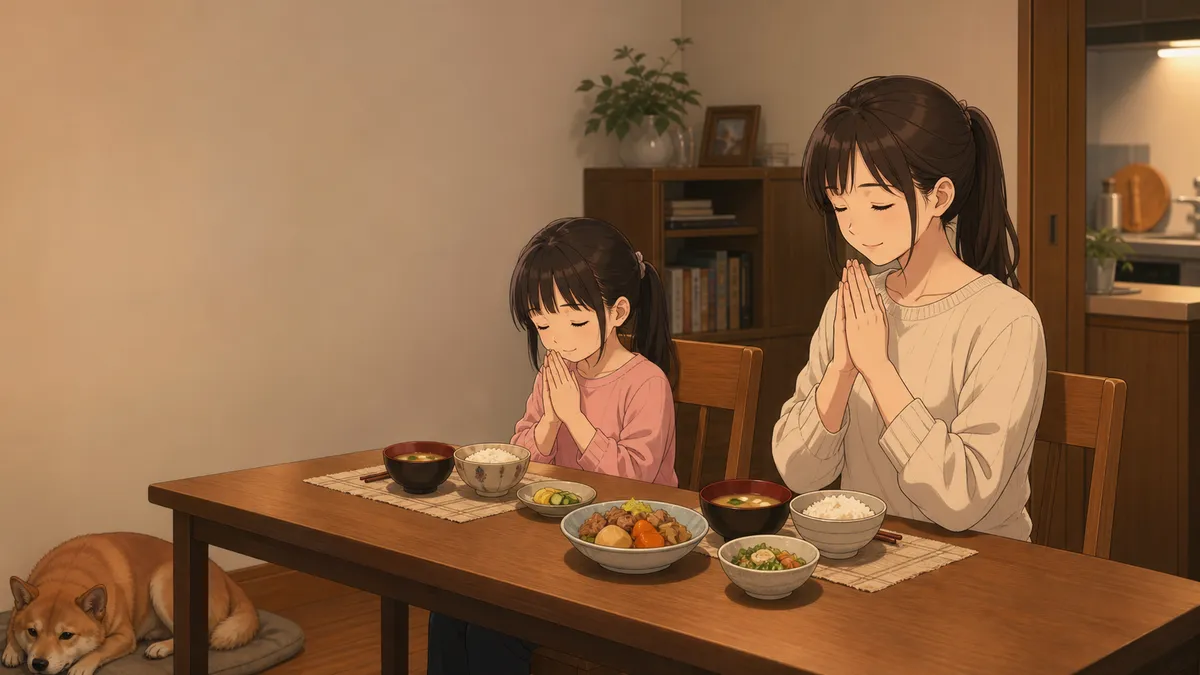
If you've ever sat down to eat in Japan — at a family home, a ryokan, a school cafeteria, or even just watched someone open a convenience store bento — you've almost certainly heard it.
Itadakimasu.
Hands pressed together, a small bow of the head, and then the meal begins. It happens so automatically that many people who grew up in Japan have never stopped to ask what it actually means. And for visitors, the usual translation — "Let's eat" — lands flat the moment you dig even a little deeper.
This piece is my attempt to unpack it. Not as a definitive cultural authority, but as someone who's been curious about the gap between what that word does and what any English phrase can do.
What the Word Actually Says
Let's start with linguistics, because the word itself is doing something unusual.
Itadaku (いただく) is the humble/honorific form of two verbs: "to receive" and "to eat." In Japanese, there's a whole grammatical register dedicated to making yourself small and elevating the other party. So when you say itadakimasu, you're essentially saying: "I humbly receive [this]." You're positioning yourself as the recipient of something given to you by someone — or something — above you.
That's meaningfully different from "Let's eat," which is an invitation to your own appetite. Itadakimasu is directed outward. The question is: toward what, exactly?
The Layers of Who (or What) You're Thanking
This is where it gets interesting — and also where I want to be careful not to over-romanticize.
One common explanation, often taught to children in Japan, goes something like this: when you say itadakimasu, you're expressing gratitude toward everything and everyone that brought the food to your plate. The fish or vegetable that gave its life. The farmer or fisherman who raised or caught it. The person who cooked it. The truck driver who delivered it. The whole web of relationships and labor that made the meal possible.
That's a genuinely different idea from most pre-meal traditions I'm aware of. Christian grace before meals is typically directed at God. The Arabic bismillah invokes God's name. Both are vertically oriented — human to divine. Itadakimasu is more like a horizontal net cast wide, acknowledging a whole system rather than a single source.
There's also a dimension about life itself. Eating involves taking life — even plants, even vegetables. In Japan, you'll often hear this framed through Buddhist influence: the idea that we survive by receiving the lives of other living things, and that this deserves acknowledgment. But scholars also point to Shinto animism (the sense that everything has a spirit), agricultural traditions of gratitude toward the land, and older social hierarchies embedded in the verb itadaku itself. The word carries all of these at once, without demanding that you subscribe to any particular one.
As a single-word vessel for that much meaning, it's genuinely hard to translate.
Why "Bon Appétit" Doesn't Quite Cover It
I've seen itadakimasu translated as:
- "Let's eat"
- "Bon appétit"
- "Thank you for the food"
- "I receive this meal"
Each captures something. None captures it fully.
"Bon appétit" is probably the closest in social function — it marks the beginning of a meal with a kind of shared acknowledgment. But it's really about wishing each other a good appetite. It's still self-directed in a way that itadakimasu isn't.
"Thank you for the food" is closer in spirit, but it implies a specific person you're thanking — usually the cook. Itadakimasu doesn't single anyone out. It's more diffuse than that.
The truth is that English doesn't have a word for this because English-speaking food culture doesn't have the same concept baked into its secular everyday ritual. Which isn't a deficiency — it's just a difference. The concept exists in English-speaking contexts too (gratitude for food, awareness of labor and supply chains, vegetarian ethics), but it hasn't crystallized into a single automatic word said before every meal.
How It Actually Shows Up in Modern Life
In practice, itadakimasu is everywhere and almost invisible at the same time.
In Japanese kindergartens and elementary school cafeterias, the whole class says it together before eating — often led by a student of the day. It's ritual, communal, and completely mundane. Kids say it without thinking about etymology or Buddhist philosophy.
In family homes, it varies. Some families say it together every meal; others are more casual. I've heard from people who grew up in households where it was treated as mandatory, and from others where it was rarely enforced. When people have children of their own, many find themselves reinstating it — not necessarily out of deep spiritual conviction, but because it feels like the right container for a meal.
At traditional inns (ryokan) and formal Japanese restaurants, there's often a little choreography around it: the server presents the dishes, says something like "please enjoy," and the guest responds with itadakimasu before picking up their chopsticks. It marks a transition. The meal is now beginning. And when the meal ends, gochisousama closes it — the word that thanks everything that made the meal possible, in one breath.
And then there's the solo version. Many people who live alone will say it quietly to themselves, to an empty room. No one is listening. It's not for an audience — it functions more like a personal switch, a small act of marking the moment before eating versus after.
What Visitors Often Notice
In my experience, many visitors to Japan first encounter itadakimasu as a curiosity — a word they hear constantly but can't quite place. Then someone explains that it roughly means "Let's eat," and that seems to settle it.
But then something happens — they eat at someone's home, or they visit a school, or they're at a ryokan and the whole room seems to pause — and they realize the word is carrying more weight than "let's eat" ever could. That's usually when the follow-up questions start.
I've noticed that visitors who bother to learn the word and use it tend to get a warm reaction from people around them — not because they've performed some cultural correctness, but because it signals genuine curiosity. You don't need to understand all the layers to use the word. But trying to say it at all often does something to the atmosphere at the table.
If you're planning time in Japan and you eat with anyone local, it's probably the single most useful phrase to learn that isn't in any phrasebook's top ten.
Honest Caveat: Most People Aren't Thinking About Any of This
I want to be clear about something, because I think articles about Japanese customs often over-spiritualize everyday behavior.
Most people in Japan are not, in the moment of saying itadakimasu, consciously thinking about the lives of the fish, the labor of the farmer, or Buddhist philosophy. The word has become so automatic — so deeply embedded in the routine of eating — that for many people it's closer to reflex than reflection. The mouth moves; the meal begins.
Some people who've moved into their own apartments for the first time stop saying it entirely. Some families eat together in near-silence and no one notices if someone forgets. The image of every Japanese household pausing reverently before meals, hands pressed together, is a little idealized.
That said, I don't think automaticity makes it meaningless. There's an argument that habituated rituals do something even when you're not consciously engaging with them — they create a small pause, a micro-transition, a boundary between not-eating and eating. Whether that pause carries spiritual weight, social function, or just muscle memory probably varies person to person and meal to meal.
And still — if you asked me personally what this word is really about, there's only one answer: gratitude. In the ordinary run of a day, I don't honestly think about it that deeply. But underneath it all is thanks to the life I'm about to eat, and thanks to the person who made the plate in front of me. Most of the time it sits at the bottom of awareness and only now and then floats up. It stays there, always, at about that distance.
The word has stayed in use across centuries and survived enormous cultural change. That persistence probably means something, even if no one can agree exactly what.
A Question Worth Sitting With
Here's what I keep coming back to: English-speaking food culture has increasingly developed language and concepts around conscious eating — farm-to-table, knowing where your food comes from, thinking about labor conditions and environmental impact. These are serious ethical conversations. But they happen in op-eds and menus and Instagram captions, not as a single reflexive word before every meal.
Itadakimasu doesn't solve those questions. It doesn't make anyone a more ethical eater by default. But it does install a pause — a small moment of notional acknowledgment — at the entrance to every meal. Whether that moment is filled with genuine meaning or pure habit probably depends on the day.
When did you last pause before eating?
Sources & References
- Agency for Cultural Affairs (文化庁), public materials on Japanese language and cultural vocabulary
- General Japanese linguistics references on the honorific/humble verb register (kenjōgo)
- Public documentation on washoku (和食) culture submitted to UNESCO Intangible Cultural Heritage, 2013
- Various academic and popular writing on Buddhist influences on Japanese food culture; interpretations of religious origins vary and no single account is definitive
The Japanese Mind: Understanding Contemporary Japanese Culture
Chapters on aimai (ambiguity), amae, giri, wa and more — the values beneath the gestures and words. For readers who want to go deeper into the 'why.'
A Geek in Japan (Revised & Expanded)
A wide-angle introduction to the 'why' of Japanese culture — manga, anime, Zen, the tea ceremony and more. A natural companion to the topics Naze explores.
Share this article
Read Next
- Words & FeelingsPILLARWhy Is Silence Not Awkward in Japan? — The Concept of MaIn many cultures, silence in conversation signals something's wrong. In Japan, silence can mean the …
- Words & FeelingsWhy Are Japanese Shops So Loud If Japan Is 'Quiet'?Japanese trains are near-silent; shops hit you with a full 'Irasshaimase!' the moment you enter. One…
- Words & FeelingsWhy Do Japanese People Find It Hard to Say No?Japan's indirect 'no' — chotto, muzukashii, 'I'll think about it' — isn't evasion. It's a system for…
- Words & FeelingsWhy Does 'Daijoubu' Mean Both Yes and No in Japanese?'Daijoubu desu' works as a polite refusal one moment and a reassurance the next — same word, opposit…
- Words & FeelingsWhy Does "Mottainai" Mean More Than Just "Wasteful"?"Mottainai" translates as wasteful, but the word carries something English lacks — the grief of disc…
Related Articles
Articles in the same category: