Why Does Japan Have a Rainy Season — and Is June Worth Visiting?
Seasons & Nature · 2026-06-08 · ~1,650 words · ~6 min read
Contents (6)
- What Tsuyu Actually Is
- Linen Snaps When It's Too Dry
- The Reputation vs. The Reality
- The Aesthetic Layer — Rain as Something Worth Attending To
- What June in Japan Is Actually Like
- A Kind of Luxury
In early June, the sky changes. Grey cover settles in. Rain comes and goes — not dramatically, not in storms, just persistently present. People start checking the forecast every morning.
It is, honestly, a bit dreary — the damp, the laundry that won't dry. But that isn't quite the whole of it. Late at night, with the lights low, listening to the rain against the window and the frogs calling somewhere out in the dark, there's something in it that quietly settles me.
Visitors planning a Japan trip often ask: should I avoid June? The answer requires knowing what tsuyu actually is.
What Tsuyu Actually Is
Tsuyu (梅雨) is formed by a stationary front — the boundary between warm, moist Pacific air pushing north and cooler continental air holding its position. This front parks itself roughly over the Japanese archipelago from early June through mid-to-late July, producing intermittent rain for weeks.
According to Japan Meteorological Agency statistics and Japan-guide.com, Tokyo's average tsuyu start is in early June and the average end is in late July, with a total duration of approximately four to six weeks. The precise dates vary year to year.
The word tsuyu (梅雨) contains the character for plum (梅) — rain that falls as plums are ripening. The word is also phonetically identical to the Japanese word for dew (露). Both associations appear in classical literature. There's no single accepted etymology.
Linen Snaps When It's Too Dry
Here's an unexpected detour worth taking.
I'm involved in a job that has to do with weaving fabric. In manufacturing, the rainy season carries a general assumption: humidity is the enemy. Mold, corrosion, warped materials — for a lot of processes, moisture is exactly what you're trying to keep out.
But natural fibers like linen (hemp) tend to work the opposite way. When they're too dry, the thread becomes brittle and snaps on the loom. So during the dry season, some workshops deliberately humidify the air just to keep the thread workable — doing, on purpose, the exact thing tsuyu does by accident. Some jobs dread the humidity of the rainy season. Others dread the dryness that comes without it. The same condition — humidity — becomes an enemy in one place and an ally in another.
This is a narrow, personal slice of experience, and I don't want to overstate it into some grand claim about Japanese manufacturing as a whole. But it does make me suspect that the whole premise of "tsuyu is just an inconvenience" is a one-directional way of looking at it. Humidity, on its own, isn't good or bad. Its meaning flips depending on what it's up against. The same condition changing meaning depending on where it lands reminds me of something I felt while writing about ma, the Japanese sense of meaningful empty space — that the value of a thing often isn't fixed in itself, but decided by the context it's placed in.
The Reputation vs. The Reality
The reputation: six weeks of unbroken grey rain.
The reality: rain probability in Tokyo during peak tsuyu is approximately 45%, according to JMA data. That means on roughly half of rainy-season days, it's not actually raining. Sunny breaks, sometimes lasting all day, are common.
The rain that does come tends to be steady and grey rather than dramatic. Heavy rain events can and do occur, but the experience is generally more "damp and overcast for weeks" than "tropical downpour every day."
What this means for visitors: bring a compact umbrella. Check the forecast each morning. Plan indoor options as backup. But don't write off the month.
The Aesthetic Layer — Rain as Something Worth Attending To
Here's the part that interests me most — with the caveat that it's a reading, not a documentation.
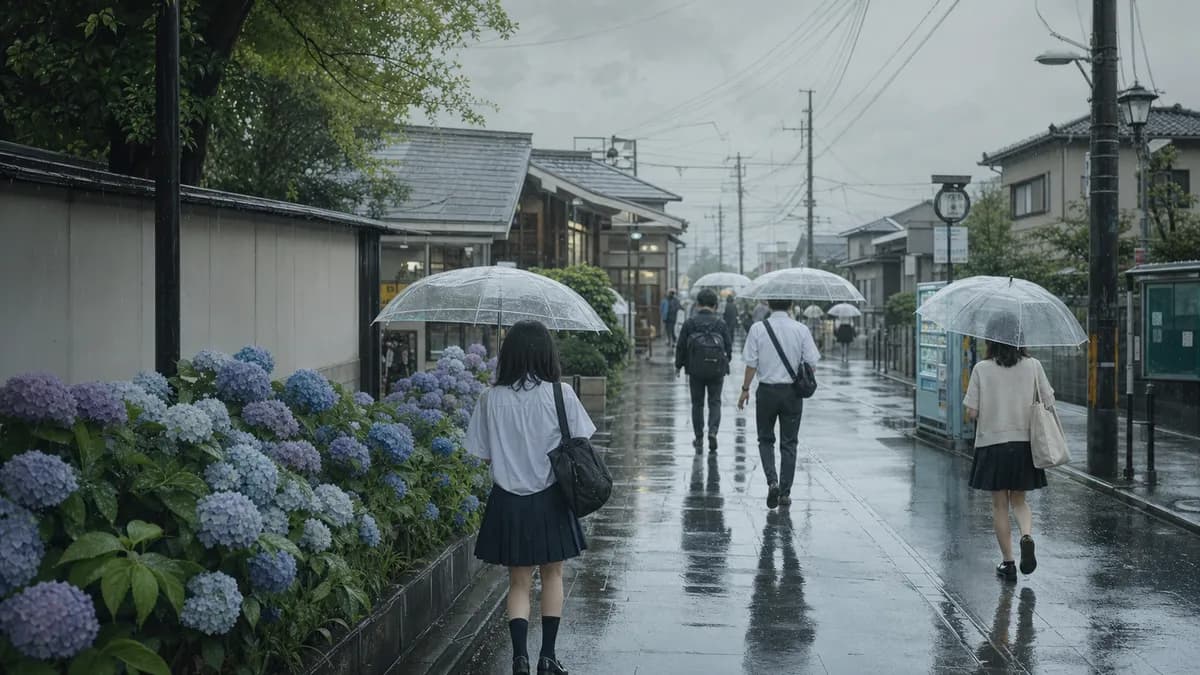
Japanese aesthetic tradition has, across literature, poetry, and visual art, treated rain not as background noise but as something worthy of attention. The sound of rain on leaves. The way light changes when the sky is grey. Hydrangeas (ajisai) — the representative flower of tsuyu — photographed wet, their color deepened.
Japanese anime uses rain extensively as emotional weather, not weather weather. A scene set in rain isn't primarily "they got wet" — it's a register change, a held breath, something that cannot be said being communicated through the grey air. This use of rain in fiction reflects something real about how rain is attended to in Japanese culture.
Tsuyu is also, for those paying attention, a seasonal promise: the rains will end, and summer will arrive. The discomfort has an expiry date written into the calendar. That temporal structure — enduring something that will resolve — may be part of what gives the season its particular texture.
Personally, there's a part of the rainy season I can't quite bring myself to dislike. When I fall asleep to the sound of rain at night, I somehow sleep better than usual. I once heard it said that the steady rhythm is close to the sounds we listen to from inside the body — a heartbeat, the sounds heard in the womb. Whether that's true, I don't know. But that odd sense of reassurance, on a night when rain is falling quietly outside the window, is real.
What June in Japan Is Actually Like
The difficulties are real and worth naming plainly:
- High humidity, which affects comfort and can cause mold issues in older buildings
- Laundry that doesn't dry
- The mood weight of days without sun
For visitors specifically:
- Expect crowds to shift indoors on rainy days (museums, galleries, popular covered spaces)
- Footwear choice matters — fabric shoes and sandals become a problem
- The famous summer festivals and outdoor events are mostly July and later
The compensations:
- Hydrangea gardens reach peak bloom in June — Hakusan Jinja in Tokyo, Meigetsu-in in Kamakura, and many others
- Temples and shrines in rain have a specific quality — the gravel wet and dark, the incense heavier, fewer tourists than in peak season
- Early mornings and evenings after rain can be sharp and beautiful in ways that clear summer days are not
A Kind of Luxury
Personally, there's a moment inside the rainy season I still can't quite bring myself to dislike.
The smell right after the rain stops. A frog still calling somewhere. The sound of insects. Smells and sounds I don't normally notice suddenly rise up in the air right after rain — and every time, I think: ah, this season again.
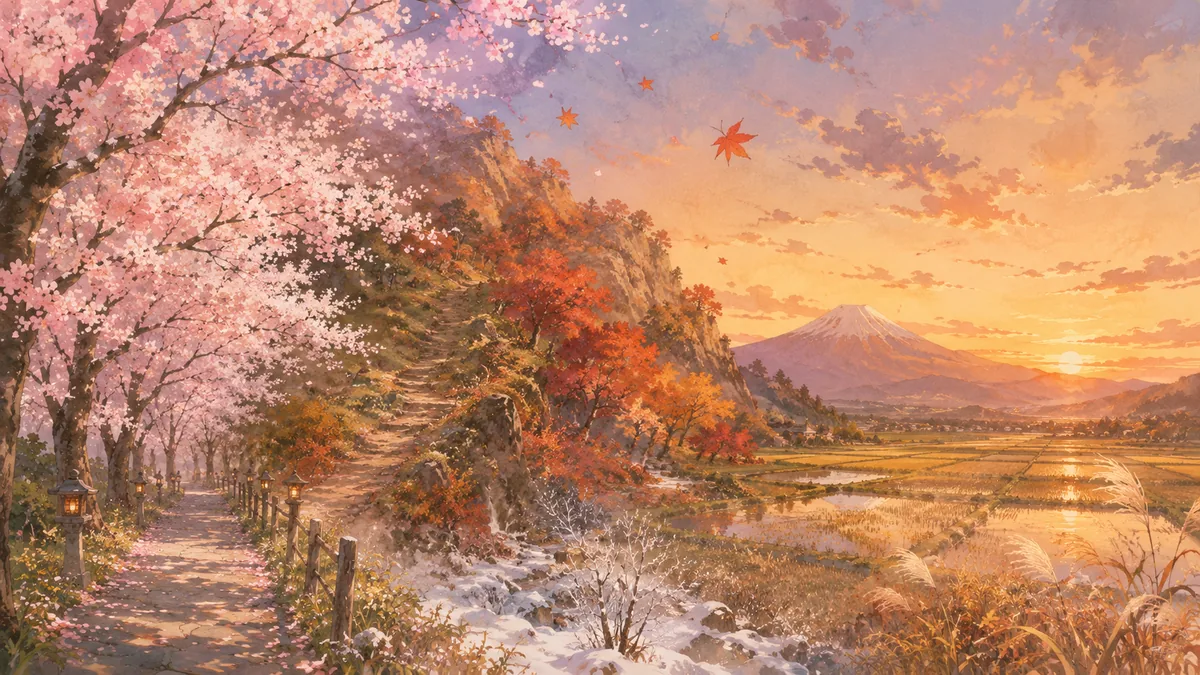
And every time, it makes me think that having four distinct seasons is, by global standards, a genuine luxury. A lot of places in the world get something closer to the same climate year-round. The dreariness of tsuyu, and the anticipation of the summer waiting on the other side of it, are both things you can only feel somewhere the seasons actually change shape. That's just my own way of feeling it, of course. But treating tsuyu as nothing more than "six dreary weeks" might mean missing a kind of luxury this country actually has.
Sources & References
- Japan Meteorological Agency: tsuyu onset and ending statistics — Tokyo tsuyu average dates and monthly precipitation statistics
- Japan-guide.com, "Japan's Rainy Season (Tsuyu or Baiu)" — seasonal overview and timing
- Rain probability figure (approx. 45% at peak): based on JMA monthly statistics for Tokyo June precipitation days
- The note on linen weaving and humidity is based on personal experience and secondhand accounts from fabric-weaving work; it is not a claim about manufacturing practice generally
A Geek in Japan (Revised & Expanded)
A wide-angle introduction to the 'why' of Japanese culture — manga, anime, Zen, the tea ceremony and more. A natural companion to the topics Naze explores.
The Japanese Mind: Understanding Contemporary Japanese Culture
Chapters on aimai (ambiguity), amae, giri, wa and more — the values beneath the gestures and words. For readers who want to go deeper into the 'why.'
Share this article
Read Next
- Seasons & NatureWhy Is a Kotatsu So Hard to Leave? — Japan's Philosophy of Local HeatThe kotatsu doesn't heat the room — it heats only you. That single design choice explains almost eve…
- Seasons & NatureWhy Fireworks Are the Heart of Japanese SummerHanabi taikai began in 1733 as a memorial for famine and plague victims. That origin explains why Ja…
- Seasons & NatureWhy Are Japan's Autumn Leaves Called 'Hunting'? — The Meaning of MomijigariMomijigari literally means 'leaf hunting' — but nothing is ever caught. This piece traces why the ol…
- Seasons & NatureWhy Do Falling Cherry Blossoms Feel More Beautiful Than Full Bloom?The tree at peak bloom is spectacular — but something about the falling petals catches harder. A loo…
- Seasons & NatureWhy Japan Divides the Year Into 72 Seasons — Calendars, Rituals & the Rhythm of FoodJapan doesn't just have four seasons — it has 72. From ancient lunar calendars to wagashi that chang…
Related Articles
Articles in the same category: